February 2013

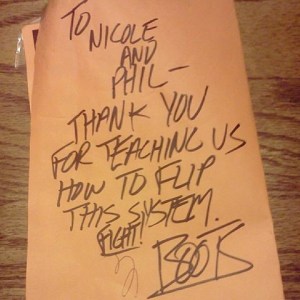
Day 108: One for the books! Old Hickman pal Mike Burden and colleague Brett Kirkpatrick brought Jamaican-born, Africa-tested, and NYU-schooled Alrick Brown to the Little Theater for one of the most entertaining, interesting, and inspiring talks about filmmaking I’ve been present for (Columbia folks, best go see his Kinyarwanda at MU tomorrow at 1). Frequent Tour reference George Frissell again proved his commitment to selflessness by allowing me to redeem myself for a scheduling error and agreeing to a one-day partnership with HHS Science Olympiad (but they all say that with Frissell, payback is a bitch). My third block class did a great job getting their personal essays started, especially Stephanie Lamoreaux, who’s writing what will prove to be an entertaining and useful “How-To” paper that John Keats would appreciate. Fourth block learned not to sell me short on rap knowledge and paid rapt attention to a 50-minute reading from A Lesson Before Dying. I met retired legend Henry Landry for coffee and received a one-of-a-kind memento from his recent trip to NOLA that connected to another kind of professor. And I got to eat at Tony’s Pizza Palace with Nicole Overeem and her interview subject and stellar student Mr. James Allen. Note to Doug Gordon: your dongle is safe in the hands of the Hickman High School Library Media Center.

Day 109: I had waited all weekend to share A Rip In Heaven author Jeanine Cummins’ responses to my first and second block literacy seminar’s (excellent) questions with the kids. Ms. Cummins, closing out preparations for the release of her new book, had generously taken the time to e-mail us answers after I sent her a message on Goodreads. I even made copies of their questions and her answers, just so everyone could read along. First comment–before we had even begun reading together–delivered with a prosecutorial edge by a sophomore: “How do we know these are REAL????” And they say today’s kids aren’t critical thinkers…

Day 110: Today, to practice looking at stylistic and thematic commonalities between a poet’s poems, we looked at some selected songs by Ray Davies of The Kinks. I know it’s due to the film Juno, but it warmed the cockles of my heart to hear most of the class singing along to “A Well-Respected Man.” And it produced a devilish grin on my grill when many who had always sung along to the chorus of “Lola” got to close-read its lyrics. Commonalities we discussed: irony, class alienation, ambiguity, satire and sarcasm, the hollowness of mere “respectability,” slant rhyme, dissonance (in the playing, and in the rubbing between the brightness of the music against the darkness of the subject matter), and artistic intent. I learned a TON.

Day 111: It has been a slow day–too many music references lately to convey my joy in Ross Menefee having his curiosity piqued in the radio station by Ornette Coleman’s “Lonely Woman,” and not much eloquence I can add to Zane El-Shoubasi impassioned sales job for the original British Shameless (I WILL watch it!)–so, when all else fails, a list.

The Top 15 Most Successful Materials I Have Ever Used as a Teacher

1) To Kill a Mockingbird, by Harper Lee.

2) “The Scarlet Ibis,” by James Hurst.

3) The Monsters are Due on Maple Street (“Twilight Zone” screenplay by Rod Serling).

4) The Bluest Eye, by Toni Morrison.

5) Cool Hand Luke, directed by Stuart Rosenberg, written by Donn Pearce.

6) Winter’s Bone, by Daniel Woodrell.

7) “Ozymandias,” by Percy Bysshe Shelley.

8) “Me and Jesus the Pimp in a ’79 Granada Last Night,” by The Coup

9) Selected lyrics by Chuck Berry.

10) Selected lyrics by Ray Davies.

11) “The Flea,” by John Donne.

12) Macbeth, by William Shakespeare.

13) Red Sky at Morning, by Richard Bradford.

14) The Great Gatsby, F. Scott Fitzgerald.

15) The Iliad and The Odyssey, Homer (6th-7th grade editions).

Day 112: Another slow day, another list–the 11 teachers I owe the most to (for being models, for being supportive and encouraging, for thinking I had potential, for opening my mind, for training me to think and see, etc. eternal etc.)….

1) Howard South, my high school art teacher.

2) Mrs. Phipps, my ninth grade English teacher who taught me discipline without disciplining me.

3) Mr. (now Dr., I think) Soos, my freshman comp teacher, who was so good he made me want to do this.

4) Dr. W. D. Blackmon, who taught me science fiction at SMSU and gave me the best reading list I’ve ever received.

5) Bob Bilyeu, whom I taught with at Parkview and who taught me the concept of benign negligence, which it took me years to successfully utilize and fully appreciate.

6) Charlie Smith, whom I also taught with at Parkview and who taught me “the ropes,” more or less.

7) Karen Downey, my longtime teaching partner at Hickman and Smithton, who taught me how little I knew, then filled in most of the gaps.

8) George Frissell, my longtime colleague at Hickman (OK, moratoriam on Frissell references starts now!), the most highly-evolved human I know. (And one of the funniest.)

9) The Steitz Team (John and Jo), for showing how you do the husband-wife teaching (and kid-raisin’) thing at its most passionate level.

10) Nicole Overeem, who daily reminds me how to (and how much to) care about students.

11) My mom and dad, for basically applying benign negligence and letting me explore and learn about what I was interested in.

12) The Grupe Team (Dixie and Greg), for setting an incredible bar on a daily basis.

13) Mike Pulley, who helped me get my legs, kept me laughing through huge class sizes and grading loads, and dared to have me teach his son (first teacher’s kid I ever instructed).

14) Mike Jeffers and Tracey Conrad, who encouraged me to be a teacher leader.

15) Rod Kelly, for talking me into coaching track and basketball, which I loved. My sincere and eternal gratitude.

Day 113: I stepped out in the hall with one of my modern Brandos to wish him luck in taking the Missouri Options qualifying test. Being careful to look him directly in the eye so he knew I was serious, I assured him I’d send as much luck as I could his way. As I extended my hand to seal the bond, I suddenly noticed both of his had been buried in the front of his pants (it is, alas, a “style”), and when he extended one I…blanched a shade and recoiled a touch. Kid: “Don’t worry–they were on the outside of my boxers.” Whew. That was not quite relief enough to prevent me converting my handshake into a brief bow.

Day 114: A respectful bow in the direction of Miss Abbie Jones, who wrote a great personal essay about sometimes feeling that she just needs books to be happy (I have dedicated a song to her in the link at bottom), and Miss Hillary Henry, who helped me figure out the best possible plan for my substitute Wednesday. We had an assessment scheduled, but it’s a shade too complicated for a substitute to execute, so they will be watching a film for their “Brit Lit Film Festival” assignment: Dr. Strangelove. Poor kids.

Day 115: Got to hear a potential new band–guitar player and singer–take The Sonics’ “The Witch” for a test drive. Lead singer is a young woman who loves the material–very interesting to hear her deliver that song. I will keep you posted, but Mark Anthony, Kenny Wright, Bryan Stuart, and Nicole Overeem, you would have wanted to have been there.

Day 116: You make some great friends in this business, friends that sometimes turn into family. Thank you, John and Jo Steitz, for great support, and great timing, and big hearts. Also, it has been a difficult week already at Hickman, and we’ve lost a retired colleague in the middle of it. Here’s to Kathy Davis, and I am speaking for many Kewpies who knew her: She was a valued colleague who cared deeply about her fellow Kewpies, and was not afraid to speak the truth. She had a great sense of humor, was our student radio station’s biggest fan, and could call a snow day (complete with number of inches of snowfall and number of days we’d be out) with pinpoint accuracy. She was also very selfless when it came to fixing damned machines (and people) and running off massive packets. We have felt her absence since she retired, and we feel it even more now. P. S. Kathy, if you are somewhere able to read this, I am sorry I screamed the cuss word that one time when I thought no one was in the workroom.

Day 117: At our final Science Olympiad meeting before regionals Saturday (we are defending champs), I learned from a Mongolian-American student what a “banana” was: an Asian who strives to be Caucasian on the inside. She was very concerned about racism–she learned it from her dad–but it certainly didn’t bother me; in fact, I had thought such a one was called a “Twinkie.” But it led me to ponder what a Caucasian who strives to be Asian inside might be, or whether that trend has been birthed yet. I am sure if it ain’t, it ain’t long from coming.

Day 118: I came into this business remembering too well that I had been offered no freedom whatsoever when my high school English teachers had assigned essays. College liberated me, so as a greenhorn I was on a mission from Gahd to insure my high school students wouldn’t have to wait. But, as the Grand Inquisitor told Jesus, humans don’t cotton to freedom as automatically as one would hope, and no English teacher’s experience is complete without 15,000 “I don’t know what the write about”s, so I have not so frequently been the great compositional emancipator. I don’t know what I did differently THIS year–my LAST one, of course–but maybe something worked. First papers’ subject matter: jackfruit (real and metaphorical), a fantasy planet that’s been being created in a kid’s head for years, a wrasslin’ match with God and His signs, and a high school friendship gone cold. I hope this keeps up–some damn fine reading.

Day 119 (a little late, but I have a pretty good excuse): A tip of the hat to all of the excellent substitute teachers who’ve ever come in to wrangle my classes into shape in my absence. They have a thankless task, but a good one is a real treasure, because when he is in the driver’s seat, you can concentrate on getting well or attending to family matters without the nagging worry that ALL HELL IS BREAKING LOOSE! Dedicated to two of my recent favorites, Jared McCormack and Joe ‘Brothanogood’ Fessehaye, and one old favorite who’s gone on to rock and roll glory, Will Saulsbery. Every teacher has a sub he’s honored, at least in his heart.

Day 120: As hard as this gig can be, there are daily reasons for gratitude.

1) Jim Kome, George Frissell, Brock Boland, Kay Garnatz, Jessica Lucas, Sharon Dothage, Tracey Conrad, Char Johnson, Leia Brooks, and Beckie Hocks, thanks for wise words of encouragement and advice.

2) Israel Santana, thanks for your ear, heart, and story-share.

3) Vanessa Nava, DeShona Rhodes, Levi Slate, and Justin Parker, thanks for staying ultra-focused and involved in discussion of 14 pages and 30 minutes of A Rip in Heaven read-aloud.

4) Spenser Rook and Marielle Carlos, thanks for running to get a new cord, playing Korla Pandit, and introducing GTA: San Andreas to the station PS2 (I could live to regret that last).

5) Sean Brennan, thanks for the cupcake.

6) Michele Sun, thank for the hug. I am not a hugger so that is always a dangerous move.

7) Jason with University of Missouri Hospital financial counseling thanks for the sanity and strategy–I hope it bears fruit.

8) Amanda Farris, thanks for doing all you could for our mutual student.

9) Nicole Overeem, thanks for the patience for bureaucratic phone calls, phone tag with me, and being a damned great daughter and spouse.

10) Lynda Evers, thanks for smiling in the face of darkness. Bonus track: Michael Linzie-Hayes, thanks for seeing me across a crowded end-of-the-school-day hallway (at Hickman, these are uniquely dense), grinning, and waving. If I can squeeze 11 out of a day like today, you can find one!

Evers Girls

The Evers Girls at True/False

Day 121: Technically, I should take a vacation from this habit, but I AM grading papers (people, if you could just get the TECHNICAL skills downs, I could actually focus on the WRITING!), slurping java, blasting Hank Ballard and the Midnighters and The Hot 8 Brass Band, and admiring the fall of snow. Also, wondering about tomorrow (“B” day? Or SNOW day?), anticipating The Book of Mormon, The Hill, and maybe Euclid Records on Saturday, hoping for some phone calls with positive insurance news (fat chance), and deciding how many more papers to grade before I start reading. A deep bow of respect to the 99% who don’t get snow days; I am grading these papers with you in mind….

Day 122: Thanks to being invited in on a grant written by one Nicole Overeem, had the pleasure of watching one of the best documentaries ever on 21st century teenagers, Only The Young at Ragtag Cinema, with 100+ extremely well-behaved and -focused teenagers from Hickman and Rock Bridge (no drama). Thanks Jonathan Westhoff and Polina Malikin for your facilitation, Tracy Lane for making the arrangement, Andrew McCarthy for providing muscle, two bus drivers for getting us there and back on time, and Jason Tippet and Elizabeth Nims for making such a great film. Also, very happy my mother-in-law Lynda Jo Evers got to see it and sit with the cool kids of today. Check out the trailer! http://www.youtube.com/watch?v=7gY8Vmky3Bk

Day 123: Some interesting moments. You may recall an earlier post detailing a visit by three admins of varying levels to my reading class, which induced a state of near-psychedelic meta-reality. Welp, it happened again today, as we were in the midst of reading and discussing A Rip in Heaven (Will we ever finish the book? YES! 20 more pages!). I was, frankly, a little irritated that the highest level administrator actually stood in front of one of my students, blocking her view of me and talking to her while we were in the middle of trying to figure out irony. Yes…irony. I guess we all know what’s most important, eh? ANYHOW, it was a good discussion despite the distraction. Also, when I popped into an afternoon T/F assembly to drop off some tickets to be given away (I had other things to accomplish elsewhere), I got handed the mic and asked to introduce the guest speakers(?) for the second year in a row (!) [though it did result in an interesting exchange between Jonathan Westhoff (aka Ye Olde Canary) and me about early 20th century pop music, “The Old Grey Goose,” and Louis Armstrong–I am not sure how interested the audience was, but Jon and I ejoyed ourselves]. I got more fist-bumps than dirty looks for wearing my Kansas Jayhawks shirt to school, though I did get some VERY dirty looks. And I had a surprise visit from Jason Michael Herd II, who claims to want to get into education because of my influence. Jay, you SURE you know what you’re doing? (Note: Jay once totally nailed a fantastic Iggy Pop-inspired performance art piece at a Hickman Poetry Slam that silenced the crowd. And did not win him a placing position.)

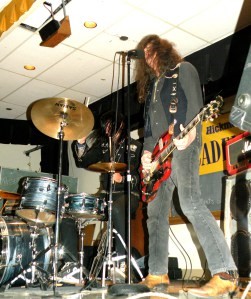
PASSING TIME, PART 6: Extracurricular Fun, Part 2–Pierced Arrows Invade Hickman High School and Justify Their Legend

Fred in LT

Note: I did not teach this lesson.

“…they won’t wear your t-shirts now….”

Local H, “All the Kids Are Right”

Through a good friend, I had heard of Dead Moon in the mid-’90s: “They’re garage rockers, but their lead singer’s about 50 and has been playing since the ’60s.” I had checked out their album Trash and Burn, which was lean, mean, raw, and wiry, with vocals that reminded me of Bon Scott’s, but, at the time, I was being deluged by so much music and stuff-o’-life that the rekkid got lost in the shuffle, even though it spoke directly to things that matter most to me about rock and roll. When they played a club here around the same time, I knew about it–but it was on a weeknight and, being a good-boy teacher for the moment (I was erratic in that area, at best), I skipped it. To what will be, I am sure, my eternal regret.

Fast forward to the mid-‘Oughts. I am sure most owners of record collections numbering 5,000-plus will relate, but, one weekend, sniffing around for something to listen to, I fetched Trash and Burn from where it had been hiding for a decade, slid it into the player, and stood back as it lit our house aflame. Both my wife Nicole and I exclaimed, in spontaneous chorus as old marrieds often do, “Where has this band been all our lives?” With the Internet now at our fingertips, we delved deeper, and found out about a documentary about the group called Unknown Passage: The Dead Moon Story, and immediately ordered a copy.

As will happen, I swear, to anyone who watches this film, we were stunned, then joined in lifetime loyalty to Fred and Toody, “The Coles,” as they are known to cognoscenti. Married for almost 50 years at this writing, successfully applying the DIY ethic yearsway before it was hip in the rock biz to everything from home improvement to instrument repair to music production and distribution to child-rearing, functioning as pretty-damned-equal partners in singing, playing and writing, these two dyed-in-the-wool rockers not only defined the rock and roll life in a way that didn’t get you looking at your shoes, but also served as a textbook case of true family values. I am not going to describe it; you just order the film, podnah. We have been pushing it on every vulnerable soul for seven years.

Concurrent to this discovery, at the Columbia, Missouri, teaching gig that was subsidizing my record collection, I was experiencing some surprising turns of event with an extracurricular club called The Academy of Rock, which a student of mine and I had founded in 2004. A couple of enterprising students had suggested that we try to convince bands who came through Columbia for shows to stop by our meetings and chat about songwriting, the rock life, and anything else fun. The worst that could happen was being told “No,” so onward we went, and, literally before we knew it, Amsterband (the future Ha Ha Tonka), Cary Hudson (former Blue Mountain and Neckbones), The F-Bombs (a local punk band), and–I had marks all over from pinching myself–eventually, The Drive-By Truckers and The Hold Steady had played–played, not stopped by to chat–in our school’s Little Theater, for free, with deep-ass Q&A, friendly autographing sessions, and invitations to come to their shows with guest-list privileges. So, when Nicole and I discovered that The Pierced Arrows, the Cole project that rose from the ashes of Dead Moon, were playing The Record Bar in Kansas City, we decided to go and maybe strike up enough of an acquaintance to ask them to swing by Hickman.

True to everything we had heard about them, Fred and Toody sat with the rabble through both of their opening bands’ sets, drinking beer, smoking, and obviously engaging with the groups’ music. Between sets, I tip-toed over to Toody, and begin shooting the shit. When I told her about our club and our (by now) tradition of bringing in bands, she enthused, but said, “Well, we’re heading for Europe next week, and we’ll be there for a few months, but, if you give me your phone number, I’ll get in touch with you when we’re back in the States.” Returning to terra firma after a shattering Pierced Arrows set (for the uninitiated, the only real difference between Dead Moon and The Pierced Arrows is slightly heavier guitar and slightly steadier drums) and hitting the prairie pavement back to Columbia, I turned to Nicole and said, “Well, we did get to meet them, we do have Toody’s phone number, and the show kicked ass–but surely after two-three months they’ll forget about us.”

Wrongo. Almost three months to the day of that show, Toody called me out of the clear blue sky and asked, “Hey, we have a day off coming up between Columbus and Kansas City, could we [YES–“could we?”–I shit you not] play at your school then?” I was so gobsmacked that about 10 seconds of silence followed before I Marv-Alberted a “YES!” into the receiver. We quickly agreed on details–we’d pay for their hotel room and food after the appearance, since they’d have to hit the road immediately following for the Kansas City gig–and I proceeded to pinch another red mark onto my arm.

The day before the band was due to play, I was moderating a Socratic seminar for my British literature students in our school’s office conference room when my cellphone began buzzing. I don’t get phone calls much, especially during the day, so I sneaked a look, and saw it was Toody. I put the temporary kibosh on the seminar–do you blame me?–stepped outside, and took the call.

“Phil, we are so, so, so sorry we are late! I think we can set up in ten minutes once we get there [they were 30 minutes outside of town] if you can still make it happen!”

“Toody–it’s not until tomorrow.”

“You’re shitting me! [Turns away from phone, shouts “It’s not ’til tomorrow,” is met by jubilant screams from the rest of the van’s occupants….] Fantastic! We are tired and hungry and need to decompress…but, hey, come by the hotel room and say hi!”


I am not making this up.


Nicole and I swung by to see them, but they were obviously beat, so we just gave ’em some dining recommendations and double-checked the details. We were particularly careful about the latter; when The Hold Steady visited, they arrived an hour after they were supposed to, and at the very moment that, in front of a packed theater, I was running out of steam stalling the crowd with their biographical details–sanssoundcheck and sans anxiety, since they drifted in on a cloud of cannabis cologne. Fred assured us they’d be on time for a soundcheck, so we left them to get their rest.

I had arranged to have a substitute take my afternoon classes the next day, and, late that morning, as some Academy of Rock club members and I were setting up the PA in the theater, my phone began buzzing again.

“Hey, Phil, we’re here.”

“But Toody, you didn’t need to be here for another hour-and-a-half!”

“Oh, that’s OK! We want to meet some of the kids and hang out if it’s OK […if it’s OK????].”

“Well, hell, I’ll send a couple of ’em to come get you.”

We spent the next 90 minutes not just sound-checking but actually hanging out and talking about everything under the sun, with Fred giving some of the school’s theater tech kids, who were helping us, tips about rock and roll sound. For example, since he had lost 70% of his hearing by that point [no big deal!], he preferred to have two monitors on each side of him, facing each of his ears. That was just one of the many things the kids learned from him in that very information-rich hour-and-a-half.

The performance? Titanic. Also, easily the loudest in Hickman’s history (the DBTs and Hold Steady had played unplugged–but you don’t unplug Fred Cole). We recorded it, but, unfortunately, we screwed up Fred’s vocal levels; it’s still power-packed and worth a listen, though (see below). The band played all of their then-new album Descending Shadows, plus the best of their previous record, Straight to the Heart.

After the sixty-minute show, they then took student questions, which–if they weren’t already excellent, which most were–they would cannily reconfigure for the best possible responses. I would recap it, but, if you search intelligently, you can read the Columbia Tribune cover story about it. The amount of wisdom shared in the nearly three hours they were in the theater was mind-boggling, and, even when the bell rang to dismiss students for the day, they were not yet done.

Toody

I sidled over to Fred, Toody, and their awesome drummer Kelly Halliburton, who matched them word for word, note for note, gesture for gesture in sheer rock-band fan-care, and said, “Well, district rules forbid us from getting gift certificates for visiting ‘educators,’ but here’s $40 to go eat some pizza and drink some beer at the local-favorite pizza joint. Let me draw you up some direct—-“

Fred: “Hey, just bring some of the real big fans and come eat with us.”

“You’re serious?”

“As a heartattack! Just let us have one of the kids to navigate!”

As it happened, one of the kids was already thoroughly inured to the ways of The Coles through our having forced Unknown Passage: The Dead Moon Story on him and his having avidly explored their discography. (Oh yeah: we also took him to the aforementioned Pierced Arrows shows in the guise of our nephew, since it wasn’t all ages and the manager had given us permission–don’t try that one at home, fellow teachers!)  So we sent him along, and, people, I have never seen a student happier. He even got to bum a cig off of Fred!

At the pizza joint, we bought several pizzas, the band knocked back a few pitchers, and we had a total blast. To the end, though, the Coles and Mr. Halliburton were fan-centered. I had expected dinner to be a barrage of questions from the kids about rock and roll history (Fred goes back to the mid-Sixties through his involvement in The Weeds and The Lollipop Shoppe, and knew Janis Joplin well), but, instead, the trio queried the kids about their lives, their tastes in music, their experiences in bands, and…just life.

PA + Kids

That kid on my right was a ninth-grader. As I drove him out to his folks’ house, neither of us could keep from shaking our heads in amazement that, along with rocking our asses off, they lived up to their advance notice and more. And as he told me,”I can’t believe they came to my school!”–it wasn’t his yet, but it would be the following year–I realized that it was probably the finest moment I’d ever experienced (could probably hope to experience–and, no, it ain’t been topped yet) as a public school educator. Beyond the educational impact, the encouragement the Coles’ chemistry and commitment gave Nicole and me, who have approached marriage unconventionally in more than a few ways, continues to resonate.

Fred had successful heart surgery earlier this year, and just turned 66 last week (Author’s note: Mr. Cole passed away in 2017). I am sure, however, that he will be back on the road with The Pierced Arrows soon, and, if they come to your town–go. They are about rock and roll, but so much more. Be sure to bring t-shirt money, whether you are a kid or not.

January 2013

Happy New Year

Day 88:

Me: “Welcome to your–and my–last semester of public education. It’ll be bittersweet for all of us.”

Student: “Do you think you’ll cry?” Me: “No, because then, to be fair, I’d have to do it for the other four classes!”

Day 89: Two interesting transition-hinting moments. In second block, I received a new student: the son of a former student (you done good, Tim Matney!). In the radio station, to which I have over the years bequeathed some excellent vinyl items of which I have duplicates (but which have not been getting played), I learned that one of our DJs got a turntable for her birthday–so I fished out some winners (Only Ones, Wild Magnolias, Heartbreakers’ LAMF remix, Lefty Frizzell, Tom T. Hall, Archers of Loaf) and gave ’em a decent home. About 30 years ago, I did the same thing with my baseball, basketball, and football cards, and my comics (at least at present I have about 1,500 records left), which I hope that kid–now a man–still owns. Bonus moments: The Phaggs (one of whom is a former Kewpie) personally delivered their new 45 to my classroom, and this chunk of dialogue tickled me, though the humor may not translate: Me: “I don’t like red grapes.” Adriana Cristal: “Grapes, figs, and bananas have non-viable seeds.” Patrick D King: “What are non-viable seeds?” Adriana: “You can remove non-viable seeds and plant them, but they won’t grow, and–wait, I haven’t finished the packet.” We are waiting with bated breath, Adriana….

Day 90: One thing I will definitely miss about this gig is being able to observe special student friendships, especially ones where one admires the kids separately, THEN discovers they are buddies with each other. My mind was blown this morning before school when two students I would never have guessed even KNEW each other (one a superb, humble, smart human from my reading class, the other with the most phenomenal range of music interests I have seen in a student in three decades) came in to introduce me to another student I had only heard…legends…about. After we talked (and set up a gig at The Bridge!), they stepped outside, and I could hear them continue to talk, with another, ALSO familiar voice chiming in. I stepped out of my room a few minutes later to discover the three of them were buddies with one of my all-time favorite students I have ever thrown out of class (he has made anonymous appearances in two previous posts). It’s this kind of friendship that is one of the few things that makes high school–particularly PUBLIC high school–VERY unique, and it’s very ennobling to witness.

Day 91: Had to search a bit today–morning was alright, looked forward to the afternoon, but got disrespected and exploited instead (another day in the human race). However, seek and ye shall nearly always find: had a nice meal at Lonnie Ray’s with Nicole Overeem, Mr. Benjamin S Carpenter (the former student who turned me on to the place) and his wife Becky Byrd Carpenter, plus their loquacious kid, Miss Vivian. Sometimes you bond so completely with a student that 22 years later he gets to buy you dinner, and you leave the tip. It’s on me next time.

Day 92: Gratitude–Zane El-Shoubasi, thanks for teaching me about Eid; J. M. Coetzee, thanks for writing so powerfully; Core 4, thanks for being so much fun today; Science Olympiad team, thanks for working so hard and enjoying each other so much; Joanna Zou, thanks for flexing your leadership; and thank my lucky stars tonight was my last Curriculum Night ever!

Day 93: Weirdly, I will miss writing grants! Today, I put together one (probably the last, at least from me) asking for funds to further grow the Hickman Media Center’s American Roots Music Listening Library, which is already about 500 discs strong and stretches from 1895 to 2008. As seen by that range, it needs some updating, so, if I’m fortunate enough to get the funding, I am going to collaborate with student experts in hip hop, punk, and blues to make the selections and write the new descriptions for the database. It will be nice to see some new students join names like Jon Hadusek, John Grupe, and Jordan Maze in the pantheon of Kewpie rockwriters.

Day 94: My longtime colleague George Frissell gave me a yin-yang test. I came out with a yin score of 16 and a yang score of 15, fairly balanced if a shade…soft. As the man himself said, “It’s not a very scientific test.”

Pound Game

Pound Game at the Bridge!

Day 95: I got to do three things today I don’t normally get to do–a) talk in-depth to my kids about next year’s enrollment; usually my advice is not needed, but this year I have several students who felt my thoughts and advocacy came in handy; b) share “Top 5 Hip Hop MCs of All-Time” lists with  Ziggy Vann Lyfe and his buddy Colin (for the record, and this will reveal my “vintage,” mine were Chuck D, Rakim, Jean Grae, DOOM, and a tie between Nas and Eminem); and c) help construct the next “Academy of Rock Showcase at The Bridge” flyer. And I got to see one thing I have never seen at school: a parent snatch a perpetually ringing cell phone out of her spouse’s hand and physically remove it from a meeting (it sounded like she flushed it down the toilet)!

Day 96: Abortive plans are a workplace hazard in this biz. Today…how could it go wrong? Same plan for both Block 2 and 3–finish “The 16th Man” (ESPN 30 for 30 doc on the role of a rugby match in immediately post-Apartheid South Africa; used to background our study of Coetzee’s DISGRACE a bit), give quiz over reading, use quiz answers as springboard for discussion, share research on South Africa. 95 minutes, less than 30 left in film–PLENTY of time. Plus, three activities planned for such a time period–that’s good methodology, Overeem. BUT…one of my students had to leave early, so she wanted to take the quiz ahead of time, so I just flipped the order of activities, BUT I jabbered and set-inducted so long that by the time of the quiz, the kid had already had to leave. Still time. I administer the quiz. Ten minutes, students have it done, steady as she goes. Quiz #1, nice, neat discussion, on the mark. Quiz question #2 dealt with the issue of consensual vs. non-consensual sexual relations as they play out in the early part of the book…65 minutes later–PING! That’s the sound of dismissal. Block 3? Rinse, wash, repeat. At least the prolonged discussed drew closer attention to the issue, especially for students who haven’t tuned into the news from Steubenville and New Delhi.

Day 97: I often mourn the fact that multiple pernicious forces (Jack White and Black Keys notwithstanding) have sucked the blues essence out of American pop music. Some would argue–and I’d have a hard time denying it–that it was inevitable. But my day was made today during my afternoon radio station supervision when one of our forces brought his guitar and amp and suddenly rippedout some gnarly slide. It had been a frustrating day but it all went away instantly. Also, at Science Olympiad, I suddenly realized that the little kid who, along with a few of his sophomore peers, talked me into coaching the club had…sniffle…grown up–he seemed twice as tall and possibly able to whoop me.

Day 98: Several years ago, by fond and oft-mentioned colleague George Frissell and his bride Susie Frissell suggested we attend the annual Columbia Values Diversity Breakfast, and I haven’t missed one since. Today’s was very special: a magnificent gospel choir performance directed by the esteemed Dr. Clyde Ruffin (whose wonderful daughter Candace Ruffin I taught as a middle schooler many years ago), and a speech by Martin Luther King Jr. III. The cherry on top was being able to bring some great, social justice-minded students (Aaron Bressman, Tierney Morales, Adriana Cristal, Zane Elshoubasi, and Marielle Carlos). AND…I got back just in time to finally teach a decently organized lesson, which I not so ironically did by not teaching much.

Lawrence 2Lawrence 1

In and around a nice trip to Lawrence, Kansas. Bands on left are Natural Child (top) and Mr. and the Mrs. (bottom)

Day 99: A quiet but deep thank you to longtime colleague Mark Blount for courage and a call to sanity. Would that all ears were open to your message, and now I see why Jacob Blount and Nathan Blount are made of such fine stuff. And good luck with the chemistry curriculum rebuild!

Day 100 (my, they are slipping by): That wacky B Day, Core 4 literacy class. Walked in worried about how they would perform on their first scored book talk of the year, on 13 Reasons Why, and was met by Sha’Quan Davis, who handed me a pen rigged to shock the sh*t out of me, which it did. Not the best omen. Two kids were behind in the reading; one had a horrible weekend dealing with a death in the family, and chose to sit it out. Uh-oh. BUT…they responded with a book talk that topped the three Brit Lit Socratics I’ve seen this year, balancing their discussion, actively monitoring their progress, evoking strategy use, quoting and READING ALOUD text sections (not required, or even encouraged!), and…having FUN. My shy gal Lashana Lopez even asserted herself eloquently. And the group dealt intelligently with these questions: What motivates suicide, and how does it affect those left in its wake? How can two different experiences of a single first kiss clash destructively? And how does a reader deal with diagesis*? (*Don’t feel bad, I just learned it myself last night from Ron Rosenbaum’s The Shakespeare Wars; it’s when a work of art, specifically a film but in this case lit, manipulates conflicting time frames–and I am not kidding, the kids explored it.) A day I would have worked for free.

Day 101: As the True/False Film Fest Academy and Youth Brigade (and friends) watched Mads Brugger negotiate his way through the corrupt labyrinth of The Ambassador in the Hickman Little Theater today, I began to wonder whether we had chosen the wrong movie–it was making Nicole Overeem’s and my own head hurt trying to following Mads (and the money), and WE’D seen it once before. Generally, when such a mismatch happens, the high school version of Roger Ebert’s “Thunder Index” kicks in: the thunder of feet stomping up the aisle and out the door. However, our intellectually committed youth hung tough for the duration, and closed our session out with some great discussion, even though it was already 4:45 p.m. Aaron Bressman, Komina Guevara, Adriana Cristal, Ambrosia McCord, Zoe Marie Clark, Savannah Brenizer–thanks for your enthusiasm!

Day 102: Spent two consecutive 95-minute periods taking apart and admiring (fortunately, those processes did not interfere with each other) Andrew Marvell’s philosophically seductive and seductively philosophical “To His Coy Mistress” and discussing J. M. Coetzee’s approach to psychological realism (particularly the nature of a 53-year-old disgraced male’s actual thought-flow). Diverged into actually relevant stories about sabotaging my math teacher’s graphing chart with a Playboy centerfold (with Todd Freeman) and once, as a youth, imagining that, if I’d produced offspring, s/he might have grown into a serial killer. Props to Emily Thornton for calling up the following Marvell lines for justly high praise: “…therefore, while the youthful hue/Sits on thy skin like morning dew,/And while thy willing soul transpires/At every pore with instant fires,/Now let us sport us while we may….”

Day 103: Today was as fraught with failure as yesterday was sparkling with victories. As Nina Simone sang, it be’s that way sometimes. A manic depression profession. BUT…I bow to two young ladies who stayed cool when they could have erupted, a reading group who didn’t want to meet but rocked, and a radio station denizen who turned me on to an ill-starred Japanese free blower last name of Abe who blew me away. And now I get to spend some quality time with my favorite colleague first name of Nicole.

JC

James Carter at the Folly, KC

Day 104: Gave my Brit Lit students the option of writing to the first prompt I ever received as a college student, and the first prompt I’d ever received PERIOD where I had ANY wiggle room: “Write a personal essay about vacillation.” No specs other than 650-750 words. They have broader freedoms but I hope some will take the proffered angle.

Day 105: Another in a recent string of hard school days marked by painful but necessary decisions involving students I have great admiration for…salvaged by T/F Film Festival Youth Brigade and Hi Def Academy meeting at Ragtag Cinema where acclaimed Missouri director Chad Friedrichs (of The Pruitt-Igoe Myth fame) took students’ questions, talked nuts and bolts, showcased a clip from one of his own favorite directors (Adam Curtis), and previewed a piece from his mesmerizing and fairly hilarious new project. Also, Academy members shared their progress on their audio interview projects, the ideas behind which are very promising. Finally, great encouragement and good cheer from our fearless leader Polina Malikin and her fellow film culture abettor Jonathan Westhoff. Columbia is truly a place where I am fortunate to teach and, you, my students and local comrades, are fortunate simply to reside in. Sorry ’bout that closing preposition.

Footnote 1: Emma Lopez, that was the funniest IEP meeting I have ever attended where I would not dare have laughed.

Footnote 2: Israel Santana, thanks for justifying our belief in you.

Day 106: I fully enjoyed, through a simple conversation, helping Bailey Marie Wilborn arrive at a way to make her electronic portfolio thematically integrated–and therefore, actually–could it be?–fun to put together. Also, a quartet of students traveled the twisted and knotted road that brought me to Hickman (and, thus, to the vehicle of my soul’s improvement) through an impromptu narrative I spun out (it’s one of my favorite stories, and maybe I’ll tell it here one day). Fortunately, it was a work day in the lab, and the quartet (I hope) was ahead on their work.

Day 107: Scenario–Science Olympiad meeting in Gold Lab. Enter, one of my Brit Lit students seeking peer editing advice. Her instantaneous response upon taking in the tableau–“What IS this???” They get that a lot.

PASSING TIME, PART 5: Extracurricular Fun, Part 1–Sponsoring Clubs and Beating Myself Over the Head with Them

Teaching five or six classes a day is a heavy enough load itself. Add a school club or competitive team to that weight, and the job can truly become one’s life. Young teachers quickly intuit this, and hope to avoid being assigned extracurricular duties. When I began my career, “assigned” was the operative concept; newbies were expected to accept happily such responsibilities as a part of dues-paying—not to mention because their energy level had not quite yet been sapped to brown-out levels. The trouble was, this acceptance usually wasn’t addressed in teacher training, so it had a tendency to take the average greenhorn by surprise.

Such was my introduction to club sponsorship. Before the start of my sophomore campaign, I was called down to my supervising assistant principal’s office. We’d hit it off fairly well during my insane first year, but he had consistently chided me for wearing jeans and staff sweatshirts too frequently, to which I’d responded that it was a strictly a matter of economics, not sartorial aesthetics. I barely made enough money to pay rent, eat, and medicate myself with beer, so assembling a slick wardrobe was out of the question. He wasn’t impressed that I’d countered with an excuse, but, back then, on final evaluations, the teacher was given a space for “rebuttals,” so I repeated the explanation in writing, and I was pretty sure he hadn’t admired that. So I was already wary as I responded to this particular summons to his office.

“Phil, we need you to sponsor a club that’s having a little trouble staying afloat.”

“I’m not interested, really. I’m enjoying the teaching, and I keep myself pretty busy after hours and on weekends.”

“Phil, I don’t think you understand. We need you to do this. Also, the kids have gotten wind that you enjoy what you’re doing here and think you’d be a good sponsor for them. Last year’s sponsor moved on.” Translation: “Phil, you don’t have a choice. You are going to do this. Also, the old sponsor ran away screaming.” Unfortunately, I was a BLL: “Bureaucratic Language Learner,” emerging division.

“No, seriously, I don’t think club sponsorship is my thing. I appreciate you and the kids thinking I would do a good job, though.”

A look someplace between severe constipation and bottled rage tightened and darkened his face. Clearly, he didn’t want to have to tell me I was going to do this; he wanted me to make it easy for him and just accept it. He did not know he was dealing with a guy who had always been a little slow on the uptake. I thought I had a choice—I’d inferred it from the language of his request.

“Look, this will look really good when you’re evaluated at the end of the year.” Now he was communicating in a tongue I understood. I wasn’t happy about the clothing issue from the year before, nor about his giving me an informal “B+” for my year’s performance (in retrospect, that was very charitable), but I also thought that, should I continue to refuse the offer I actually couldn’t refuse, I would end up bumping my hard head on a glass ceiling of sorts.

I folded. “Alright, I’m in. What’s the club?”

“Have you heard of Canterbury Society?”

My eye began to twitch.

“No.”

“Well, that’s the problem. The club is way under the radar and hasn’t done anything of note to be on the radar for a long, long time.”

“So, uh, is this a club of…Chaucer admirers?”

“Actually, Phil, I am not sure what it is at this juncture. But I’ve taken the liberty of setting up a meeting for later on this week for you and the five or six remaining kids from last year, so you can find out then. I think you’re smart to accept this position.”

Walking out of his office, I thought to myself, “Well, the main problem is that the idea of a high school club apparently designed to celebrate Chaucer will never be a hot proposition. At least for long.”


When I met the kids, many of whom I wasn’t too surprised to find were or had been my students, I was slightly relieved to learn that Canterbury Society was a club for kids who generally liked literature, but, when I asked what they’d come up with for activities, they responded quizzically. Did they know what a club was? I suggested that we get together maybe once a month to share excerpts from what we’d been reading, but that was met with blank stares. They’d tried that, and it’d had the effect of chasing off members, with which the club wasn’t teeming to begin with. They felt they needed to really do something.

“We could do a fundraiser,” someone chimed in, apropos of nothing.

Curious, I asked, “What would we be raising money for? Usually, the need comes first, doesn’t it?”

Someone else piped up. “The Developmental Center for the Ozarks always needs some funding, according to my parents. They train disabled adults to work and contribute to society. We could raise money for them.”

Always an annoying nit-picker when it came to relevance and practicality, I posed another question: “How would said fundraiser connect with, y’know, reading?”

Silence.

I lurched into the void with an idea that, had it come from an experienced teacher, would have given one cause to question his mental well-being: “We could do a 24-hour read-a-thon, and collect pledges based on each individuals’ pages read. They could just lock us in the library on a Saturday morning and let us out on Sunday.” Someone clearly needed to object to such a proposal. And fast.

A month and a half later, we stood staring as a janitor locked the school library’s doors from the outside, a group now grown beyond 40 and hoping that our coolers of soda and piles of snacks would hold out—and that the Domino’s delivery guy wouldn’t set off the school alarm. What I’d already discovered (and should have remembered from my own high school experiences) was that, outside the classroom, students were even funnier, more interesting, and energetic than they were in it, which had the welcome effect of balancing the frustrations I was experiencing trying to make learning happen as an English teacher. The 24 hours passed surprisingly quickly, as we played cards and games every three hours or so to keep ourselves awake and fresh, traded stories from our respective trenches, shared what we were reading, and shifted over to mathematics to try and project how much money we might raise. Knowing the bare minimum about the ground rules for school activities and letting my enthusiasm drown my already sketchy common sense, I’d not arranged to have other teachers or a few parents help me supervise—I think the principal assumed I’d done so, because I can’t imagine she would have otherwise allowed me to go it alone—so I had to stay awake keeping them awake—and monitoring for clandestine romantic interludes within the stacks. As well as waiting for the pizza.

The night custodian let the Dominos delivery boy in with the pizzas mid-evening, and after chowing down we’d found we’d overordered—grossly. At least it wasn’t coming out of our fundraising; we’d chipped in together and gotten a boost from the office to pay for the pies. Still, it’s depressing to see a tall stack of full pizza boxes you’re too full to eat. Suddenly, one of the kids burst forth out of a burgeoning brainstorm.

“There’s a speech and debate activity in the Commons tomorrow morning. Let’s sell cold slices for breakfast for 50 cents apiece!”

The rest of the group exploded in laughter, and even I thought the idea was even more cuckoo than a 24-hour read-a-thon with no supervisory backup, but, well, I’m often wrong. Happily, I was also wrong about the idea being cuckoo—never underestimate the pull of pizza—as we spent our last hours, with the morning custodian’s assistance, rotating into the Commons to sell all the leftover pieces and adding cash to the charity coffers.

All told, we raised over $2,000 on nickel-a-page pledges and who-knows-how-many total pages read. I wish I still had the paperwork after 30 years. And it felt good to set out to do something and actually end up with cold, hard evidence that it got done, and got done well, all the while with all involved having a blast. That’s not quite so easy to replicate in the classroom. Also, I didn’t have to commandeer the activity with the intensity teaching required; I could relax a little bit, kid around, tell some stretchers, and be myself. We repeated the activity the next year, with almost twice as many students (as well as some backup chaperones), and raised almost $1,000 more than we had before. True: the read-a-thon was our only activity of the year, other than planning meetings for the read-a-thon, but, hey—we did something.


Of course, no good deed goes unpunished. I was soon very comfortable in my role as the sponsor of Canterbury Society, and, after a rough second and third year, I was getting my pedagogical footing. Those are also the years when young teachers begin to feel deeply the mental, emotional, psychological and even physical cost of the job, and begin wondering how long they can keep it up. For the first of only three times I can remember, I had been considering another profession, but my involvement with kids outside the classroom had helped me come to my senses.

I had also weathered my first career controversy: during a first-hour class, with several female students surrounding me at the front of the classroom, I had taken out my wallet to buy some fundraiser cookies, and a 10-year-old condom, probably turned to powder in its weathered wrapper, flew out of my wallet and onto the middle of my meticulously clean desk. After the deafening laughter died down, I begged the young ladies to please keep a lid on the unfortunate occurrence. That was like asking a pyromaniac not to ignite a river of kerosene, and by lunch, I knew from my second, third, and fourth hours’ razzing that my mishap was already the talk of the halls. Then came the inevitable call to the office–the principal’s office, occupied by an administrator, Dolores Brooks, whom I very much liked, thoroughly respected, and feared not a little.

I shuffled sheepishly into the main office and reported to Mrs. Brooks’ secretary, who was sporting what I quickly interpreted as a Puritanical glower. She waved me in with disgusted officiousness, where Dolores, who’d been a basketball player at Purdue and towered over me, was standing glaring at me, arms crossed and lips pursed.

“Sit down,” she fairly ordered me.

I sit down and stared at my lap, unconscious of the meaning that might have conveyed.

“We have a problem, don’t we?” she asked, funereally.

“Yeah. I screwed up.” You know, I actually hadn’t. In fact, had I not been mortified and 25 years old, I would have alchemized it into a teachable moment. But this was Springfield—my friend Frank called it “Banks & Bibles, Missouri” with good reason—and I feared the very worst.

Mrs. Brooks went on. “I have a very serious question for you.”

“Yeah, I figured.” I knew she was going to ask me if I wanted to keep my job.

“Do you need a fresh supply of condoms?” she asked, poker-faced.

She proceeded to lapse into a convulsion of guffaws, tears glazing her eyes. They don’t make principals like that anymore.

She came out from around her desk, put her arm around me, and said, “C’mon, I’ll buy you lunch. Some of your peers would like to harass you in the teacher’s lounge.” And did they.


But it wasn’t this call to the office that is relevant. A few days later, Dolores called me into her office again, where she was visiting with my evaluating principal, who was also the administrator charged with overseeing school activities. He’d formerly been Parkview’s student council advisor, a position that’s frequently a rung on the ladder out of teaching and into administrating (wherein the big money lies). I still had a touch of the fan-tods from the condom incident, and since I hadn’t quite made an effort to dress more fashionably—this was the Miami Vice Eighties, so I had another reason to drag my heels—I was a little leery of Brooks’ underling. They wasted no time getting to the point.

“Judy Brunner will be taking an administrative position at another building next year, and we’ve been talking to our student government about whom they’d like as their sponsor next year.”

Uh-oh.

The AP chimed in. “They didn’t even take time to think about it. They would like you to do it.”

I’d like to interject at this point that these student desires had little to do with any quality teaching I might have been doing. I was young, full of energy, easily manipulated, and liked to have a good time whatever I happened to be doing. By and large, the bulk of the rest of the faculty at Parkview, as much as I had learned from them, was a bit worn out, cynical on a regular basis, and not totally invested; I would understand all of that later. As for the moment in question, as you will see, I had learned very little and understood even less.

I countered, confidently, “Well, I have a club, it’s doing pretty well, my classes are huge, and I am working very hard. Plus I’m a lit guy, not a government guy. I’m going to have to pass.” I looked at them for a response. They appeared lightly dumbstruck. They said nothing.

I continued. “I need to grab lunch because I have to set up an activity before my next class comes in. Good luck with the sponsor search.” I hurried out, with a creeping suspicion that the interaction had been too easy.

Later, on my way out of the building, Dolores saw me and waved me into her office again. I started to sit down, but she told me, “This won’t take long. We appreciate your reasons for not wanting to sponsor student council, but we figured that by now you got the concept that you don’t have a choice. We were a little stunned, or we would have corrected you last time you were in here.”
that council

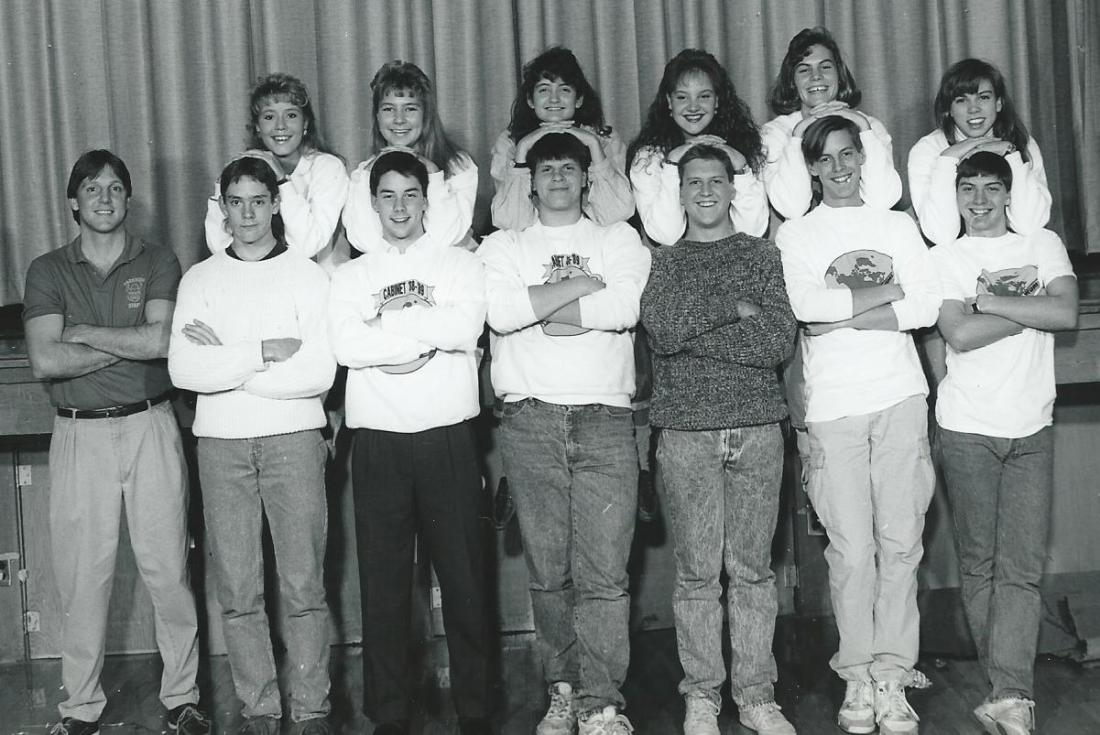
Parkview High School Student Council, 1988-19898: A great one. Author on far left.

Thus began my tenure as a student council sponsor, an experience that would lead me directly out of Springfield to Columbia, where I now live. My first year was exhilarating and absolutely draining. Parkview’s student government model put the group in charge of assembly scripting and execution, the school blood drive, elections, decorations and events for homecoming, and interviewing and selecting top leadership for the following year. In addition, members were expected to read, obey, and augment file folders documenting past years’ responsibilities for their positions—a nifty idea, especially when you’re a new sponsor working with a 12-member council of strangers. Unlike many student council sponsors today, I was fortunate to have my final class of the day dedicated to meeting the group for planning and working (one less class of essays to grade!), but that was just enough time to get settled, crack wise at each other, and brainstorm—by the time we were ready to work on a script, compose memos to faculty, or paint a sign, the school day was long over.

The kids were bright, hard-working, creative, and witty, and thus a true pleasure to work with, but, after working at the school for 85 hours during my first five-day week of homecoming, then awakening at 4:30 a.m. the following Saturday morning to load the gang onto a bus for an all-day state student council conference, I was able to accurately measure the cost. I have always been a high-energy person who’s never needed much over six hours of sleep a night to run at full capacity, but two moments from that week communicate just how draining my responsibilities were.

I happened to be showing my fifth-hour class the film version of To Kill a Mockingbird on the climactic Friday of homecoming–the fourth consecutive hour I had shown it, and, since my fifth hour took lunch in the middle of the period, I had to dismiss them, since no bell was sounded. At 12:05, five minutes after lunch dismissal, I awakened from a deep sleep, head on my desk in the back of classroom and drooling, to the whole class laughing and pointing at me—I’d passed straight out.

The next evening, after returning from the student council conference, my housemates and I were hosting a Halloween party and, though I had the energy to don a costume (I was a dancer from Madonna’s MTV voting commercial), I made the mistake of kicking back in a recliner to chill a second and have a beer, and within seconds was dozing soundly for the entirety of the crowded soiree. I awakened at 7 the next morning still in the recliner.

However, I was just the overseer. Imagine the drain to the students’ system! They even had to stay after the homecoming dance Friday night—with their parents—and clean up, a long-time student council tradition from which I was mercifully excused. Fortunately, I was still in my 20s; I’d never survived it at 50!


The second year was not so nice. For one, Dolores Brooks, who’d visited our class after every major event to express her admiration and written notes to specific commissioners when an assembly or election had gone swimmingly, had retired, and her successor was the AP who’d been my evaluator for my first five years, who’d “asked” me to sponsor Canterbury Society and balked at my daily ensembles. He’d been the student government sponsor before the sponsor I’d replaced, and I’d heard he’d controlled it with a mandarin grip. I soon realized that grip extended to his strong emotions about student council. It’s not that I ran a loose ship; I operated on a principal of trust and made a point to always know what each member was supposed to be working on, plus I had gotten good results from a peer’s advice. Bob Bilyeu, the legendary Parkview speech and debate coach, upon learning I had ascended to a challenging supervisory role, had pulled my coat about his concept of “benign negligence”: you work closely with them early to make sure they have a grip on the basics, then you hang back—at times, disappear—and let them do it and, very important, figure out their own solutions to problems which arise in the process. Again: trust. It’s an element that’s taken a back seat (if it’s even in the car) in many 21st century public schools, between student and teacher and between teacher and admin, but I speak the truth when I say it worked for me. Did I ever get burned? Once. To that in a moment. Suffice it to say that the new principal did not approve of “benign negligence,” but he chose “passive aggression” to communicate his disapproval.

Exhibit A: we’d set a city record by collecting 180 pints of blood the previous year during our spring blood drive. Plus, we’d run the drive efficiently, and even had fun—though I’d fainted while being asked questions about yellow jaundice and never made it to the stretcher. Our president asked, “Hey, why don’t we do one each semester—we have a great organizational scheme, our kids like to give, and we had a record number of faculty show up as well.” I think that’s the first time (of many times to come) as an extracurricular advisor that I’d invoked the Wild Bunch credo: “Let’s go. Why not?” We received a slightly grudging approval from the new boss, spaced the first drive a reasonable set of weeks away from homecoming, and broke our own city record with 189 pints. However, as we began planning for the spring drive, the principal showed up to the classroom to tell us two drives was too many.

“But wait, you already approved us for two, and we’ve set city records two drives in a row,” our president replied, hurt.

“I’ve changed my mind. You guys have been doing too many things.”

I dove in. “What’s too many things? We’ve had exactly zero failures, I can’t staunch these guys’ creativity, and I’ve heard no faculty complaints.”

Irritated, the new boss stiffened and made a pronouncement: “One event per month. That’s the rule.”

The kids looked at me. I looked at him. “Since when? We didn’t observe that last year and nobody said a peep.”

“That was last year. One event per month.”

Not a little outraged, I blurted, “We’ve already made our contacts and set up a date with the Red Cross, and they’re thrilled, and we’ve got no major events anywhere near the drive. We’ll look extremely weird cancelling it.”

“Have the drive at your own risk,” he warned us, and he turned on his heel and was gone.


We had the drive at our own risk. 191 pints: another city record. But that marked the end of congratulatory notes from the principal after events, and of his classroom visits to praise us and participate in our regular debriefings and post-event critiques. It was the beginning of a kind of harassment, typified by the loose-leash situation to which I previously alluded. In order to hold on to some energy, I seldom attended athletic events at Parkview, but the student council kids were almost expected to be there, and likely would have gone even had they not been. I had no reason to think that any one of them would have needed to be on any kind of leash in public, nor that it was also my responsibility attend every big game. At a contest shortly after the principal’s huffy visit to the classroom, one of our commissioners unwisely hollered at the opposing team, “You guys are asses.” The principal fell upon on him like a Fury, kicked him out of the gym, and called me at home.

“Get rid of him. He’s not student council material.”

“I agree that his behavior was inappropriate, but I don’t think it’s cause to kick him off. How about we suspend him from events for a month. Even that’s a little harsh.”

“I want him gone.”

“I don’t think I can do that. But you are welcome to kick him off yourself, since you are in charge.”

That did not go over well.

“We’ll talk tomorrow,” he said, his words sounding like air being slowly forced out of a balloon.

The next day he stormed into our classroom again while we were meeting, upbraided the wayward commissioner in front of the class, and announced that the student was being suspended from activities for two months. He reminded us of our hallowed obligation to be perfect due to our position within the school, glared at me, and left. The students and I looked at each other without words, in clear, foreboding telepathic communication: “We still have three and a half months left.”


The conflict came to a very intense head during our process of selecting commissioners for the next school year. In Parkview’s model, the president, vice-president, and secretary were to be elected by the student body; those three members and the sponsor were then to interview candidates for the remaining nine positions during the three weeks leading in to spring break, select the best possible candidates for each position and obtain the administration’s approval (usually of rubber stamp variety—remember that), post the results on the bulletin board in the student commons three minutes before the bell rang to excuse the student body to spring break—and disappear. It’s a pretty good model, if you ask me, other than the time expended on interviews, which, in a large high school like ours was a chunk.

The applications had come rolling in, and, the afternoon after the deadline had expired, the three new officers and I sat at a table and gave them a cursory look. One applicant stood out like Custer in a sweat lodge: the principal’s tenth-grade daughter. Since all three of the elected officers had come from that year’s commissioners, they understood exactly what that meant.

“Mr. O, what are we gonna do?”

“Easy. We will interview her, and if she’s tops at either of the two positions she applied for, we put her on. If she’s not, we don’t. Plus, she’s a sophomore, and the unwritten rule that we only put a sophomore on if she’s a genius was one that our lovely current principal invoked back in the day. I’m not saying we won’t get any kickback, but it is that simple.”

They looked at me dubiously.

In what seemed a flashing moment but most certainly was not, we’d interviewed everyone. During a different year, the selections would have been a breeze—a clear frontrunner materialized for each position. The trouble was—though it shouldn’t have been—that the principal’s daughter, though a very sweet kid with solid potential, had submitted a drastically subpar portfolio for each of the positions she was vying for.

Again, the question: “Mr. O, what are we gonna do?”

“Kids, we’ve done it. We are submitting our list as is to the activities AP, she’ll pass it on to the principal, and he’ll have to accept it. Otherwise, he’ll be exposing himself to charges of nepotism, which he does not need, being a rookie boss. He gets his marching orders, too.”

They bought it, and I did, too—pretty much. But doubt lurked as I slipped the list into the AP’s mailbox.


She called me at home about an hour after school was out, her voice panicked. Despite our difficulties with the head cheese, this assistant principal had been extremely supportive of us throughout the year, which had to have brought some black rain down on her head.

“Phil! HE. IS. LIVID. He cannot believe his daughter’s not on the list. He was literally screaming at me to do something and stomping around my office. If you’re going to go with this list, you better come in with full ammo.” That metaphor spooked me.

“OK, I’m going to get the kids back together tonight or tomorrow night, since that’s all the time we have left, put the situation to them, and go with whatever they decide—though I am going to advise them that, while sticking to our guns will not necessarily help us sleep better, it will make our faces more attractive the next morning when we look at them in the mirror.” That metaphor didn’t make me feel much better.

The kids and I met for pizza the Thursday before we were due to post the results. We laid out the situation as accurately as we could: if we stuck to our decision, we very likely would be harassed even further than we already had been, and lose approval for new projects, not to mention simple support for our existence—but we’d know we’d acted with pure integrity. On the other hand, if we changed the list and put his daughter on the council, the rest of the selected group was versatile enough to easily compensate for her deficiencies—and help her hone her talents—and this would cheer the boss up, possibly—but only possibly, we recognized—regaining his full support. The cost? We’d always know we’d folded. These were high school kids who just wanted to have fun and not be at war, so I didn’t blink when they unanimously opted to fold. At home, I typed up a new list to post, drank several beers in anger, fear, frustration, anxiety, and anticipation, and slept a few minutes. At 7:30 the next morning, sobered and recharged by two pots of coffee and emboldened by an hour’s meditation with a Johnny Cash best-of, I walked into his office, dressed cornily in black and visibly unshaven.

“Here’s our list.” I remember unwisely tossing it on his desk. I was tenured at this point, though because I didn’t quite understand the timing of the process, I didn’t even know it yet.

He crumpled it up and tossed it back at me. “I want the real list.”

“You saw the real list, and I heard very vividly from Pam what your opinion of it was. Let’s not play games. You have what you said you wanted.”

He slumped, and seemed to deflate. He began to cry. I am not making this up.

“I know she’s not good enough,” he blubbered.

No! She’s is a good kid! She has excellent potential—she just is not ready yet. She has two more years—good grief, man!”

“I haven’t been a good father…I have to get to a meeting at the central office and I’ve got to get myself together. I want the original list, Phil.” I could believe neither my eyes nor my ears.

“Look, this has nothing to do with your abilities as a father. But if you accept the original list, you can’t ride us next year. It’s not fair. We’ve done a very good job this year, but it’s been in spite of your lack of support rather than because of it. They need you behind them, and—”

“Fine, fine, I know what you’re saying. I have to go. Please just put up the real list.”

I rolled my eyes, picked up the wadded-up revised list from the carpet, and got the hell out of there, thinking of Captain Queeg in The Caine Mutiny: “Where’s my strawrberries?” Could I survive another year under this man’s authority? I gathered the three new officers and discreetly told them he’d changed his mind and accepted the original list. They high-fived, and began to prepare for their spring breaks, decompressing mentally and emotionally before my eyes. I posted the original list in the commons at 2:44.45 and hit the fucking road.

Alas, this was not the end of it.


The next evening, visiting with my parents on the first day of my low-income vacation, something happened that I would assign to fate if I actually believed in that. My dad’s fishing buddy and best friend had come by. He was the local principal—and also the head of the state principals’ association. I’d known him long enough to trust him, he was one wise and funny son of a gun, so I told the tale of our rocky year, which still had two months left.

He shook his head in amusement and disgust. Then he brightened and asked, “You ever heard of Hickman High School in Columbia?”

“Oh yeah.” Having subbed for Bob Bilyeu as a speech and debate coach, I’d learned of the school’s reputation, which was considerable. At the time, I was impressed that Sam Walton had attended Hickman.

“You think you might want to teach there? Their current principal, who’s retiring, had an English opening which he may have already filled, but if you’re interested, I think I can convince him to interview one more candidate.”

“That sounds like a long shot, but sure! Thanks!”

I didn’t think even a remote possibility existed for my being hired, but I was definitely game to go. 36 hours after witnessing Parkview’s principal’s meltdown, I was having trouble imagining that I wouldn’t pay for having witnessed it. It occurred to me that I’d be abandoning the kids on the council to bear the brunt of his emotional instability, though they’d have a new sponsor to run interference for them whom I could prepare, and in no time they’d be graduated and on to bigger and better things. If I stayed, who knows how long I’d have to stay?

I got an interview.

I was offered the job.

But, in Springfield, on the other end of the phone call from Columbia extending the offer, I was informed that the teacher I was replacing was on sabbatical, and when she returned, she had a right to her original job. I’d still be teaching in Columbia, but they couldn’t guarantee where I’d land. This aggravated me to no end, as they’d known this and could have informed me when I’d come to Columbia to interview. Clearly, their strategy was to get me on a long-distance phone call mulling a sudden job offer and bet I wouldn’t care about being uprooted. They bet wrong. I turned it down, because it felt shady. I accepted my lot and began to prepare mentally for a long year—or possibly a long decade—at Parkview. My anxiety increased when the student body president’s band began opening for mine at a couple of local clubs—perhaps a first in the annals high school president-sponsor relations—for, even though his wealthy, well-connected, supportive, and influential parents were on board, I couldn’t help thinking that if the boss caught wind of the arrangement, I’d be further over a barrel. But you don’t fade on rock and roll because you’re worried about your straight job, man.

Alas, this still was not the end of it.


In the middle of the summer, as I was heading down the main hallway of Kickapoo High School, where I was teaching a summer school class of lovable sweathogs, I passed the office of the school’s principal, who’d been an AP at Parkview and the first face I’d seen when I’d reported to the building as a rookie. She was packing up. She’d just accepted a new principal position—at Hickman in Columbia.

I congratulated her, and told her we’d almost ended up working together.

“Yes, they were very disappointed when you turned down the job. They still haven’t filled it, can you believe that?”

I explained my reasoning for walking away, and with her characteristic spunk—she was another of the good ones—she said, “What if I could guarantee you’d stay at Hickman?”

“Hell, you just got hired! Do you have that much clout yet?”

“Let me see what I can do.”

24 hours later, I was offered the job at Hickman a second time—with a specific promise I’d be staying safely put. I took it without hesitation, even though the promise wasn’t in writing. Folks, I usually think in musical references: as Exene Cervenka and John Doe of X once plangently harmonized, “It’s who you know,” and as Steve Earle once wrote, “You know the rest.”

Except you don’t. That still wasn’t the end of it.

Turns out the girl we selected instead of the principal’s daughter for one of the positions she’d applied for was caught making the beast with two backs with a math teacher after hours in a classroom—she was probably supposed to be there working on a student council project. So I am kind of glad I missed that, and chose not to follow the story further. I still don’t know the ending—so, for me, I guess that is the end of it.


Except to say, to the untenured teachers who may be reading this, that you should step up and ask for an extracurricular duty, rather than duck it. For me, the excitement, improvisation and creativity involved, and the chance to work with kids in a different context as a different kind of teacher, helped balance the uncertainties and fears and energy drain of those early years. And, needless to say (but I will say it), you will learn much more fully how the worlds of a school building and a school system operate and, while it may feel like, even be, a baptism of fire, you will likely be much better battle-tested for the challenge of a multi-decade career. You might want to watch The Caine Mutiny, though—it has a rather surprising ending, given my own tale.

December 2012

Day 74: I have been very lucky to work in the same building (actually, two of them) as my wife for over a decade, but outside of extracurricular activities we don’t often get to work together. For the last month, however, we have teamed up to “academically harass” a shared student out of a 44% into a 69%. The student made the last jump by composing a poem about an unnamed teacher who was holding her back (based on Milton’s style and content in Paradise Lost), which gave us mixed feelings, but…but…the things we do to see a senior cross the stage.

Day 75: All in one class, I have two students who cannot leave without an escort (due to their perpetually wandering ways) and one who has been truant for the last two weeks. One of the wanderers also has come off such a string of suspensions I have not seen her for over a week. They all showed up today and, predictably, once I’d “induced” the lesson and got kids rolling, each of the trio had legitimate reasons to need to leave (counselor, re-check a book, get a new book). These reasons are also popular ploys. I gazed deeply into their eyes (like Larry David in Curb Your Enthusiasm)–and validated their departures, despite having not fallen off the peach truck yesterday. They all returned promptly, having actually done what they said they needed to do. Willingness to trust against the odds? Naïveté beyond the call of experience? Avoiding a sure confrontation? Unfortunately, you have to roll some dice.

Day 76: Ran sound for and recorded the umpteenth HHS Poetry slam this afternoon. 30-some poets bared their souls and occasionally their wit. The Slam is one of the best things that happen at Hickman–many kids justifiably have stuff to get off their chests, and this event gives them a safe, artistic opportunity to do that. GREAT DIVERSITY OF PARTICIPATION, too–I’d venture as good as ANY event at Hickman other than a homecoming foo’ball game, and the diversity I’m thinking of is in the stands. Props to Poetry Club sponsors Diana Rahm and Brett Kirkpatrick (and MCs Adriana Cristal and Patricia DeCastro) for facilitating its success. Next one’s coming in the spring.

Day 77: Some days are slow; this was one of them. Though I taught about eliminating deadwood and wordiness in writing, introduced a class to the writing and music of Linton Kwesi Johnson, facilitated a discussion of social media with 12th graders, and advised (with shaky wisdom) a kid being troubled by lack of sports success, nothing sparked. My favorite moments were small: a very passionate student decided to speak truth to power, and a young English teacher whose work I’m very fond of suggested a new name for our school Curriculum Fair. I’ve always found the joining of those two words painful, and was cracking wise about it when Sam Kriegel said out the side of his mouth, “Cirque du Curricula.” That is a lovely vision, Sam.

Day 78: Though I swore to myself as a youth that I would never wind up in sales (no offense intended to anyone, just not my bag), in essence it’s what I do MUCH of the time. Case in point: I have a reluctant reader who, based on the two books she’s read and liked so far, seemed a good target for Felicia Pearson’s great memoir Grace After Midnight. Ms. Pearson played the charming and frightening Snoop in The Wire, and having gotten my student half-hooked today, and observing her nibbling ever so daintily while holding the book, I showed her the famous Wire clip of Snoop buying a new nail gun at a hardware store. Deal sealed. By the end of the hour, 20 pages read. One does what one HAS to do.

Day 79: A moment in our in-class reading and discussion sends me back, back into time. 1984. I arrive at my first teaching interview in Lebanon, Missouri, wearing a grey three-piece suit and maroon tie and driving a beat-up Renault I could probably have lifted off the ground. Viewed from afar, the tableaux already smacks of doom. I am on time–in fact, early–but I wait 45 minutes past my appointment time to be ushered into the AP’s office. In the 90 minutes (!) I sit still for the interview (I was not then nor am I now the sharpest tool in the shed), I am:

1) Encouraged to get married, and informed that some attractive single women teach in the system.

2) Alerted that only a few teachers STILL smoke cigarettes (at the time I learned this, I was dying for a chain of five).

3) Warned that, should I be seen buying alcohol anywhere in the vicinity of Lebanon, I would be terminated. (I am hoping he didn’t see the cooler in the back seat on his way into the office.)

4) Offered four SEPARATE preps (that’s teacher-speak for different courses you teach in a given day–normal’s two). Ninth grade English, 10th grade English, basic speech, and…see next #. Thank you, sir, can I have another?

5) Asked to sponsor the yearbook. Thank you, sir, can I have another?

6) Asked to assistant coach track. Thank you, sir, can I have another?

7) Congratulated on my being just the kind of young teacher Lebanon was looking for, and let know, that upon my acceptance, a contract would be in the mail, and I could be getting ready to teach summer school. Thank you, sir, can I have another?

On the loooooooooooooooooong drive across I-44 back to Springfield, enveloped in gloom, I imagine who–what!–I will become if I don’t get another offer. And 30 years later, re-reading this before clicking “Post,” I thank–with deep reverence–my methods prof and supervising teacher for making sure I did.

Day 80: Know-nothings saw many disparaging things about “today’s students,” mainly because they don’t get to watch them on a daily basis. I know one, for example, for whom “ethics” is not just a term to be written in one’s notes, or a concept upon which to compose an essay answer–for her, ethics are to be put into practice. And that’s where the game of life gets difficult–and where one finds that it’s a worthy one to play. This entry is for her.

Day 81: After many years of teaching Hamlet, I was delighted when a student actually SANG Ophelia’s lines in Act 4, extremely well, with no advance study of the text, and without my requesting it. That one makes the year’s Top Ten. Also, a reading student more than doubled his August STAR test score, but given the waxing and waning motivations of students’ approaches to such computerized assessments, I am not quite prepared to dance a jig. But…I am happy. Oh, speaking of happiness, we also traded “stories of joy” in Brit Lit (it was related to an extra credit question on a grammar quiz): they offered tales of perfect dates, escapes from bad family situations, attending anime and music festivals, and performing on stages, I replied with the stories of the first winning football game I ever experienced (after two years of no victories, against a Fayetteville, AR, team that was clearly Goliath–right, Shawn Baugh?) and the first (and only) winning romantic relationship I have ever known, courtesy of Nicole Overeem’s willingness to take a chance on me.

Day 82: I am almost always in a jovial mood at school, but today, as I entered my first class, my main man (and fellow pain in the butt, right, Andrew McCarthy?) Theo Howard said, noticing my glowering intensity, “Are you OK?” “Yeah, Theo–I just want you to do fantastic on this danged STAR test.” Honestly, I could NOT give less a hoot about electronic standardized tests, and I won’t bore you with the 101 reasons why, but I had offered the kids a less stressful final exam if they improved their scores, I had written some decent practice questions, and, by Jove, I was going to at least…FRIGHTEN some of them into caring. Well, it definitely worked with my second block–the whole class, aggregated, improved by over 10%, my most struggling reader improved by 250 raw points, and a scrawny little JD who just clicked through the test back in August almost doubled his score. I’m not beating my breast over this–all I did was provide an orderly space for reading and glower for four months, and they just came in and read every day. And many have good regular English teachers. Plus, after all–it’s an electronic standardized test, being excited about the results of which is like cheering paint for being able to dry. But, I have to admit, I am going to enjoy watching a few kids JUST READ A BOOK for their final, and have some donuts to boot.

Day 83: Things I got to do today—

1) read a blistering journal entry (that I didn’t even assign) where a student related a father-son struggle worthy of Hamlet and wrestled with race, class, romance, and self-image in a more powerful fashion that in any student writing I’ve read in the recent past;
2) tell my most-disadvantaged reader that, due to improved work on strategies and a jump of 135 points on a diagnostic test, she could just READ for her final exam;
3) hear a student tell me, with a SMILE on her face, that Yale had turned her down (their loss);
4) sell a student who just finished The Hunger Games series on Orson Scott Card (even though I am not a fan);
5) discuss William S. Burroughs and Captain Beefheart with two radio station kids–yep, Ken Shimamoto, 16- and 17-year-olds into Bill and Don!;
6) open a package to discover a vinyl copy of Professor Longhair Live on the Queen Mary, which I had forgotten I bought off some sucker two months ago;
7) eat one of Tranna Keely Foley’s daughter’s should-be-illegal chocolate-covered cherry cake fund-raising confections;
8) be greeted by former student and peach-fuzz-faced Ryan Pruitt as I was walking out of school at the end of the day–BEARDED and grinning, having survived a 20-hour semester (no wonder he hadn’t shaved)!
9) experience, with my students, a productive, safe, and reflective day of public education.

I am grateful for this job.

Day 84: The great thing about being a literature teacher that you don’t think about when you start teaching is having to, then wanting to, look at the same great lit every year, year after year. And often looking at lit you have been ASKED to look at that you don’t initially WANT to look at, that you grow into loving (for me, John Donne, Gerard Manley Hopkins, Lady Mary Montagu come immediately to mind). Today’s case in point: Hamlet. This has to be my 10th go-’round in the classroom with that text. We are steaming toward the final exam, which will require my “Brit Litters” to pose a thesis about the play and support it. We read most of the play together, but I made them read Act V on their own (really, that’s part of the final), and today, our last meeting prior to the test, I showed them the Olivier film version’s Act V for concreteness’ sake, and found my mind wandering to any number of current dilemmas that act ALONE touches upon, and opens windows of understanding to. Then on to what it says about the difficulty of facing evil while remaining free of evil yourself. About the too-frequent impotence of intellect and nobility in this tangle we are caught in. The second half of the period, students tested their theories out in a Socratic discussion, and it just made me hope at least a third of them end up reading the play a few more times, not because their theories were poor (not at all!), but because of how it can help them pull the veil back. Sorry that took a while. The rest (of the evening) is silence….

Day 85: Finals have begun at Hickman. It is definitely a quiet place as I type, with a sprinkling of students here in the media center hunkered down over projects, making final alterations. But I fondly remember my middle school tenure at Smithton, when the last days of the semester meant celebration, fun, and reflection. As my old buddy John Steitz (a fellow teacher whose also stalked the halls and paced the floors of both schools) always says, “I love middle school because their last semester’s memory of you is NOT you hitting them over the head with a 90-minute test.” Actually, I am paraphrasing because I can’t post what John actually said. Which I agree with even more.

Day 86: Ahhh, the snow day. We didn’t get one today(four finals worth of hell on the schedule, would have had to have been made up somehow), but I remember one special day when we did. I am probably the only teacher in Columbia Public Schools history to WALK to school, unaware that school had been cancelled. I lived four blocks away from Hickman at the time, arose at the crack of dawn as usual, noted the lack of snow on the ground, showered, dressed, chowed on brown sugar cinnamon Pop Tarts, slurped down some coffee, grabbed the briefcase, and headed out. 15 minutes later, I arrived at the east guidance doors and found them…CHAINED! Disappointed (!), I rattled them, and a custodian arrived on the other side of the glass and, curiously, drew his finger across his throat (lots of room for interpretation there). Initially, I refused to leave, but when he made shooing gestures, I turned to go. By the time I reached the corner of Wilkes and 8th, the sleet began to slice in waves across my face….

Day 87:

10 Things I Accomplished on 2012’s Last Day of School:

1) Survived both Mayan Apocalypse (I know, I’m arrogant, six more hours to go) AND first-ever Hickman All-Day Lock-In Closed-Lunch Final Exam Party.

2) Ate entirety of Leia Brooks’ bag of chocolate-covered mint Oreos (and I hate mint) in 15 minutes.

3) Thought very intensely about grading on-line HAMLET finals, and didn’t.

4) Gave away a bunch of great old cassettes to a student who still listens to them (Little Walter, John Fahey, MC5, and more).

5) Discovered Hickman student who both likes Lefty Frizzell and played guitar on The Phaggs’ “Pee-Pop” cassette (Spenser Rook).

6) Filled out CPS’ Exit Survey Questionnaire (but ignored the standard form and typed four pages in Word).

7) Avoided eating Tranna Keely Foley’s daughter’s sinful Christmas confections–white chocolate-covered cherry-filled cherry cake balls, if you’re curious–AGAIN, but bought two for radio stations kids. (The young Foley could be raising money for a cult and I still would have bought them.)

8) Thought very intensely about grading literacy seminar finals, and didn’t.

9) Wasn’t apologized to for the sixth consecutive day by the student (not even my own) who hammered me with F-bombs last Friday, unprovoked (I have been known occasionally to provoke, but, as Elvis as my witness, I was a gentleman in this case). Note: This does not count as negative because it’s humorous now; I was asked to tell the story at lunch yesterday, which allowed me to yell F-bombs in the lounge! Don’t blame me–it’s what my audience wanted!

10) Surreptitiously checked out four additional True/False Film Fest documentaries under my account for one of my doc-addicted students (student limit is two).

Hidden track: Conspired with Jim Kome to put Kewpie Internet Streaming Radio in motion before end of next semester.

Part One of Farewell Tour (Liquid Goo Stage) Complete! Happy Hollerdays! And now that the Mayans have eaten my shorts, the NRA can get started on my “fresh” pair.


PASSING TIME, PART 4: Brothanogood

Then

Brothanogood, back in the day

By the 2002-2003 school year, I had returned to high school teaching after an intense, rewarding, and embittering seven-year stint at middle school, and was having difficulty regaining my footing. Sixth and seventh graders are never short on energy and have little else other than school—cars, romance, parties, jobs, and serious athletic competition are, largely, in the future. Aside from being tired of a decade or more of instruction, not all of it imaginative, high schoolers are far more withdrawn and skeptical, and can withstand the most exuberant and creative attempts to motivate them. I was missing middle school kids sorely, and literally wandering the halls before school and between classes in a daze, looking for some kind of catalyst; I was putting out plenty of pedagogical energy, but I was getting barely more than a faint pulse of intellectual response in return. For the first time since my second year as a teacher, I was questioning how long I could stay in the profession.

Being a habitual early riser, I typically arrived at school about an hour and a half before classes began. Relaxing in my classroom, turning on some great music, and doing some informal meditation upon my daily goals were—and are, though I only work part-time—essential parts of my day. I could never have enjoyed the work as much if I’d shown up a minute before the bell and hit the ground running. But I was also restless, aimlessly taking laps around the hallways a few times a morning for no good reason. By the time a few weeks had passed, I’d noticed a somewhat unusual chap hanging around outside the business teacher’s classroom next door to mine. No self-respecting student showed up to school that early; no other student in the school (which normally pushed a population of 2,000) had a fully-blown ‘fro; no student I’d observed seemed so excited to see his first teacher and get started working. I made the mistake of inferring he was a high-gainer, and introduced myself one morning for gits and shiggles.

“Hey, man, what’s up,” I asked, affecting a cool-dude casualness.

His near-uni-brow arched almost to the base of his puff. “Excuse me?”

“Ah, never mind, man. I see you playing the wall every morning and thought I’d say hi since we will apparently be seeing each other every morning. No biggie.”

He stared at me as if I were an alien being. “Uh, I’m Joseph Fessehaye. Sorry, man.” He cautiously stuck out his hand, and I shook it.

After a brief chat, I learned he was a 10th grader (he seemed more together than that, though) and that, though he wasn’t a business nut, he rather enjoyed the teacher, Mrs. Thompson, and liked to visit with her as she was preparing for the day. I complimented him on his hair, and carried on with my morning preparations.

Over the course of the year, we talked almost every morning for a few minutes: about sports, television, school, rap and r&b, and race. The latter subject was an obsession for both of us, and, before long, we were kidding each other about the stereotypical traits our social groups had assigned each other: he quizzed me over arcane facts in the career of Billy Joel (I flunked), and I asked him why he didn’t have a Black Power pick in his back pocket (his coif was as meticulously sprayed solid as a Ken Doll’s). We agreed heartily on two things: the respective mastery of Michael Jackson and Richard Pryor. In fact, Joe, doomed to failure but destined to take his future classrooms down with him, yearned to ascend to the mantle of the latter. As for the former, I was impressed he never (and has never, to this day) tried to dress like, sing like, and move like The King of Pop. I don’t think I ever walked away from him that year without chuckling, and I encouraged him to take my American literature class the following year.

Why, oh why?

Sure enough, as the bell rang to begin my initial first-hour American lit class of 2003-2004, Joe had staked out a spot in the back left corner of the classroom, and would proceed to behave as if he were on The Hollywood Squares. When I saw him on my roster, I had hoped he’d help me anytime our discussion turned to being black in America (an unfair expectation, I know); instead, his goal was to launch at least one successful laff-line a class period, his Pryor influence exercising itself. Though his funniness percentage was a shade above the Mendoza Line—Joe was a 175-pounder—his habit did give the class a flavor my others lacked, and he maintained a “B” all year long. And I never had to move him.

What does all this have to do with my struggles? Well, I’d forged an enjoyable connection with a very unique kid, which had come so easy at middle school but at which I’d become rusty with older students. Joe was adept at making friends with everyone, so that led me to further student connections that would prove momentous. In addition, in class, he played that catalytic role I’d been seeking—not exactly to my specifications, but it was a start. Trapped together in a 7:45 a.m. to 8:35 a.m. class, our repartee at least kept things lively, which is a must when, say, a class is wading through the Puritan era or non-Twain realism. But most important to the return of my mojo and a major shift in his personal growth was what transpired after he popped into my classroom one day after school and launched this question:

“Do you think I should run for student body president?”

Um.

“You have the charisma, you have the connections, your Afro gives you visibility, we need a black president, but. Your other teachers are always asking me, ‘Are you having any difficulty with Fessehaye?’ And, uh—do you have any ideas?”

“Like what?”

“Well, you need a platform, and you need to be able to promise achievements you could conceivably pull off. As far as your behavior, you know, teachers don’t vote for student body president, but you would have to work with your sponsor and interact with the faculty.”

“It’s my understanding that’s just talk and no president really does anything.”

“So why would you want to do nothing?”

He looked at me like I was insane for asking that, then paused to consider.

“We could bring the school radio station back.”

“Not exactly a pressing political issue at Hickman, but, OK. Still, you really need to go think about this.”

“So are you telling me ‘Yes, run!’?”

“I am telling you ‘Yes, run!’” but I am not going to share any responsibility for disaster should it ensue. On the other hand, I want some credit if you win and do stuff. And I do think you could win. You gotta get your people out, and make a few splashes.”

On that we shook hands. After he left, I strolled down to the student council advisor’s room. Jami Thornsberry had really taken Hickman High School’s student government and energized it. Fundraising, entertaining assemblies, service—she’d taken it to such a high level that the organization was taken seriously by many students and most faculty. And, in the face of this, I pulled up a chair in front of Jami’s desk and admitted, “I just encouraged Joe Fessehaye to run for president.”

“Goddammit, Phil! Why would you do that? He can’t possibly win, but just the thought of the havoc that would result is making my stomach do flip-flops. I thought we were friends. You know he’s an ass.”

“He does have his moments, but that’s a little harsh. I just think he has untapped potential. He can lead, and given the chance, he might surprise us. And we’re a school that’s 25% black that hasn’t had a black president, to my knowledge.”

“Well, it doesn’t matter, because he can’t win. He’ll be lucky to come in third.”

He won. Shivers went up the administrative and extracurricular backbones of the school.

Joe walked in the morning after the results were announced and very humbly thanked me for giving him a push. I congratulated him, reminded him of our deal, and wished him luck. I’d gotten very informally plugged in, and helped something into being for a student. Jami swung by my room later in the day, stuck her head in, and looked daggers at me, but eventually forgave me. She was a pro.


I’d hoped to be Joe’s advisor-in-the-shadows during his 2004-2005 term, but I seldom saw him during the first half of his senior year. From the grapevine and the school newspaper, I’d gleaned that he wasn’t going the Nero route, and Jami hadn’t been by to complain; on the other hand, I wasn’t sure he was working on any legacies. One day, in late fall, I was grading after hours in my classroom when Joe blew in, clearly rattled, carrying some paperwork.

“Oh, so you need me, do you? What’s up?”

“I have to make a grant proposal to the PTSA tomorrow night. How do you write a grant?”

“Wait, what? Tomorrow night? A grant for what?”

“A new school radio station.” Ah—a legacy.

“Oh, no problem, we should be able to knock that out in, oh, about five days! What the hell were you thinking, waiting this late?”

“I’m a senior. You’re the only one who can help me.”

“Well, definitely not really, but let’s not waste time.”

For two hours, we scoured web pages for the materials we thought we’d need, neither of us knowing a thing about radio station equipment. Our theory was, if Joe’s grant could just persuade a fair amount of money out of the PTSA coffers, we could make adjustments later if the grant was actually funded. We came up with a $2,800 plan for an antenna, a transmitter, boom mics, a mixing board, cable, speakers, and some furniture, and printed off some merchandise web pages, and I sent Joe home to fill out the paperwork. I still can’t believe we were home by 7.

He drove me nuts the next day about what he should wear to the PTSA meeting and how he should speak to them—I think he was picturing blue-haired old white ladies, when in fact our group was a diverse, excited, generous and relatively free-thinking group—and I dismissed him with a simple, “Just be yourself. But no jokes.”

He convinced them to fund the grant. When he told me the next morning, I felt like busting the cap on some Moet, then remembered where we were and how old he was. I was still a little aggravated with him, but my payback was that it took so long to get the materials together and create the station (in a basement room that had previously served as the men’s lounge, the smoking lounge, in-school suspension, and one fondly-remembered janitor’s secret nap space) that, by the time we made our first broadcast in January of 2006, Joe was a freshman at the University of Missouri. We never did order the gold plate he asked to be inscribed with “Joe Fessehaye Memorial Radio Station”—I had to remind him, “Joe, you’re not dead!”—and nail it above the door. But it was, and still is, the location of student talk-show broadcasts, interviews, music programming, and rich conversation, as well as a brief escape from all that rat-race noise up in the halls. Joe has much to be proud of, but he did more than he knew: he helped me get back in stride professionally, and make it to my first finish line. Tonight, I am due as a guest on the college radio show he has hosted for years—now, as a Mizzou employee—and I am planning to read an excerpt from this encomium.

Joe and I, relatively recently, on the air at KCOU

Lately

November 2012

Day 56: The last time ’round with another sure-shot piece of early Brit Lit–Duchess Margaret Cavendish’s “Female Orations,” in which Cavendish creates seven brief theoretical orations that express the various outlooks women of the mid-17th century held about male supremacy. I assigned each oration to a different student, and after each reading led a brief discussion. Amazing that non-fiction so old and British could produce spontaneous exasperated laughter–and outrage. I tried to Google a text to attach…but all I found were “free essays” on the piece. Ah, the times.

Day 57: In this profession, you can feel completely ineffective, even unnecessary–then a student asks, while discussing a true crime read-aloud and a lawyerless teen in an interrogation room, “What if the teen can’t AFFORD a lawyer?” Even if the rest of the week is a yawning educational void, your response to THAT ONE might be worth a year’s failures. That wasn’t an abstract example; all “Farewell Tour” entries are guaranteed fresh and authentic.

Day 58: As a student, I DESPISED group activities–I just wanted to be taught by an expert, and when an expert wasn’t available, self-educate. As a teacher, I have consistently violated the well-considered dictum that what worked for me might not work for all, or even most, of my students–by studiously avoiding group assignments, other than one cursory quarterly wave in the collaborative direction. Of course, I have had to incorporate more group work into my planning this year, with 90-minute (as opposed to 50-minute) periods to contend with. And, also of course, I have not only started to like it (a little), but also get better at facilitating it–it helped that today’s lesson was on John Donne. A little late for an addition to the kit bag, Overeem.

Day 59: I created a hyperlinked guide through Brit Lit as I have been teaching it for future teachers at Hickman and Battle. NERD ALERT!!!!! (As if you didn’t know.) (I wonder what these unknown individuals are going to do with Linton Kwesi Johnson and Samuel Beckett’s “Ping.)

Day 60: I guess I have become a dyed-in-the-wool literacy teacher. First question at 7:46 a.m. (from a VERY smart but quiet kid I have taught for a year and a half): “Mr. Overeem, who’d you vote for?” Me: “OK, let’s practice inferring.” I think they reached an accurate conclusion without me uttering anything close to a direct answer and without me impugning the dignity of the runner-up–objectivity ain’t easy, or possible, really. However, we closed down the discussion, one of the best of the year, with an investigation into the wisdom of voting for someone solely due to their skin’s melanin content or lack thereof, and they reverted to looking at me like a pack of cross-eyed penguins. Keep ’em guessing–that’s what literacy is all about.

Day 61: Followers of the tour may recall a certain feisty reading class I have referenced from time to time (last mention was my meta-pedagogical near-mind-imploding walk-through experience). An unfortunate truth about the biz remains that sometimes, if a certain one or two are absent, a class’ core chemistry can be unleashed. That happened today. We had a BLAST: great post-election discussion and journaling (I saw actual brows furrowed during scribbling), productive partnering up for fluency practice (they had to do four read-aloud reps of their favorite ‘graph in the current independent reading book), and EXCELLENT final “recitals” to me. Then…they read silently all the way to the bell without trying to line up at the door. Lagniappe: Mr. Kelson Floyd getting to sample The Graphic Canon!

Day 62: Scrambling around unfocused as a result of not hitting the sack until 12:30 (see concert below), awakening at 5:30 to discover someone had attempted to break into our house, and arriving at school at 7:25 (not my usual practice), I patiently assented to allowing an MU Language Arts fellow who’s teaching at Hickman to OBSERVE ME right out of the gate. (“No” and I have as many issues as Molly Bloom did with that word.) Leave it to my packed-out band of ragamuffin lit seminar kids to do an expert imitation of an honors class and bail me out–led by yet another kid I kicked out earlier this year. Hmmm…maybe I’m on to something…maybe you HAVE to kick them out to show them you care? Nah. Surely not.

Day 63: Hey teacher friends! You ever done Socratic seminars? That’s where you get to sit back and listen to and think about student questions like this one, posed during today’s discussion of an excerpt from John Milton’s Paradise Lost: “In what way does Milton’s representation of Lucifer’s fall comment on, or parallel, Milton’s political experiences during the [Cromwellian] revolution and the restoration of the monarchy?” Then you get to hear the rest of the class change the subject! (Sean Brennan, I’m paraphrasing, of course!)

Day 64: After my first two classes today, I just needed about 20 minutes (our lunch allotment, when it’s boiled down) away from students to return to serenity. The Hickman PTSA being so nice as to serve us harvest burgers and pie in the media center (did you ever see the “Pretzel Day” episode of The Office?), I loaded up a plate and picked what I thought was an inconspicuous table at which to dine. It was not to be. Two students, including a son of a former student, turned on their instructor radar and sat right down with me. At first…I repressed a sigh and a roll of the eyeballs and attempted to send Garbo vibes–all of which were not received. But eventually, those two goofballs had me laughing, and I ended up more Zenned than I’d been if I’d gotten the solitude I had craved. Kids–it’s too bad they have to grow up.

Day 65: Sean Jarvis, I thought it couldn’t be done, but someone just topped your standard-setting Ian McEwan/Saturday independent reading project from ’07. I shared with her that, in my estimation, you had risen to honorable heights, and I am sure she will follow. It made me miss you, and her, and she’s not gone yet! (By the way, her subject was Brave New World.)

Day 66: Well, on the plus side, I had a nice mini-conference with a student whom I’ve taught for two consecutive years in reading who’s really turning into a nice human being, and a student who has trouble being interested in anything school-related told me he thought what we did today was cool (watched part of Errol Morris’ The Thin Blue Line). Down the ambivalent middle was actually filling out retirement forms in Jeff City. On the negative side, do you know what Gavilax and Bisacodyl are? I’d rather face Scylla and Charybdis.

Day 67: Shakespeare never fails to stir students. Seriously. I don’t think I’ve ever had a BAD experience (overall) with a unit on Ol’ Will, whom I’ve taught to grades 6, 7, 10, and 12. Today, in the midst of a reading and discussion of Act I of Hamlet, a student–perhaps the best writer I am fortunate enough to be teaching–spontaneously queried, “The quality of this writing is SO HIGH. Does he sustain it?” That’s one of those moments where you think, “If I could just lead them to a moment like this once an hour, I’d do this for free.” Or at least in exchange for food.

Day 67 (Revisited): Attended my first-ever Kewpie wrestling match–I did go to the state finals once with my dad–and saw one of my students slap a pin on his opponent to seal his status on the team! A nice way to spend a Monday night! (I left a little early, so I don’t know if the guy in the kilt did a demo afterwards.)

Day 68: Many rituals in this school biz, and one of them is the return of graduates to old haunts just before a hollerday. Some may ask, “Why would they do that?” but, in the school biz, we don’t get to see the finished product; we only get to hammer it a little when it passes our place along the line. So I’m glad that people like Kit Webster stop by to assure us we didn’t necessarily break anything–occasionally the dents are pounded OUT, rather than caused.

Day 69: People, after five days away, our vocabulary word for the day is one of my favorites. Logy (pronounced LOW-ghee) means “characterized by lethargy, or sluggish.” Today, it pertained to me; it pertained to four-fifths of my 3rd block and three-fourths of my 4th block. I do not know what my 2nd block was fed, but they appeared to have defied the law of educational science by being almost…academically perky. All they did was set me up for disappointment the rest of the day. Serious bright spot: a student who transferred from “the other school,” who has been a fantastic addition (thank you, “other school”), called the film adaptation of A Lesson Before Dying, which we saw a small chunk of, “cheesy”–then backed it up.

Day 70: Today’s radio station debate, stimulated by Mr. Brock Boland–Western-style education (“Help the student unlock the special inspiration inside him!”) vs. Eastern-style education (“Teach the student the value of struggle!”). And you thought all we talked about down there was Dimmu Borgir! Bonus props to ace DJ Ziggy, who at 17 loves KRS-One and won’t quit nagging me until I listen to his new album, which I will do now. Double-bonus props to the custodian who was moved to capture the aforementioned MC’s song “Black Cop” on his cell by using Shazam while we were playing it in the station–you know those guys and gals KNOW EVERYTHING!

Day 71: Those who have experienced my instruction know that I can launch a tangent of personal narrative from the base of a piquant literary moment at a moment’s notice. This is a weapon than can be used for good or ill, and I have had mixed success keeping it in the silo (and aiming it). In lit seminar today during our read-aloud, the introduction of a religious conflict between the main character (a backslider, to put it mildly) and his aunt (a true believer) triggered Defcon 1 and loosed the story of how the Sex Pistols got me kicked out of Mrs. Schull’s Sunday school class for good (I will leave that to your imagination). I feared the tale would destroy my lesson on an epic scale, but it set off a chain of several similar reminiscences from kids–and locked them in to the reading for an extra chapter. Seriously, it doesn’t usually work, and it IS always deliberate (though not always consciously so), but when it does–it’s fun. Bonus track: thank you to Daniel Johnston for reversing roles and encouraging ME in our shared battle with Hamlet earlier in the day.

Day 72: Much thanks to my former student from 1996, Helen Pfeifer, who, as a 7th grader, beautifully balanced academic excellence with joie de vivre and outreach to other kids, and who, currently, as a PhD candidate in history (15th and 16th century Middle East) at Princeton, is sustaining that balance, for visiting the radio station, enchanting the kids, and batting the old pedagogical ball around with her old teach. Good luck to you, though you always made your own, and don’t forget to recommend some Middle Eastern fiction to me! Ms. Pfiefer is just one of a particularly amazing Smithton Middle School class that also included Josh Parshall, Sam D’Agostino, Cale Sadowski, Anne Rodeman, the Facebook phenom known as Weird Danger, Nathaniel Taber Stebbing, Jackie O’Brien, and many, many other brilliant miscreants.

Day 73: A simple pleasure on a Friday afternoon with my reading class. We all read for 90 minutes–no one dozed–and I came away with this jewel, courtesy of George Eliot in Middlemarch:  “…what believer sees a disturbing omission or infelicity? The text, whether of prophet or of poet, expands for whatever we can put into it, and even his bad grammar is sublime.” Words for the wise….

Boots Boots Autograph

Boots Riley signs autographs post-show at The Blue Note, and his personal missive to us.

PASSING TIME, PART 3: Rookie!

23 years after I started teaching, I finished a master’s degree in education administration with an action plan to increase teacher retention at my school. Though the main thing I had learned from my studies is that I did not want to be an administrator, the process of researching my action plan helped me realize that my mostly fun and exciting ride through teaching was not the norm. How did I not already know that? Well, for one, I wasn’t in the habit of hanging out with teachers—that can be trying after a long week of teaching—and, for another, the ones I was hanging out with really enjoyed it. Still, forced me to consider objectively the forces that were spinning (and still are spinning) young people out of the profession, I often wondered how I’d made it as far as I had.

Entering the profession is indeed a crap shoot. It’s hard to know how much you’ll love it until you have your own class, in your own building. Though both my supervising teachers abandoned me completely after watching half a lesson a piece—I believe they covertly “collected their data” (we didn’t talk like that then) through moles—today’s student teachers are probably oversupervised, which I’d argue doesn’t help with retention once they’re in the biz. I had always pictured what teaching would be like by putting myself behind the eyes of my best teachers, but then I tended to imagine looking at 30 students who were exactly like me, which was a monstrous distortion. From day one of my student teaching experience, though, when I introduced a Chaucer unit to a class of very jaded seniors, I felt more myself than I did in normal social settings (my buddy Ken tells me, “That’s power, man,” but I hope it was more complex than that). Classroom control, the thing all my cohorts in education at what was then Southwest Missouri State University were worried about, seemed a snap, though when I shifted to teaching 7th graders my last eight weeks I was forced to think harder, faster, and more imaginatively than I had wth 12th graders. Still, I walked away from the experience thinking, “Dang! That was fun and easy!” You will note that I had only been assigned two classes to teach, each of them with fewer than 25 students. Also, I taught at Greenwood Lab School, where there was reputedly a long waiting list mostly made up of professors’ kids. I had definitely not been put in touch with reality, and my methods classes hadn’t taken up the slack.

My first day teaching at Parkview High School in Springfield was, um, quite different. My first class opened with a local television station’s camera rolling into my room for a “first day of school” shoot—I had not been warned, but, in retrospect, I might well have been set up. Already nearly paralyzed with fear by the 33—33?—ninth graders confronting me, waiting to be entertained and possibly educated, I begin bleeding sweat into my grey three-piece suit; I felt like a 19th century British imperialist in the heart of Indian heat. I asked a student to pass out copies of my syllabus and turned to get a stack of To Kill a Mockingbirds off the shelf. The shelf was about seven feet high. Common sense having apparently flown from my being, I attempted to bring down a stack of 20 in one trip, which I did, but upon my head, as the stack immediately toppled. The camera still rolling and my students, who still had not heard me say my own name, giggling as politely as possible, I picked up the books from the floor in extreme panic and began sending them down the aisles.

“My name is Mr. Overeem.”

Rather less impressive an introduction than Eminem’s, wouldn’t you say?

Back then, teachers often got hard copies of their rosters on the first day of class. I hadn’t even had a chance to peruse mine, and, by the time I had crawled across the seventh-hour finish line, I was forced to come to grips with these numbers: 150 students. In five classes. 125 of them freshmen. Only my ignorance kept me from trying my hand at self-immolation; I assumed that what I had just survived was normal. I didn’t know I’d walked into the schedule no one else wanted, the schedule that traditionally awaited the “new meat.” Deluded in thinking that everyone had such a schedule, that this was the job, I put down the kerosene can and carried on.

I was also so absorbed with the challenge of just controlling so many freshmen that I had not fully considered some other unsavory aspects of my schedule. I’d been assigned two sections of 12th grade “Personal English”; any experienced teacher knows exactly what that euphemism means, but I wasn’t experienced: this was the last-chance class for seniors who’d already blown several credits and weren’t exactly the reading and writing type. (“Wait? You mean everyone doesn’t love to read and write?” Such are the thoughts of the previously self-absorbed when they embark on a career in public ed!) Sure, I’d inspected the materials beforehand: Forms in Your Future—that title is making me tear up in laughter as I type—the complete works of S. E. Hinton, a very thin Scholastic magazine delivered in the middle of the week, and—well, that was it. I had inferred from said inspection that that class would be “the easy class.” Silly, silly, silly boy.

Most disturbing was the amount of grading entailed in properly educating such a mass of humanity. I wasn’t calculating that accurately, if at all, because the homework of two classes (not taught concurrently, I might add) had barely interfered with my beer-drinking regimen when I was student teaching, and no mentor had suggested tricks by which I might reduce my grading load while still giving students necessary practice and holding them to a high standard. Then again, I never asked for suggestions. It was guesswork to me, and my arbitrary standard of eight full works of writing per student per year would carry to my final year of teaching, clearly demonstrating my taste for S&M. You do the math: 135 students a year x eight papers/writing-intensive projects x 30 years that you can’t really grade at school. The contract’s from 7:30 to 3:15, you say?

No choice was available but just to do it. In the opening weeks (though, actually, this phenomenon has never quite vanished), I was aided by the waves of sheer intensity, fueled by my fear, insecurity, panic, and nervousness, which I sent rippling out through the rows. I remember the eyes of front-row kids reflecting fear right back at me, which was fine by me. Fairly soon, though, my enthusiasm for literature and writing wedged its way into my attack—that’s exactly what it was. Attack, or be attacked. Within a few more weeks, I felt comfortable enough to crack the occasional joke, the earliest ones followed first by students exhaling with relief, then laughing. It helped, too, that my sense of humor roughly approximated that of a 14-year-old. However, just as I was beginning to feel that my teaching was actually working, serious difficulties began to arise.

My first paycheck was stolen out of my mailbox. By one of my seniors. He was caught trying to cash it at a convenience store about three blocks up from the school. Fortunately, I had enough Ramen to get me through the three days I had to wait to get my hands on the check; I’d taken a pay cut from the $880 a month I earned working in a cheese factory over the summer to the $865 that was my monthly teaching wage, and I was already running on financial fumes. On top of that, I was trying to figure out how I was going to keep teaching the kid. I went to my principal for advice, and she just shrugged and said, “Oh, he won’t be back.”

Not even counting the theft, “Personal English,” predictably, was not “the easy class.” These kids were rough as cobs. Initially, they would be attentive for my fancy set induction, then as soon as we moved to the real action, they zoned out. Before class and after class, they were quite friendly, but when it came to being asked to read and discuss a story or book, fill out a 1040EZ form, practice balancing a checkbook? No can do. And once they saw I was in quandary about what to do about that, they began ignoring my opening monologues, especially one student, Steve Patterson. As soon as opened my mouth to explain a lesson or begin a discussion, he would turn and start talking at party volume to the girl on his right. Like clockwork.

One day, I just lost it. Without any conscious consideration, I yelled, “Steve, you get up here and lead the lesson. Clearly, I am not making The Outsiders an interesting experience for you, and clearly, you must know everything Ms. Hinton has to teach us in the book, so you help us understand it and get better at reading it.” In retrospect, I can see why he—if not the entire class—might have been bored by the subject matter.

Brow furrowed for the first time in my experience with him, Steve replied. “Are you serious?”

“As a heart attack. I can’t do this as well as you can.”

I held out the book.

He scanned the faces of his peers, most of which seemed equally stunned, though a few others sported excited grins. “So I can get up and take the book and teach the class? I haven’t quite finished reading the assignment, though.”

“Don’t worry about that. You’re smarter than I am, so you’ll figure it out.”

He got up, walked up the aisle, took the book, and turned to the class with eyebrows raised. I walked back and sat in his seat.

He actually began. Or tried to. “Well—”

I immediately started chatting up his favorite listener. “So, how’s your school year going? Think you’ll graduate? Think Steve’s going to graduate?”

Steve looked up from the book in annoyance, our eyes met, and I became silent.

He continued. “So—”

“Um, what kind of car do you have? I have a Lynx. It’s pretty rad.”

“Uhhh, Mr. Overeem…can you let me get started?” I had to give him credit: he was trying. I admired that.

After a few more ritual repetitions, which I ceased when Steve’s pal asked me if I got high, I stood up, walked back to the front of the class, took the book from him, and asked him, loudly, “How’d that feel?”

“It was frustrating as hell.”

“Indeed. So, could you give me a chance to teach? You might be surprised.”

To this day, I cannot believe that gamble worked. It was barely even a gamble, as I had not calculated any risk. Steve went on to make As and Bs for me; he needed my credit to graduate, and got it. Though he didn’t quite reform, he was very enjoyable to have in class, and too smart (as I had suspected) to be in “Personal English.” We stayed in touch for many years afterward, and he even invited me to his wedding. Most important, since it was clear he was the sole leader in the classroom, once he gave me breathing room, the rest did, too.

The class remained difficult to inspire, but few failed. They brought in their actual 1040EZ forms in February and knocked them out. In a job simulation, they interviewed each other, then I interviewed each of them, then Steve interviewed me—and had to explain to me that he couldn’t hire me: I was overqualified. Balancing checkbooks? I am not sure they mastered that skill.


Despite the fact that my ninth graders were far more numerous—those three classes housed an average of 32 souls—I found them far easier to work with. I fed off the collective restlessness they radiated, and, being less jaded, they were far more fun. If I was excited about a lesson or a project, most of them would be, too—and since I was designing all my own lessons, I was purt-near always excited. They, too, however, presented obstacles, ranging from pebbles in the road to boulders. One day, as students were finishing the first test I’d given them and possibly feeling altered from the fresh duplicator ink fumes rising from the pages, I strolled up and down the aisles. A scrawny, scrappy kid named Andy Rittershouse was chilling to the max in the seat nearest the door, hands cupped behind his head and, like Huck Finn, “gapping and stretching.” Before him lay a completely blank test.

“Andy, you haven’t even filled the test out.”

“I didn’t have a pencil.”

He was serious.

I’d barely begun my first unit, a study of To Kill a Mockingbird, when I was presented with my first parental conflict. The school day had ended, and, as usual, I was slumped, totally drained, at my desk, staring into space that, while empty, still reeked of sweaty freshmen (my students and I would not enjoy an air-conditioned classroom until 1996—12 years later). Suddenly, a strange man strode into the room and up to my desk, glowering at me the whole way. He slammed a copy of Mockingbird down on my desktop, jolting me out of my catatonic state.

“My son is not gonna read this trash!”

“Come again, sir?”

“MY SON is not gonna get sex ed in his P.E. class!!!”

OK, now I was really confused. To Kill a Mockingbird, trash? Yes, well, reading is a very subjective experience. But, um, P.E.? Sex ed? I was thinking, “What the fuck, dude?” and standing on the precipice of actually saying it, when I realized, “Ohhhhhhhhhhhh. I am a man. No man with any pride would teach anything but physical education; all others are pussies. Ah, yes, I get it. He thinks I am a coach!” One puzzle solved, on to the more titillating one!

“Sir, I am not a physical education teacher. I am an English teacher. So, can you explain what you mean when you say, ‘sex ed’?”

He slammed open the book to a page he had bookmarked. Taking a pen from his shirt pocket, he began repeatedly underlining a phrase, exerting so much pressure that the pen tip was tearing through the pages. He turned the book toward me and said, with utter moral indignation, “Right there!”

Readers of Ms. Lee’s famous novel may remember that, early in the book, a new teacher at Scout’s school, Miss Caroline, has a tense encounter with a poverty-stricken student named Burris Ewell. Lacking the community wisdom to handle the encounter gracefully, she blows it, and Burris calls her a “snot-nosed slut.” Ladies and gentlemen, meet the offending passage.

“Sir, have you read the entire book?”

“No, I don’t have to. It’s right there in black and white!” And blue ink, for emphasis.

“Sir, the young man is not held up as a character for admiration. In fact, he’s more to be pitied.”

“I don’t care. My son will not get sex education at school. Period.”

“Sir, I can’t excuse him from the unit.” Out of the clear blue sky, just like the impulse that pushed me to ask Steve Patterson to teach The Outsiders, an electric jolt of problem-solving mischief was visited upon me. “However, I could assign him alternative reading, something with similar themes and style.”

“As long as it doesn’t have sex education. What do you suggest?”

“Have you read The Adventures of Huckleberry Finn? By Mark Twain?”

“Oh yes. That’s perfect. That’ll do. Way better than that book.”

Feigning disappointment, I blurted, “Oh wait, he can’t read that. It’s got the word ‘nigger’ in it on almost every page.”

“Oh, that word’s fine.”

Oh, it is? Just as I suspected. Not that I have any issue with Twain’s usage; you understand me on this, right? The imp of the perverse within me just had to see a little more of what this fellow was made of.

We shook on it, but, the next morning, when I explained to his son that I was assigning him an alternative book, I saw the face of heartbreak. If you teach, you eventually will.

“But Mr. Overeem, I love this book.”

“Your dad paid me a visit, and he doesn’t want you to read it, and I could not convince him otherwise. I can’t force the issue, because no one will back me up. But I did assign you a fantastic book, in fact, one of my personal favorites, and I’ll work with you on it independently while we finish up Mockingbird.”

“Do I have to leave the room?” This was uttered in abject fear—the fear of missing out.

“Of course not. If we distract you, though, you are certainly welcome to.”

“No, no, I won’t be distracted. I want to stay in here.”

“OK. Don’t worry—you’re gonna dig Huck Finn, and I’ll write you a great test.” Cold comfort, that.

So, as we finished the unit, the young man sat at his desk, pretending to read Huck Finn, but in actuality absorbing every drop of discussion and reading we engaged in as we moved through Mockingbird. Peering over the top of his alternative book, his eyes met mine about five times a class period, and it made me mad and sad, and worried for him.

After we finished the book and students took the test, I rewarded them for being very decent learners with a viewing of Robert Milligan’s screen adaptation. After I announced the event and the bell rang, I saw our young man still lingering in the room. He shyly shuffled up to the desk and, eyes on shoes, asked a question I had saw coming:

“Can I watch the movie, Mr. Overeem?”

I thought for a second.

“Yeah, but if you tell your dad—I will kill you.” The mid-Eighties were less sensitive times.

The kid sat so close to the VCR I thought the cathode rays would burn his retinas out. I don’t think anyone has ever watched a film so intently. I never did hear from Pap, and I have always wondered if our young man ever checked the book out later in life and read it on his own. I suspect and hope so.


Oddly enough, To Kill a Mockingbird was also the springboard for the most difficult problem I encountered that year—and it ranks with the most difficult I’ve ever had to solve in a classroom. In my most populated class sat a young lady who vibrated with tension. Blonde, troubled with acne, astoundingly gifted and naturally pugnacious—I had witnessed her thoroughly kick the ass of the class bully under the bleachers at a football game—she’d identified with Scout, the novel’s protagonist, and actually bought in to the class. She’d also, following with a heavy tread in the footsteps of her literary kin, found her way to the office multiple times by mid-first quarter (a few of them at my expense—and it was indeed at my expense). Julie’s nervous system featured many subtle triggers a mere greenhorn like myself could not divine, and I had an oaf’s tendency to trip one nearly every class. I would be sailing through a lesson, or she would be working (sometimes, not so quietly) on an activity, when, upon a mere guiding comment to another student or a mild wisecrack on my part, she would erupt, springing out of her chair by the window and spewing verbal lava in my direction. Sometimes, I later realized, she was perceiving an injustice I’d committed, and she was so acutely sensitive she may have been right; I blanch when I think back on some of the things I casually said and did when I was paying my dues. Sometimes, she was looking for an excuse to blow out build-up from her difficult home life. Sometimes, it was too quiet in the classroom and she felt an explosion was required. And sometimes, she just wanted to assert her existence. Trouble was, I had a class to teach, and, as classes will, this one was looking at me to seal up the mouth of the volcano. I could feel my ever-so-tenuous control slipping.

I knew I had to act, but I honestly had no answers. I’d tried everything: rap sessions, calls home, referrals to the office, incentives, classroom responsibilities, seating chart chess moves. I lost sleep dreading Julie’s next outburst, and, inevitably, it came. I was handing back a test and explaining the curve I’d applied—a curve that left Julie a mere point away from an A-. Her overall grade was still an A-; believe me, I’d checked, anticipating her dissatisfaction. Upon scoping her score and letter grade and absorbing my explanation, she informed me, and the class, in a serrated tone, “This sucks. You just made up that curve.” I patiently reminded her it wasn’t made up; I curved it to the class’ top score, so everyone benefited.

“Nope, it sucks, I got the shaft. Fuck this!” The F-bomb had made its first appearance in my journey, as it does in every teacher’s.

Breaching the cardinal rule of disciplinary engagement, I replied, as she sat there steaming, arms crossed, “It’s over. I’m done having to cater to your every whim at the expense of the other 32 kids’ education. Get out in the hall—I’ll be there in a minute.”

She flipped me off, spun out of her chair, and ran out the door.

After begging the shocked class to simply talk amongst themselves quietly for a few minutes, I headed out the door myself, having no clue what I was going to do now that I’d drawn a very faint line in the sand, and hoping she hadn’t just bolted for home.

To my somewhat ambivalent relief, she was waiting, red-faced, outside the door. The crimson shade was not wrought by shame; she clearly wanted to kill me. I inhaled—and winged it.

“Look, Julie, I love you, kid. You are smart, passionate, funny, and talented. You never miss a class and I’d miss you if you did. I know things aren’t easy for you outside of here, and that pretty much the whole world is pissing you off. On top of that, I’m not perfect. But seriously, this can’t go on. I am losing them just trying to keep you. And I have tried everything.”

I clammed up as a student runner zipped past us. And inspiration hit.

“So, how about this? What if, when you feel you are about to lose your shit [I have cussed in speaking to students in the hall—many times—because, sorry, it works like a charm in the right situations], you just get up, quietly walk out of the class, and just do a few laps, then come back in when your blood pressure’s normal?” I said this with the ease and matter-of-factness of one who had it all figured out.

Julie narrowed her eyes. “You can’t be serious.” Yes, I have heard that response many times in three decades, but probably more often my rookie year than any other.

“Yeah, I absolutely am. I know you could just leave the grounds. I know you could just go hang out in some nook and cranny in the building and not come back to my class. I know you could fake it just to blow off work or hearing me yammer. But I am going to trust you on this. I know you could get busted, but I am going to make you a permanent pass.”

“You are kidding me.”

“You think it’ll help?”

“I hate to admit it, but I think it will.” She liked me, but she really didn’t like me to win.

“OK. Starts tomorrow. Can you come back in and let me salvage the last seven minutes of class?”

“Nope, just let me stay out here and I’ll listen to you through the door.” I was just smart enough to recognize this as face-saving, so I went back in to finish class.

Next day: no blow-ups.

Day after: no blow-ups.

That Friday: stealthy exit, fellow students barely noticed, back in 5, raised her hand to answer a question (correctly!) that she hadn’t been present to be able to know.

And that was it. For the year.


Later, I realized that student runner had helped me subconsciously tap in to something buried in my memory: my great high school art teacher Howard South’s strategy of letting us go out in back of the art annex and take his sledge hammer to a stump when we became creatively frustrated. It had worked for me, though I was stupider and less volatile than Julie, and though it would also lead me to one of the most egregious and imbecilic acts of my high school career (more on that later). In this case, it sealed the deal between me and one of the best students I’ve ever taught. What’s more, it convinced me, finally, that I was going to make it to May.

October 2012

Day 33: My first two literacy classes chose A Rip in Heaven for their read-aloud, followed closely by The Color Purple. Also, I will miss supervising our school radio station, which is hidden in the bowels of Hickman, with the infamous “tunnel to Jeff Junior.” Today, Brock Boland and Isaiah Cummings, two peers of mine, and I debated the promise of a David Bowie memoir vs. a Neil Young memoir (Brock held for The Thin White Duke), and a young DJ who is taking guitar lessons got to hear this cranked up really high (for full appreciation) after our shifts were over: Memphis Minnie’s “Me And My Chauffeur Blues.”

Day 34: Some fantastic spontaneous moments–in the morning, two seniors whom I didn’t even know wandered into the radio station (where I was hunkered down grading during my planning time, and where they’d never been before–they were lured in by my “Pop Hitz” Spotify playlist), and we proceeded to discuss Hickman and the complicated wonder that it is, touching on class, race, history, “the tunnel,” and the Grupe-Frissell experience; in the afternoon, a great student who’d just finished Ian McEwan’s The Comfort of Strangers and was a bit gobsmacked came to me for some assistance, and I think I actually helped (I have not read it, so it was a challenge). Another spontaneous moment that was not so fantastic: only seven people showed up for my fourth block lit seminar class.

Day 35: You have not lived until you have seen Science Olympiad contestants lay their eyes on a new manual. That yelling people heard coming out of 135 was Ryan Wood gleefully reading the specs for the new builder’s event. In other news, Hickman flautist Michele Sun was introduced to Rahsaan Roland Kirk, Marielle Carlos laid her ears on Peter Stampfel and Steve Weber’s “Euphoria,” and the literacy kidz started A Rip In Heaven.

Day 36: Items crammed into 95 minutes of Brit Lit today…

*Plug for The Graphic Canon; also, discussion of the idea of “canon” with accidental cuss word escaping….
*Explanation of “Whirlwind Tour of Early British Lit” assessment (kids have to creatively emulate their favorite piece or author from the unit)
*Quickest political/cultural/spiritual overview of first British millennium in public school history
*Reading and discussion of “Caedmon’s Hymn” (oldest English poem) in three versions (Old E, Latin, Mod E)
*Enjoying of Richard Thompson’s stellar version of “Sumer is A-Cumen IN” from his “1000 Years of Popular Music” show
*Group work and discussion of Brit-Culture changes to be inferred by the space between “Caedmon’s Hymn” (7th century) and Carol Duffy’s “Prayer” (1990s)
*Speculation on possible U. S. epic (Huck? Wizard of Oz? Star Wars?) as lead in to…
*Intro to Beowulf and first few lines from Grendel’s appearance (2nd block only for the latter)
*Scattered jokes
*Enjoying of Richard Thompson’s stellar version of “Oops…I Did It Again” (see link) from his “1000 Years of Popular Music” show.

THAT’s what I want to do EVERY day. Right there. Why did I get it right out of the blue?

Day 37: It’s Friday. I’ve had 3-4 hours of sleep. It’s overcast and chilly. It’s an “A” day, first-block, nap-time situation. But no! They explode UNCHARACTERISTICALLY, OUT OF NOWHERE, with DEATH PENALTY QUESTIONS, and we haven’t even started reading A Rip in Heaven yet! An ultra-quiet young lady who hasn’t said ANYTHING all year rolls her eyes and hollers, “How could a country that’s anti-death penalty sell chemicals (thiopental) used for execution to a country that’s pro-death penalty?” I don’t want to stop the discussion (and, by the way, they voice both sides), but we have to read. I stop 20 minutes later, and a kid right in front of me says, “Just a few more paragraphs?” These are the surprises you never count on, and they will be deeply missed. (Note: the next class had no questions and no answers.)

Day 38: After 28 years of use with 6th, 7th, 10th, 11th, and 12th graders, I am retiring the following sentence, written by an actual student of mine who doesn’t know she’s legendary, which I have used to illustrate misplaced modifiers and the importance of precise comma use: “She is now living in Florida, pregnant with her aunt and uncle.” (I have never used the student’s name in conjunction with the lesson, by the way.) Soon to follow: “When my dog Baby died, the neighborhood kids balled in remembrance.” (What a wake!)

Day 39: I reflexively waved at a student I kicked out of class a little over a week ago, and she waved back and smiled. I say reflexively, because I did not intend to wave, which would have been a sign of weakness, which would have lent her the upper-hand in our psychological battle to the death in the classroom, which we cannot have on our Farewell Tour. Why am I so WEAK, so FRIENDLY? To quote Drake in Strangers with Candy, I wish I was smarter. Seriously, it was the highlight of my day. Leia Brooks, you know which student I am speaking of.

Day 40: Another weird Lit Seminar explosion, this time from the normally somewhat torpid B Day Core 4. I entered grimly, expecting our read-aloud of A Lesson Before Dying to be a blood-from-a-stone exercise in futility, and 45 minutes of conferences a series of grueling conversations. We started with a journal entry on the death penalty (same topic, different book from morning groups), and I asked a few folks to share. And did they! Then they took a right turn into incarceration inequities. Then a left into classroom inequities. Then another right into middle-school bullying. Then they drove across the median and suggested that, as the final seconds of class expired, we have a similar discussion at least once a month. They didn’t read, I didn’t read aloud, we didn’t conference, but they left happy–especially a kid who hadn’t shared all year and asked all the best questions. I received a $650 grant and taught a lesson in Brit ballads today, and those were second and third on the list. Sometimes you have to just…let go.

Day 41: If you will permit me a more abstract venture today, here are ten fears in no particular order of intensity that are associated with teaching on a daily basis that I will not miss.

1) Fear that nothing you did all day made any difference.

2) Fear that someone will actually act on something you mused about out loud and destroy his life.

3) Fear that you’re not as good as the other guy.

4) Fear that you’re not simply any good, period.

5) Fear that someone will expose you as a charlatan.

6) Fear that THEY have seen right through you into something hideous you either haven’t realized about yourself or about which you are in denial.

7) Fear that on this day, at this moment, you will lose whatever it is you had or thought you had.

8) Fear that the one thing THEY will remember about you in 10 years was the worst thing you ever did in their presence.

9) Fear that you’re not getting it all done, and getting it all done well.

10) Fear that you COULD have reached someone, but just didn’t take the time because it wasn’t convenient.

Of course, the joke’s on me, because they aren’t that specific to teaching. HAHAHAHAHAHAHAHAHAHAHAHAHAHAHA!!!!!!!

Day 42: In ’84 or ’85, a mere rookie, I won the faculty “Turkey Legs” contest at Parkview High in Springfield–I believe it was a fundraiser for Thanksgiving dinners for struggling families–and I was photographed wearing slacks, button-down shirt, and (horrors!) a tie. Today, I was pleasantly surprised to have been awarded the “Mr. Kewpie” spirit award at Hickman; truly, my spirit is dwarfed by not a few of my male peers. My garb today conveyed what prospects I thought I had: jeans, Chucks, a red and black flannel shirt (open) over a “Kurt Cobain” t-shirt–but no purple and gold. The ever-present shutter bug (and true Mrs. Kewpie) Terese Dishaw was there to snap a photo, so I guess I have my career bookends. But is what we find…devolution? Props to son-of-a-former-student Matt Matney for the photo!

Mr Kewpie

Mr. Kewpie, 2012-2013 Homecoming

Day 43: Some days, when the kids are lethargic (“lethargy” was a read-aloud vocab word in one of my classes today), your peers pull you through. I had a fantastic lunch with True/False Film Fest educational outreach heroine Polina Malikin, fellow English perpetuator Brett Kirkpatrick, and Nicole Overeem, the teacher from across the hall (among other things), and we plotted out the second installment of the True/False Hi-Def Academy, a program that involves students deeply in the art of filmmaking and the wonder that is the festival. I can’t wait to see which kids’ applications knock our socks off.

Day 44 (they are adding up quickly): I woke up on the wrong side of bed this morning, but was tickled by two incidents at school today. First, an office runner entered my room while my Brit Litters and I were listening to “Desolation Row” by Bob Dylan, and upon aural contact, she grimaced like she’d just smelled a fart. Second, immediately after school, I was witness to humor-ninja George Frissell North Dallas 40-ing (how ya like THAT verb?) our colleague Sam Kriegel. I don’t know if the humor of those two moments will translate, but I left smiling.

Day 45: After virtually assuring me they were going to hate A Rip in Heaven after its pokey expository opening, several students in my lit seminar class howled in pain when I stopped our read-aloud at the absolute peak of suspense….uh, just so we’d REMEMBER where we left off. If you are a former student and recall me having done this to you (my third favorite trick behind asking students, “I don’t know–CAN you go to the bathroom?” and constructing diabolical seating charts), LIKE THIS POST!

 Day 46: Hey, guess what? Chaucer is still relevant! Exploring the glorious Wife of Bath’s tale, Brit Lit had an uproarious time (both hours) discussing her warning never to point out a woman’s flaws–turns out a few of my students have learned it the hard way! Also, I was reminded of the first question a student ever asked me (Jessica Mee Kirchhofer will verify this) as I taught this tale in my very first student teaching lesson 30 years ago: “Mr. Overeem, what’s a maidenhead?” Apparently, some current students are still in the dark, though I am not sure the original interrogator was….

Day 47: It is helpful to remember, as I drag my fatigued carcass to the end of a work week, that, while today I am eagerly awaiting a music-filled road trip south to see my parents right after school, 29 years ago I would have been eagerly awaiting deep slumber by 7:30 p.m. on a Friday night. That’s far from a casual confession, as those of you who knew me at 21, who tried to pry me out of my apartment for hijinks, can attest.

Day 48: Another thing I will miss about Hickman is its distinguished tradition of excellent heavy metal musicians who are also scholars. This year, the honor goes to Sean McCumber and Daniel Johnston of Volatile, who not only shred, but give a damn about their work and studies. Sorry to embarrass ye, brothers, but ye deserve it. Step up on the pantheon next to Isaac Stickann!

Day 49: All teachers have a secret weapon or two in their arsenal for days when, for example, a school-wide test decimates a class to a quarter (or a fifth) of its usual size. For the last decade, one of mine has been a box set of Errol Morris’ intriguing First Person episodes, which force students to keep their eyes and minds alert and do some heavy inferential thinking. Today–maybe for the last time–I showed my two tiny classes what I believe is the best episode, “Leaving the Earth,” in which pilot and hero Denny Fitch recalls his experience being coincidentally thrust into the position of helping land a commercial airliner that’s lost its hydraulics at top elevation. The dang thing can be a life-changer.

Day 50: Sometimes, kids, you gotta get the heck out of Dodge. 29 years ago, The Replacements; tonight, Rosie Ledet, the Zydeco Sweetheart. Will return refreshed.

Days 51-52: Yesterday, as followers of this status may well have deduced, Nicole Overeem and I took a personal day and visited two sites in St. Louis associated with our educational experiences: The Pruitt-Igoe site (see The Pruitt-Igoe Myth by Columbian Chad Friedrichs if you haven’t already) and the Old Chain of Rocks Bridge (the site of tragedy in A Rip In Heaven, which my lit kidz are currently reading). We also visited Left Bank Books, where I successfully avoided buying new material for my stack. Today was a “slow news day” (other than a tale about our visit to Edgar Allan Poe’s home in Baltimore) but after school, we had a fun-filled dinner with my first excellent student teacher, Tasha Terrell, and her adventure-geared hubby Ryan Terrell. Mrs. Terrell made me realize I’d actually like hosting student teachers, and I’ve had four since her…though no way will I have one this year. But fellow teachers, you need to try it sometime.

Rip in Heaven Plaque St. Louis Bridge

Day 53: It was a between-the-lines day. The teachin’ and learnin’ were fine, but what was best were the conversations–with Isaiah Cummings and Patrick D King, about whether music is really losing its urgency; with Laurie Hoff, about the world’s largest pecan, Todd Akin signs, and medical insurance; with Arnel Monroe, about a mysterious football poem called “He” that we cannot locate n(help if you can!); with Sean McCumber, about the absurdity of the importance given standardized tests; with Michele Sun, about “twinkies” (not the kind The Candy Factory dips in chocolate, either); and with Nicole Overeem, about the worst scene ever in the series Treme that would have been a fantastic scene in Top Secret (clue: it involved the metal band Eyehategod). Now I am getting ready to get back to a book by Padgett Powell (You and Me) that’s one long conversation.

Day 54: You want theater? OK, I am reading aloud a passage from Ernest Gaines’ A Lesson Before Dying (set in 1948 Louisiana) in which a dying teacher tells the protagonist, his former student and also a teacher, that if he stays and teaches the local kids (who are destined for either SLOW death in the fields if THEY stay or QUICK death or incarceration if they flee to the cities), the controlling white culture will turn him (the young teacher) into “the n***** they want [him] to be.” The dying teacher is embittered from years of helplessly watching and enabling the vicious cycle; the young teacher is beginning to recognize that he is, indeed, enabling the cycle himself. I am reading the passage aloud to a group of students whose OWN futures are too uncertain, and who have their OWN cycles to cope with that I am none too sure I am effectively battling, and most of whom (I said MOST) are only dimly aware of the passage’s import. While I am reading the passage aloud, before I arrive at the word I censored above (but did not censor in my reading–I don’t do that) but after I have engaged the kids in some contextual discussion, the district suits roll in for a “walk-through observation” of about five minutes. The resulting situation was so meta- my brain almost imploded. Am I writing clearly? It’s hard to capture it sparely.

Day 55: Came to school dressed as Walter White, and was immediately identified by a honey bee and a French maid. Walter has come a long way. (Note: Hickman does an annual Halloween scavenger hunt where teachers dress up, and students have to get signatures from them on their master list of characters.)

Halloween Fire


Halloween 2012: left, waiting for trick-or-treaters; below, aping Walter White.

Walter White


PASSING TIME, PART 2: Advice for Young Teachers

  1. Stay out of teachers’ lounges. They have a tendency to attract bitterly bickering bitter-shitters (I stole that from Ed Sanders of The Fugs) and student-bashers.
  2. The best classroom control technique is a combination of deep knowledge of your subject matter, genuine passion for your subject matter, and the ability to communicate how your subject matter changed you for the better to your students.
  3. Patience is a virtue.
  4. Respect your elders. If they are still in the biz and haven’t evacuated to an admin job or some educators’ rehab job, you have something to learn from them.
  5. Figure out quickly how to balance your life and teaching, which can become your life. If the latter’s what you want, fine—it can work. I would argue that continuing to have experiences without having to punch in your building security code will make you a better teacher, not least because they rejuvenate you and keep you honest. Teaching is a job that can always expand to as many hours in a day that you want to devote to it. It is a job that is never completed.
  6. Eagerly pay your dues. They will help insure your survival, and enhance your love and understanding of the profession. Volunteer for a couple committees and ask if a club’s available for you to sponsor. If one isn’t, create one around your own interests.
  7. Set a goal to be human in the presence of your classes once a day. Once a week might be fine at first, but “don’t smile until November” is a crock. You can be kind and challenging, warm and tough, encouraging and demanding. It takes dedication—then it begins to feel natural. All my best teachers and peers had that complex core, and I always tried to.
  8. Never forget why your own worst teachers were bad—and avoid their habits. It goes without saying that you should emulate your best teachers, but that’s more complicated—their power often derives from an external je ne sais quoi, and you have to figure out how to give your own wellspring air.
  9. I can honestly say I never suffered by admitting I was wrong or deeply misguided in front of a class. First of all, they will sense you are lying; second, they will relate to you. I can think of three situations, in fact, when my relationship with a student radically improved when I confessed I had wronged him or her. Heather Porter, it’s been many years since our extra-credit argument, but you won, and I am glad, because it made all the difference.
  10. Don’t think you can win a disciplinary showdown in front of a classroom. You can’t. If there is a way at all, sic the class on an academic problem and have a calm discussion with the unruly one in the hall. Goals: keep them in the class learning, and handle your own business. If you need a motivation, it’s that achieving those goals will gain you freedom to be trusted, which does not come cheap or frequently these days.
  11. Reflect daily. (I hope you will see the value in that by the time you’ve finished this book; reflection is really the secret.)
  12. Screw professional reading. Yeah, I said it! It’s bad for the brain and rots the soul. Read exciting books on your subject matter or your personal interests. I’ll go out on a limb and say reflecting on your practices on a daily basis is the most important tool in improving yourself as a teacher. Besides, 99% of those writers can’t write to begin with and aren’t even in the classroom anymore, so why waste precious seconds of life? (Exceptions: Jonathan Kozol and Alfie Kohn, but I am not sure the former writes “professional literature.”)
  13. If you don’t like your situation, get out and/or move on—there’s always a school looking for a good teacher. Don’t punish yourself, buffet your soul with pain, and become a martyr. As a great colleague of mine, Becky Sarrazin, once said to such a martyr’s face, “Climb down off the cross. We need the wood.”
  14. Abjure competition. No matter how great other teachers in your building are—and there will be some great ones—you will be able to do things they can’t. The difficulty is in figuring that out. Another thing: rather than sit stewing about how awesome they are and how much you suck, STEAL FROM THEM! It’s completely legal. All great artists are accomplished thieves, so you might as well hone that skill.
  15. It’s well worth the time and effort to learn about your students’ lives and interests. That seems like common sense, but the Herculean amount of other things you will have to do may distract you. When you know about their lives, you will understand the demeanor with which they enter your room (whatever their attitudes, they are seldom “about you”); when you know about their interests, you can more skillfully and honestly make connections.
  16. Look for the best in kids. And you may have to squint. Just remember the great things within you that your teachers couldn’t see and that you just couldn’t articulate.
  17. If you’ve made it this far without having developed a sense of humor about yourself, for Pete’s sake get started now. That lacking will lead to you being eaten alive, if anything will.
  18. Find a way to communicate weekly (at least) with your students’ parents. It’s simple now that we have email. Over the last decade of my career, I made a practice of sending out the coming week’s curricular overview, with some comments on the previous week’s activities. Though I mostly enjoyed talking to my students’ parents, that habit cut my parent calls and emails down to a trickle. Believe me, I found constructive uses for the saved time.
  19. Your administrators get their marching orders, too. It’s tempting to fall into an “us vs. them” mindset, but your building principals don’t have as much control as you think. You want to be a rabble rouser? You’re going to have to aim higher, and get your ass to board and teacher’s union meetings. I’m not discouraging that—it’s valuable as can be. Just make sure your aim is true.
  20. Be prepared to drink (or smoke—you may pick your own poison, child) heavily.