Cloister Commentary, Days 92-96: “Because I Could Not Stop for Death”

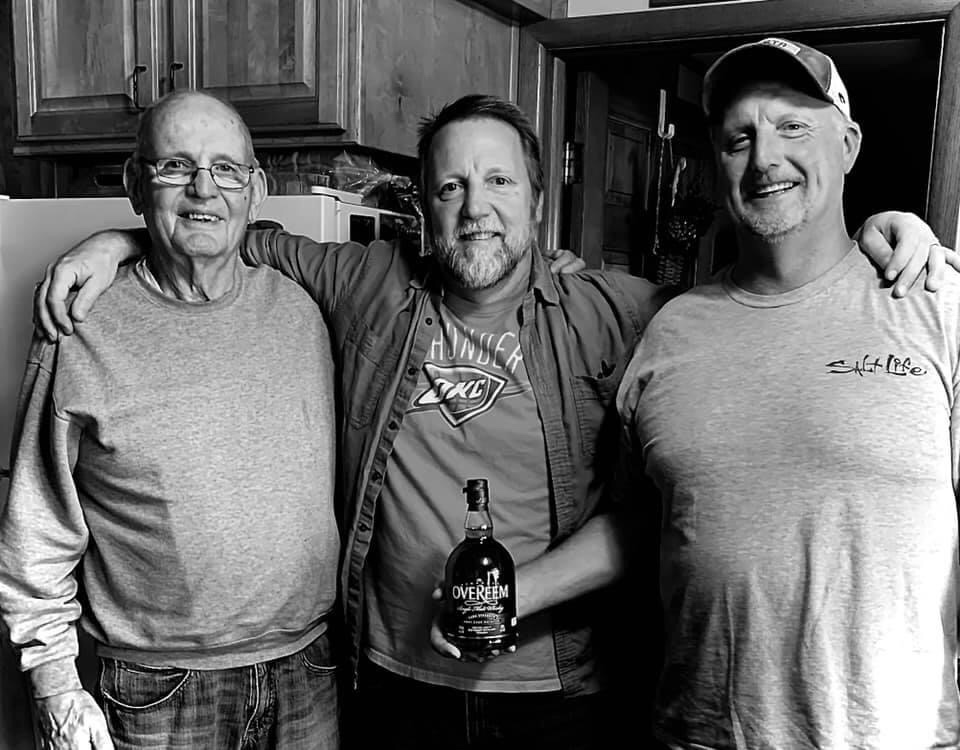
My dad Ron (1935-2020), me, my brother Brian

Friday, 92:

Traveled to Monett for an up-and-back visit with my parents, to limit our exposing them to virus risk. As we were leaving, my dad experienced a dizzy spell, fell to the driveway, hit his head, and briefly lost consciousness. We followed the ambulance that spirited him away to Cox South in Springfield, where he eventually landed in the neural trauma ICU after a CT scan: brain bleed. He had been on blood thinners for another health complication, which wasn’t a great situation. But the last doc we talked to before we headed home sounded cautiously optimistic. Dad had spoken to us: “I’m ok.” “Where am I?” “Oh, God.” “Jesus.” But also garbled syllables…

Saturday, 93:

At 1:15 a.m. Cox called to inform us Dad had taken a turn for the worse and would likely not last beyond Monday. Stunned, we returned to the hospital to begin a vigil. He did not regain consciousness. Calling Dad’s friends to tell them was exquisitely painful. We rotated by twos to sit by his bedside, though a few times we cheated and snuck in by five. Many readers have experienced the gradual succumbing of the unconscious by dying-gasp phases, which is among the most excruciating witnessing one can do; it was my second time. My dad was a hard-headed man, and twice conjured laughter from us out of despair by seeming to be ready to depart, drawing us together in tears and embraces–then beating death back. Finally, his exhalations faded, then stopped at around 8:45 p.m., 3:15 short of Father’s Day. Following the chaplain’s visit, we trudged out as if shackled to ball and chain, and drove home. Through it all, my mom was wondrously strong.

Sunday, 94:

We vowed this would be a buffer day: no business. Only decompressing and dealing with waves of sadness, happy memories, shock, grim humor, confusion, relief, and the agape, frightening state of being overwhelmed. We were fortunate also to enjoy waves of support, though we could not finish my cousin Jim’s made-to-order truckload of delicious biscuits and sausage gravy. We were all surprised that we were so drained we could go right to sleep: it was as if we’d been hurtling smoothly down life’s highway, the driver had stomped on the brakes, and we’d mass-exited via windshield and were airborne in a blur of forward motion, just feet above asphalt stretching out of sight.

Monday, 95:

I am a big believer in routine and ritual in times of stress, as I’ve demonstrated in earlier commentary entries. I chose to continue teaching (my peers at Stephens had offered to cover for me), and my brother and I agreed to deal with three-four post-death imperatives per day maximum, so we would also have time for self-care. I almost regretted the former choice when an NPR Tiny Desk Concert by Alicia Keys left me sobbing two minutes before class started.

We met with the funeral director and knocked out details for the service, but totally preoccupied by tragedy might not have wrestled with the coronavirus factor thoroughly enough. I knew I would be writing Dad’s obituary after the Saturday early morning phone call, but I dreaded it. I found an isolated corner in which to write, poured some Canadian courage, plunged into the task, struggled, cried, had to pee, walked down the hall to the bathroom, and happened to notice the framed commendations of my dad’s service that have been hanging on the wall for almost 20 years. I took them all off the wall and back to my cubbyhole, where they fed me the linchpin segment of the obit. By the time I was finished, I needed a cup of Twining’s Extra Bold Breakfast Tea just to relax. After dinner we had a great religious discussion that drained us enough to go to sleep immediately again.

Tuesday, 96:

Mom awakened to the impact of sudden loss. She let it all out, then recovered after embraces and shared tears. She is tough–even tougher than I thought–and though this road will be long and full of potholes (it IS Missouri), I know she’s equal to it. I awakened and realized I had neither shaved or applied deodorant since Thursday–I addressed the latter. At the funeral home, we viewed Dad’s body one last time prior to its cremation–not easy, but we were together. I tried to grade papers through the masked and unmasked friends who streamed through Mom’s door, and succeeded, though I couldn’t (as usual) go full-medieval with editing commentary. Our dear friend Hiedi continued to look after our culinary needs and offer beaming smiles, laughter, and hugs, and the highlight of my day was wandering around Dad’s fascinating and slightly insane workshop with my brother, Hiedi’s husband and our honorary brother Greg, and his son-in-law Logan. I am the opposite of a craftsman, but as I watched them wander from skillsaw to lathe to air compressor to sander, remarking on their qualities and vintage, I told them, “Dad’s lucky to have three people who know exactly how special and how unique these machines are, and how special this spot is. Some folks leave things behind only to have survivors complain, ‘What do we do with this junk?'”

I’m trying like hell to keep this commentary going. I’m nervous about the crowd coming to Thursday’s service. Dad had many friends, but these times are threatening. Folks need to be cool.

Streaming for Survivors:

For my brother Brian, who I watched the Netflix ZZ Top documentary with, but who hadn’t heard of this band, which was mentioned as a kind of influence.
Cloister Commentary, Day 91: California, OK!

My Thursday classes are open Zooms: they serve as opportunities for one-on-one tutoring, clarification on coming assignments and grades, testing out fresh writing on me–basically anything related to comp. Three of my students hail from California, all of them are thriving, and one of them always takes advantage of Thursdays. She’s a delight, she always asks the best questions, and despite taking FOUR classes this summer, she is always full of cheer. My favorite quote from her yesterday? “Mr. Overeem, I LOVE writing!” She’s an equine studies major, too!

I have too many books on my stack, but that didn’t stop me from picking up National Book Award winner James McBride’s new one, Deacon King Kong, and, with Nicole, starting the audiobook of Marjorie J. Spruill’s Divided We Stand, one of the guides for the creators of Hulu’s Mrs. America. I know you were hoping I wouldn’t mention that again. It’s that good.

Amazingly, I handled a power drill and didn’t affix myself to the deck’s latticework, upon the posts of which I installed some doo-dads so Nicole could string some colored lights (we call ’em “joy lights”). I earned two fingers of Four Roses to back my cold beer.

Have a great Juneteenth tomorrow, and if you’re not sure about it, look it up!

Streaming for Strivers:

Pre-U.S. release Wailers with Scratch on the sliders and knobs.

Cloister Commentary, Day 90: Tip-Toe Foiled

My Stephens virtual summer school students continue to shine. Their first set of final drafts were very good, and I shared two of them in which the writers tore down their rough drafts and rebuilt them into, well, models I could read out loud. On a lesser but fun note, I figured out how to perfectly screen-share YouTube videos, so from now on, students will join (and perhaps exit) to a soundtrack. The first featured artist was South African MC Yugen Blakrok, who it seems sparked some interest.

In the late afternoon, I listened to the underrated Willie Nelson album Me and Paul, which is chock-full of great tunes by the artist and ol’ Billy Joe Shaver, and on which Willie really exerts himself on those cat-gut strings. I was reading, when it occurred to me the world won’t have that forever. This cloister-stretch has me thinking about impermanence more than usual, and, to be honest, I’ve thought about it a lot for a long time. It’s not a bad thing, because it intensifies the moments you’re in.

Nicole and I shut down each day by sharing our favorite things about it, but first–the things we do for love!–I have to go sit with Louis in the living room until he’s snoring (or he will bark indefatigably), then tip-toe back to the bedroom. Trouble was, I fell asleep before Louis did. Sweetheart, my favorite thing was just hearing about the foxes!

Streaming for Strivers:

Sample for yourselves the musical highlights of my day.

Cloister Commentary, Day 77: WWJJD?

The day opened with Nicole’s delicious thick blueberry pancakes, some real maple syrup, and two poached eggs. After that, I was ready for anything.

I experimented with an open Zoom writing workshop, since my charge have a paper due for peer (and my) review Monday. Seemed to work fine. I had a few students pop in to (gently) bounce ideas off me, including the one who wore a WWJJD shirt to class yesterday (“What would Joan Jett do?”). Week 1 of summer school teachin’? Loved it.

For lunch, Nicole fixed us our 10th locally-grown 🍅 + (Blue Plate) mayonnaise + lettuce sandwich of the pandemic. Our summer officially starts with those.

I previous mentioned Derf Backderf’s graphic novel Trashed, but I didn’t expect to devour it in two sittings (it’s 260 pages long). If you’ve ever wondered about the fate of your trash, or reflected on your trash practices, you might want to check it out. Plus, it’s eye-wateringly funny, and distinctively drawn. Backderf’s much-anticipated Kent State book arrives on September 4th.

We closed the day with a relatively long jaunt around our neighborhood which we completed just before trouble descended in our locality–and just opened today marveling at a strange, jaundiced sunrise.

Streaming for Shut-Ins (Do I need to rename this feature?):

Rod Taylor, thanks for recommending Mr. Gil’s Refavela to me, which led me to THIS one, which I also love and had never heard. Folks, this musician is a shining jewel of Brazilian expression…

Cloister Commentary, Day 76: Run For a Jewel

First long neighborhood walk in awhile. First watering of the landscaping. The roses are poppin’–Japanese beetles, stand down!

Absolutely not kidding–my summer school students responded to their reading assignment with the best analytical discussion I’ve witnessed in a long time, through that dang Zoom. They read three essays that I carefully selected to help them set early goals for their own writing: Roxane Gay’s very recent piece in the NYT, Yuyun Yi’s short, sharp, and vivid “Orange Crush,” and Zoe Shewer’s three drafts of “Ready, Willing, and Able.” They participated pretty broadly and had amazing insights, and I think they’d have appreciated my facial expressions if I’d remembered to “Start Video”!!! All they saw for the first half-hour was an avatar of me standing on the stage of The Blue Note in a Dead Moon shirt, yelling during a Battle of the Bands.

I played with three of our cats for maybe too long (Jeez Louise, I’m 58!). They have found a cruddy piece of cord that is driving them insane–they have no time for official toys–and I have to hang it up on a nail high on a wall after each round unless I want to lose it. I walked into the office and Spirit was sitting there, staring at it as if that would make it drop, so I put her, Junior, and Cleo through their paces. #COVID19activities.

Speaking of COVID-19, my test results came back and I am negative. Nicole is still waiting for hers.

I began Walter Johnson’s The Broken Heart of America: St. Louis and the Violent History of the United States. If the whole book is as shattering and mind-boggling as the introduction, it will be one I will never forget. Also, Run The Jewels literally said “F***k it” and dropped what could well be the album of the year early, for free–but with suggested funds linked to which fans can donate and support the protesters and the fight for justice. I would have linked the full album today, but a usable one doesn’t yet exist. You’ll have to settle for Thelonious Monk and John Coltrane.

Streaming for Shut-Ins:


Cloister Commentary, Day 74: The Buzz

Some readers may breathe a sigh of relief to learn that I finally taught my first-ever Zoom class to a group of students I’d never met (from all over the country), and not only did I catch the buzz of teaching excitement that I was afraid I wouldn’t, but the students who showed up were down for the program to a one–and it’s some hard work. No more neurotic whining from me! Six students didn’t make the scene, but one was at the dentist with a broken tooth, one was a working mom with log-in issues–those two did turn in their assignments–and I hope the rest had to sacrifice a class to get some sleep after having protested this weekend. The essays students submitted last night (on-demand diagnostic essays) look sharp, Dr. Trish!

I celebrated my relief by donating a pint at the American Red Cross. I’ve tried to to donate the maximum pints in a year the last three years, but something always trips me up, COVID-19 this time (I’d had to cancel two appointments). The local branch off Providence has their pandemic operation down cold, though two dude donors apparently could not read the signs planted right beyond the entrance. My new goal is to try to catch my friend George Frissell in total donations, since he will not be donating anymore (the Red Cross staff is mourning him a bit as well): he’s only 228 pints ahead of me.

Speaking of the late Mr. Frissell, we were happy to learn that a memorial project for him at Hickman High School has gotten the green light. More later. I can assure those that know him it is fitting.

You like graphic novels? I do, especially if they’re off the beaten track. I started Derf Backderf’s Trashed yesterday, which draws on his experience as a city sanitation worker in Milwaukee. Backderf’s main claim to fame is his book My Friend Dahmer (yes, he went to junior high and high school with him), and his Kent State book arrives timed perfectly in the fall.

Nicole and I put the day to rest with some great spaced-out conversation with our neighbor Shireen on her back deck. As usual, our talk was rangy, and Steve, we broke into that Guinness care package you sent us and it was effective.

Streaming for Shut-Ins:

Don’t let nothin’ turn you ’round.

Cloister Commentary, Day 72: A Defiant One

With COVID-19 cases swinging up, we decided to pick up are groceries curbside yesterday. The crew at Hyvee was very efficient, and we bought the fruit of four local enterprises’ labor at the Farmer’s Market: Uprise Bakery, Happy Hollow Farms, Thoenen Produce, and The Veggie Patch. Good stuff!

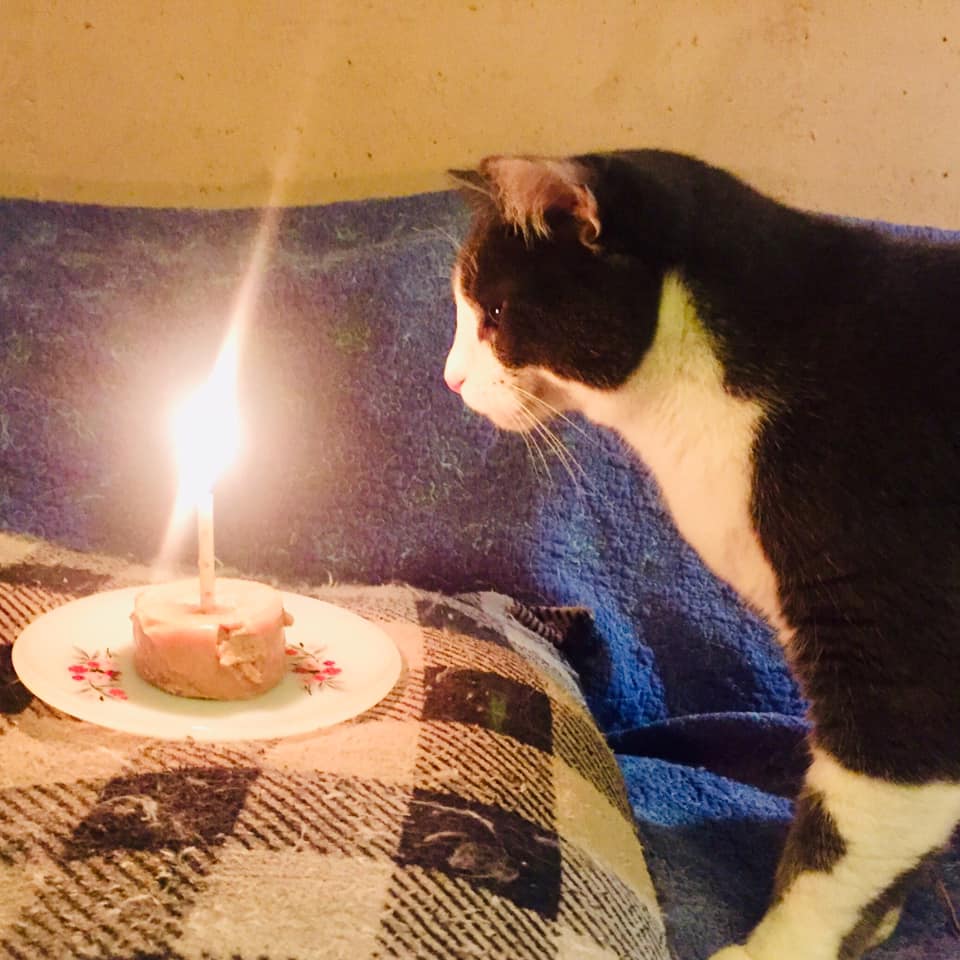
We also celebrated our Keystone Kitten Junior’s first birthday, even though it’s actually today. He shared a can of soft stinky salmon stuff with his mom and dad, his three best friends, and the two feline sentinels who watched over him and his siblings after they were born on our back deck. Nicole put a candle in the middle of it, and Junes sizzled some whisker-tips, but it was fun for all.

Jr Birthday

These times are full of dread. Even stoics I know are airing morning anxiety. I’d like to thank that old Parkview Viking rascal Stephen Fischer again for sending me a video (see below) out of the blue that lifted a heavy cloud of my own to a much higher elevation. I wish I’d taught that guy; his two brothers were a pleasure in class, as well. We teachers do frequently wish we could have taught people we didn’t get to.

One of my future students in the coming Stephens College virtual summer school program emailed me that she had broken a front tooth and might miss our first class. a) I was actually delighted by the missive, because I’d been fretting about how ready students were to “arrive” and communicate; b) I reassured her all would be well; I know how she feels since I broke my two fronts in sixth grade, and I simply wrote her a reply that summarized our first class; and c) the command of written communication her email demonstrated has me looking forward to her first essay. I always tell worried friends that I don’t “grade” correspondence–but with current students I occasionally make an exception.

We closed the day with Clarence Brown’s 1949 adaptation of William Faulkner’s novel Intruder in the Dust. The film was shot in Oxford, Mississippi, and nearby Holly Springs National Park, and has historic resonance: Puerto Rican actor Juano Hernandez plays the lead role of Lucas Beauchamp, and in so doing may have been the first black man to peer at us from the screen from a position of independence, equality, and defiance. His performance is electrifying, and Claude Jarman, Jr., as the young boy Chick, impresses as a very complex white adolescent. Highly recommended–if you can find it.

Streaming for Shut-Ins:

Some strong aural medicine for struggling spirits.

A Supreme Love? (That Might Be Sacrilege)

220px-John_Coltrane_-_A_Love_Supreme

My current excellent crop of freshman writers at Stephens College have a new task: make a case for a musician, act, album, song, video, or music film or documentary. It’s essentially a persuasive paper, but I like to avoid the traditional labels, and we’ve been arguing pop merits in class lately, so it fits. Also, our recent Socratic seminar–focusing on Lana Del Rey’s Norman Fucking Rockwell–indicated that many of them are too comfortable with “like / dislike” to think deeply about whether a work works. Thursday, I arrived to work an hour early having made myself a challenge: write a rough draft yourself, to the exact specs you’ve given them, quickly enough to print them copies to critique. I’m a big fan of modeling skills you want your students to master; I’m not a professional, but after 35 years of teaching, you’d think I could, um, as they say we can’t, do. When I arrived on campus, I still didn’t know what I would write about, but as I took the sidewalk into Dudley Hall, it occurred to me that Nicole and I have a framed copy of Trane’s A Love Supreme in our living room. Out of tens of thousands of records in the house, why that one? So after getting coffee and brown sugar cinnamon PopTarts, I was off to the races. Here’s what I produced, in 45 minutes (still in its rough form, though I did have time to re-read it before class started):

Phil Overeem

English 107

September 19, 2019

“Making a Case” Rough Draft

The Album on the Wall

Should one enter our house through the front door and turn immediately to her right, she would see, hanging from the front wall of our living room, a framed album cover. In fact, inside that cover is the advertised LP, titled A Love Supreme after its lone 33-minute song, a four-part suite composed by jazz tenor saxophonist John Coltrane and performed by Coltrane’s legendary quartet. The black and white album photo that comprises the album cover is of the saxophonist in profile—significantly, looking very serious. In fact, A Love Supreme is very serious music. Elsewhere in my house are approximately 1,726 other albums; that does not count CDs, 45s, 1.5 TB of digital content, and music performance and documentary DVDs. How is it that, of all that musical tonnage, A Love Supreme is the lone piece honored by a place on one of our house’s walls? If one chanced to listen to it, she would very likely understand.

Jazz, though it is one of the few artistic inventions unique to the United States and known by practitioners and admirers as “black classical music,” does not command the attention of many young listeners. However, A Love Supreme is a great starting point for any curious Gen X or millennial listener. Simply put, the musicians—Coltrane, Elvin Jones (drums), McCoy Tyner (piano), and Jimmy Garrison (bass)—would make any list of the greatest performers on each of their instruments since the end of World War II, and likely before. In particular, Coltrane’s driving, searching, intense playing can yank listeners by the lapels into full concentration, and Jones’ stormy playing around (and suggesting of) the beat is one of the most easily identifiable percussion styles in jazz history. A Love Supreme is certainly a peak in each musician’s storied career. In addition, though curious neophytes, after their first sampling of jazz, often wonder whether they have the musical background to “understand” what the musicians are doing, particularly when they are improvising, and particularly in non-vocal jazz, this album only requires the listener to have ears, and to have lived. From the opening meditative sounds—a gong, a questing saxophone phrase, a brief chant of the album title—it is clear that the musicians (and listener) are going on a journey.

What kind of journey? Aside from being an outstanding “first jazz album” for the inquisitive, A Love Supreme stands tall in the annals of general music history as one of the greatest spiritual albums ever made. In his original liner notes for the album, Coltrane explains that the suite is a seeking after, and a paean (or a song of praise) to, God. He does not specify a religious denomination, which is a good thing: the surging emotions (carried by the players’ imaginative exploratory phrases and solos), the extended focus, rising tension, and serene relief represented by the suite’s sections, and the resulting aura of mystery and majesty, should be familiar to anyone who has ever been filled by religious passion and devotion—be she Christian, Hindu, Muslim, Buddhist, Sikh, or First Nations, to name but a few possibilities. The effectiveness with which the composition and the performance mirrors the path of the seeker can arguably overcome the musical persnicketiness of even the most skeptical of audiences, and, even so, can appeal just as strongly to atheists and agnostics, most of whom are no strangers to the search for enlightenment themselves.

A Love Supreme is an aural experience for jazz initiates and spiritual veterans that carries considerable potential for landing in their personal pantheons, but one more aspect strongly commends it to adventurous ears: among the hundreds of thousands of records released since the dawn of the turntable, when it is absorbed by two or more present in the same space, it can be a profound communal moment—and not just a moment, but conceivably the birth of a ritual. Many fans of A Love Supreme whom I happen to know excitedly tell stories of having listened to it with other people, a situation that has heightened significance in the age of headphones and heatedness. Sitting side by side with friends and family, in a candle-lit room emptied of smartphones and other modern distractions, one can be transported from the grinding monotony of this world—wake, eat, work, eat, sleep, rinse, wash, repeat—into a more complex, absorbing, mysterious, and—paradoxically–real one, one that can bind the group together and promote true inquiry and produce epiphanies.

That kind of transport, that kind of bonding, readers, is why A Love Supreme hangs on our living room wall. Thirty years ago, crushed flat by serial romantic disappointments, I’d vowed to become monk-like, and disavow romantic love. I drove to my friend’s house to inform him of my decision; he wasn’t home, but a young lady who was renting a room in his house was. I introduced myself, and as we were chatting, I looked over her shoulder to my friend’s stereo and stack of records. In the stack, I saw a certain LP. I asked her if she’d mind me putting it on—she hadn’t heard it. We still have that actual copy. We have it on CD and mp3, too.

Besides providing my students a copy, after I’d read the best final drafts from their last assignment, I read it aloud. Instantly, I noted the same ol’ bugaboos: convoluted sentences, unnecessary italics, inconsistent voice–they noted them, too (which was the point: if I struggle and it’s OK, then why not them?). I also tried to be Mr. Clever and, as I repeat too often, “stick the landing” on the final sentence; maybe it worked, but most of my students wanted to know more. However, I used the reading as a lesson on “Killing Your Darlings.” I love writing personal narratives, but I forced myself to abjure the story and just make the goddam case.

One student commented: “I want more of your story, and I don’t like the title! What about A Supreme Love?

Me: “Um, well, er…I’ve been married almost 30 years and my wife inspired the essay–but maybe let’s not go that far!”

Anyway, submitted, still rough, for your approval, too.