GEORGE & PHIL’S BREAKFAST MEDITATION, STOP 5: Perche Creek Cafe

Anyone who knows George knows he is influential. However, few know that he pioneered cargo pants/shorts as traditional (i. e., daily) men’s wear for the chronologically gifted, and when on the way out the door to pick him up I noticed I, too, was showcasing many, many pockets, I chose to deny my slow decay and changed into jeans. Not all influences are positive….

This week, we headed to Midway on a recommendation from a mutual former student, the lovely and peculiar John Grupe. Once inside the cafe, I counted the calendars. Readers of William Least Heat Moon’s “Blue Highways” may remember that Moon argues that the excellence of a blue highway diner can be measured by the number of calendars on its walls. If my deteriorating memory serves, he writes about a seven-calendar cafe; I’ve never seen more than three in one, and that’s the number we counted this morning. Three = powerfully good dining.

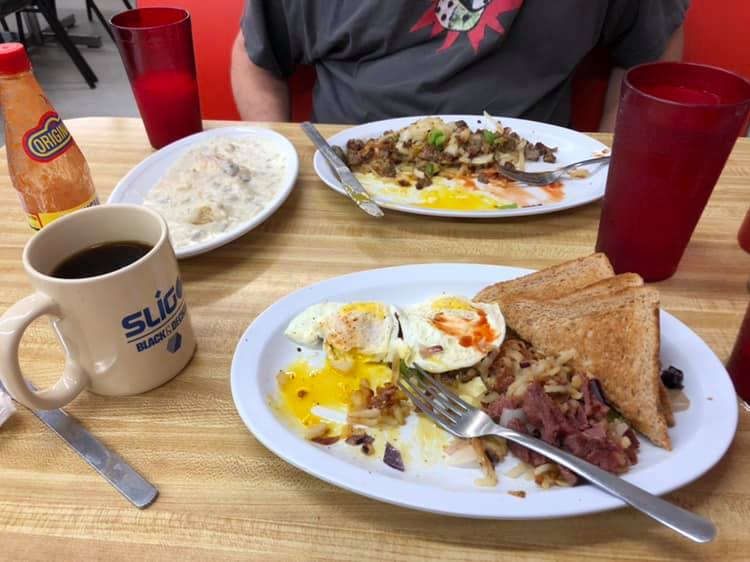
George ordered the Perche Skillet Special (eggs sunny side up, hash browns, sausage, sautéed green peppers and a half-order of b&g), though those who imagine Frissell a beacon of economy should note he left his b&g for the garbage-gut (aka me) to “help” with. In the arena of things humans are drawn to as moth to flame, I admit a helplessness before a plate of corned beef, but the C. B. Skillet* set me free (to borrow a phrase from our fellow retired teacher and curmudgeon Michael). Perche Creek Cafe: 10. The pies and pork loin are reputedly their specialty, and we’ll return to gobble those.

Miracle of miracles, the server who rang us out and the cafe’s proprietor both had kids who went to Hickman, and none (!!!) suffered one or the other of us as teachers. They are consequently leading blissful lives.

We headed back down I-70 recounting the sweeping changes we’d seen in our lives, but the sun was coming up, not going down.

Perche Creek

Photo: corned beef skillet, foreground; Perche Creek Skillet, Steve Earle t-shirt, background. Note the corned beef has well-nigh vanished.

*I prefer HASH, but I’ll gladly wolf down SOS-style c. b. fragments!

GEORGE & PHIL’S BREAKFAST MEDITATION, STOP #6: Bleu Market Cafe

If any of you have spent much time around either of us, this installment of our breakfast medications might well seem the most characteristic. Literally before I even got in George’s car, I began nerding out on Columbia’s upcoming Dismal Niche Festival and didn’t stop until we pulled into Bleu‘s parking lot. Along the way, George almost crossed the double yellow line thrice, either because I was so effectively enthralling him with my banter about music from the Sahel that he couldn’t concentrate or because he is a terrifying driver. At any rate, I sold at least one ticket, Matthew!

Upon arriving a few minutes before the restaurant opened, we noted we were both wearing the same color cargo shorts. Once the restaurant opened, the absence of other diners somehow made it difficult for us to choose from among ALL the available seats, and when we finally grabbed a table, I sat next to George rather than across from him (???). Then after I clearly stated what I wanted (eggs Benedict–wait, do I capitalize both words?), Frissell violated one of our few rules and decided to order the same thing, forcing me to order beef hash that was distinctly not corned. He also ordered a side of four pieces of bacon (“very, very, VERY crispy”–I’ve never heard him triple up on it before) and told me I’d be eating two of those. Fine.

We proceeded to revisit “Hickman Tales from The Dark Side” and our respective student teaching experiences, pondered the origins of the phrases “knocked up” and “ass jack” (scroll down to the second definition), cleaned our plates–then, thorns amongst the roses, realized our setting was more posh than that to which we are best fitted. Bleu–note spelling–is the anti-JJ’s, which we should have realized by the presence of avocados on the menu. Something had seemed afoot, and that apparently was it. Posh we not. Excuse me, are not. However, the food was quite good, the service was very, VERY, VERY crispy, and at least we were not brunching (I believe those are illegal in the country of Texas, anyway). Rating? 8 (food 9, plus environment 7, divided by us 2).

We forgot to take a picture. I think we were both a shade fogged over.

See you in two weeks. George is going to Chicago where he is–apparently–going to be engaging in athletic activities with his young relatives. Have you seen this guy move lately?

GEORGE & PHIL’S BREAKFAST MEDITATION, STOP #7: Glenn’s Café (guest starring Adam Sperber)

Glenn's Breakfast

Axiom of the Day: “Never trust dinner at a breakfast place; never trust breakfast at a dinner place.”

This axiom lands with some irony. Originally we had planned to defy the latter clause and head to McLank’s, which, along with some nice recent publicity has received some wildly varying reviews. Since none of the bad reviews were focused on their breakfast menu, we felt there was little risk, plus we could poach us a little of their publicity. (Our biggest concern was the dissonant, euphonia-bereft name). However, since our fond fellow Kewpie Mr. Sperber was in town, we decided to divert to a highly-lauded, time-tested Columbia spot that Adam (born and raised here!) had never heard of. I was surprised and excited to learn that Glenn’s opened at 7 am, because I’d only ever eaten dinner (and enjoyed a couple of tipsy brunches) there, thus the former clause sailed five feet over my head.

Things learned? Adam is Larry Bird’s Peanut Brittle Brother! Adam’s recent knockout karaoke rendition of “Suspicious Minds” evolved into an emo-cum-screamo interpretation due to Sperb’s lack of a Presleyian baritone! Adam is now a choir director bitch! And Adam finally digs Toni Morrison! This is why we occasionally invite him: George’s biggest news was that he was folding laundry later in the afternoon, mine that I am (supposed to be, right now) grading papers. We also mourned fallen comrades.

Also, he was a distraction from the fare, fortunately. I love this place, but–alas, that first axiom. George’s Belgian waffle was fancied up to resemble something more Las Vegas-ian, with an equivalent level of taste. My ham scramble was a touch on the watery side, and the bell peppers…can those be al dente? Adam’s cup ‘o yogurt appeared decent–he did pause his narratives frequently enough to eat it–but, as George noted on my way to drop him back off at his laundry room, “How can you —- up a parfait?”

I provided the adverb; no sooner had it left my lips than he provided, and I agreed with, the score (we’ve known each other awhile): “Profoundly–” “–a 5.” We have no plans to avoid Glenn’s in the future. Every institution has a bad day, and we’ve spent time in many of them.

Our server was delightful, attentive and stylish, and agreed to take our picture. If I look slightly unimpressed, it’s only because I’d just been crop-dusted upon returning from plugging the meter (Adam’s stories are long).

GEORGE & PHIL’S BREAKFAST MEDITATION, STOP #8: Ernie’s Cafe

G & P at Ernie's

This ain’t no discovery. George and I have been coming here forever, together, separately, with our better halves, you name it–and if you haven’t been, you best change that condition. We just hadn’t gotten around to Ernie’s on our tour, and we were needing to recover our street cred after the last two stops. George had his heart set on their celebrated ham when he called me the other night; I had what I think of as “The Number 15”–anyone else add numbered combos to Ernie’s “Big 12”?–a pepper cheese, mushroom, and onion omelet, sausage patties, and hash browns. The place’s menu is beyond inviting.

I can hear you asking, “Did you get them extra extra extra crispy?” Funny you should bring that up. Our server was the dynamic, charming, and very awake Chloe (it was 6:30 am, and I hope I spelled her name correctly), and after Herr Frissell hissed to her his traditional potato expectations, she turned to me, smiled, and asked, “Would you like yours extra extra extra extra crispy, too?” How could I refuse? (Oh–and they WERE.)

Topics: NOMADLAND, the great Houston novelist Attica Locke, the ease of writing a check, our former colleague Sarah Gerling‘s excellence, the music of the Sahara, St. Louis’ crisis, platelet donations, the waning relevance of the Statue of Liberty, attempted but botched surreptitious tape recordings, and the charm of 6th, 7th, and 8th graders (no, we are NOT insane). Speaking of insanity, we also meditated upon absolute freedom and its danger to life and limb.

That doesn’t seem like much, but we were only there for 45 minutes…


GEORGE & PHIL’S BREAKFAST MEDITATION, STOP #9: Heuer’s Country Store (“postponed”) / JJ’s Diner (back-up)

I should have been prepared for the unusual when my supposedly laid-back old hippie friend changed our embarkation time from 6:30 to 6:15 to 6:00 over the course of four days (what’s the adverb form of “persnickety”?), which resulted in our near-replication of two classic horror scenes.

Since our trip required the traversing of over one mile, I insisted on driving out to wherever Heuer’s is. Ill-advisedly, I also insisted on immediately initiating a meticulous conversation while traveling 63 North in the pitch-dark and looking for Pinnacles Road. Remember Christopher Walken’s scene in ANNIE HALL? If George had been driving, I wouldn’t be alive to be writing this; since I was driving, we only narrowly escaped a Boone Country Traffic Incident text. Then, at 6:15, we arrived at Heuer’s, advertised as opening at 6, but emanating not a dim, mildly pulsating speck of light. We parked and decided to wait, and, for a few seconds, surveyed in silence the scene, which was dominated by an intensely lifeless cottage set just a ways back from the restaurant–intensely lifeless, that is, but for a single burning, lamplit window. George turned to me and stated, simply, “The Bates Motel.”

In record time, we were ensconced at JJ’s, our old stand-by, a place we claim to have once “internationally integrated” when we met our wonderful former students, Michele Sun and Maya Ramachandran, there for lunch. Apparently still rattled from the wee-ooo-WEEE eerieness of…is it Sturgeon out there?…Frissell 1) THOUGHT he was ordering from the senior menu (he’s not THAT old!), and 2) ACTUALLY ordered from the children’s menu! No, I am not kidding! Look at the pancake pic below! (I don’t ever have to think at JJ’s and thus avoid such eccentric displays: #7, over medium, no toast.) Our regular and wonderful former Kewpie server Sean did not even bat an eye. Of course, George was one of his teachers at Hickman, so why would he have?

Topics of banter: Love vs. Doors (those are bands, not emotional states); murder; NOMADLAND (it’s a great book!) and our own good fortune; Attica Locke (she’s a great writer–with a new book!); connubial splitting (in the dining sense); “cancel culture”; “Can human beings change?” (we have taught for a combined 3/4ths a century so they had better damn well be able to); political shenanigans; and the song “Hey Joe” and its misogynistic plot. Oh yes: and the Providence Bowl–George was sporting a vintage PB tee from the year Hickman won state.

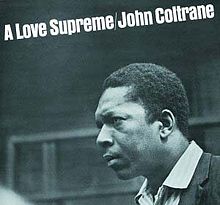
A Supreme Love? (That Might Be Sacrilege)

220px-John_Coltrane_-_A_Love_Supreme

My current excellent crop of freshman writers at Stephens College have a new task: make a case for a musician, act, album, song, video, or music film or documentary. It’s essentially a persuasive paper, but I like to avoid the traditional labels, and we’ve been arguing pop merits in class lately, so it fits. Also, our recent Socratic seminar–focusing on Lana Del Rey’s Norman Fucking Rockwell–indicated that many of them are too comfortable with “like / dislike” to think deeply about whether a work works. Thursday, I arrived to work an hour early having made myself a challenge: write a rough draft yourself, to the exact specs you’ve given them, quickly enough to print them copies to critique. I’m a big fan of modeling skills you want your students to master; I’m not a professional, but after 35 years of teaching, you’d think I could, um, as they say we can’t, do. When I arrived on campus, I still didn’t know what I would write about, but as I took the sidewalk into Dudley Hall, it occurred to me that Nicole and I have a framed copy of Trane’s A Love Supreme in our living room. Out of tens of thousands of records in the house, why that one? So after getting coffee and brown sugar cinnamon PopTarts, I was off to the races. Here’s what I produced, in 45 minutes (still in its rough form, though I did have time to re-read it before class started):

Phil Overeem

English 107

September 19, 2019

“Making a Case” Rough Draft

The Album on the Wall

Should one enter our house through the front door and turn immediately to her right, she would see, hanging from the front wall of our living room, a framed album cover. In fact, inside that cover is the advertised LP, titled A Love Supreme after its lone 33-minute song, a four-part suite composed by jazz tenor saxophonist John Coltrane and performed by Coltrane’s legendary quartet. The black and white album photo that comprises the album cover is of the saxophonist in profile—significantly, looking very serious. In fact, A Love Supreme is very serious music. Elsewhere in my house are approximately 1,726 other albums; that does not count CDs, 45s, 1.5 TB of digital content, and music performance and documentary DVDs. How is it that, of all that musical tonnage, A Love Supreme is the lone piece honored by a place on one of our house’s walls? If one chanced to listen to it, she would very likely understand.

Jazz, though it is one of the few artistic inventions unique to the United States and known by practitioners and admirers as “black classical music,” does not command the attention of many young listeners. However, A Love Supreme is a great starting point for any curious Gen X or millennial listener. Simply put, the musicians—Coltrane, Elvin Jones (drums), McCoy Tyner (piano), and Jimmy Garrison (bass)—would make any list of the greatest performers on each of their instruments since the end of World War II, and likely before. In particular, Coltrane’s driving, searching, intense playing can yank listeners by the lapels into full concentration, and Jones’ stormy playing around (and suggesting of) the beat is one of the most easily identifiable percussion styles in jazz history. A Love Supreme is certainly a peak in each musician’s storied career. In addition, though curious neophytes, after their first sampling of jazz, often wonder whether they have the musical background to “understand” what the musicians are doing, particularly when they are improvising, and particularly in non-vocal jazz, this album only requires the listener to have ears, and to have lived. From the opening meditative sounds—a gong, a questing saxophone phrase, a brief chant of the album title—it is clear that the musicians (and listener) are going on a journey.

What kind of journey? Aside from being an outstanding “first jazz album” for the inquisitive, A Love Supreme stands tall in the annals of general music history as one of the greatest spiritual albums ever made. In his original liner notes for the album, Coltrane explains that the suite is a seeking after, and a paean (or a song of praise) to, God. He does not specify a religious denomination, which is a good thing: the surging emotions (carried by the players’ imaginative exploratory phrases and solos), the extended focus, rising tension, and serene relief represented by the suite’s sections, and the resulting aura of mystery and majesty, should be familiar to anyone who has ever been filled by religious passion and devotion—be she Christian, Hindu, Muslim, Buddhist, Sikh, or First Nations, to name but a few possibilities. The effectiveness with which the composition and the performance mirrors the path of the seeker can arguably overcome the musical persnicketiness of even the most skeptical of audiences, and, even so, can appeal just as strongly to atheists and agnostics, most of whom are no strangers to the search for enlightenment themselves.

A Love Supreme is an aural experience for jazz initiates and spiritual veterans that carries considerable potential for landing in their personal pantheons, but one more aspect strongly commends it to adventurous ears: among the hundreds of thousands of records released since the dawn of the turntable, when it is absorbed by two or more present in the same space, it can be a profound communal moment—and not just a moment, but conceivably the birth of a ritual. Many fans of A Love Supreme whom I happen to know excitedly tell stories of having listened to it with other people, a situation that has heightened significance in the age of headphones and heatedness. Sitting side by side with friends and family, in a candle-lit room emptied of smartphones and other modern distractions, one can be transported from the grinding monotony of this world—wake, eat, work, eat, sleep, rinse, wash, repeat—into a more complex, absorbing, mysterious, and—paradoxically–real one, one that can bind the group together and promote true inquiry and produce epiphanies.

That kind of transport, that kind of bonding, readers, is why A Love Supreme hangs on our living room wall. Thirty years ago, crushed flat by serial romantic disappointments, I’d vowed to become monk-like, and disavow romantic love. I drove to my friend’s house to inform him of my decision; he wasn’t home, but a young lady who was renting a room in his house was. I introduced myself, and as we were chatting, I looked over her shoulder to my friend’s stereo and stack of records. In the stack, I saw a certain LP. I asked her if she’d mind me putting it on—she hadn’t heard it. We still have that actual copy. We have it on CD and mp3, too.

Besides providing my students a copy, after I’d read the best final drafts from their last assignment, I read it aloud. Instantly, I noted the same ol’ bugaboos: convoluted sentences, unnecessary italics, inconsistent voice–they noted them, too (which was the point: if I struggle and it’s OK, then why not them?). I also tried to be Mr. Clever and, as I repeat too often, “stick the landing” on the final sentence; maybe it worked, but most of my students wanted to know more. However, I used the reading as a lesson on “Killing Your Darlings.” I love writing personal narratives, but I forced myself to abjure the story and just make the goddam case.

One student commented: “I want more of your story, and I don’t like the title! What about A Supreme Love?

Me: “Um, well, er…I’ve been married almost 30 years and my wife inspired the essay–but maybe let’s not go that far!”

Anyway, submitted, still rough, for your approval, too.

The Walk-Out

The beginning of my friendship with Shawn was inauspicious. He punched me in the mouth.

Shawn and his older brother Kyle were protecting their turf at the Carthage baseball field. I was about as far from invading it as I could be. Looking back, I imagine my parents had dragged me out there hoping sports would rub off on me by osmosis and distract me from Birds of North America, comic books, and dinosaurs. Perhaps I was a bit too old for those pursuits; one thing’s for certain, though—soft, brown-shoe-clad, uncoordinated, nine, I was no threat to the boys’ diamond kingdom. By the time I’d gotten off my back and the ground, the brothers were gone, their point made all out of proportion to my willingness to understand it.

A couple summers later, I was horrified to learn that, after my dad built us a house out on the rural route, Shawn would be one of my new neighbors. Barely had fear balanced upon my brow when he came in the yard, walked up to me—I was probably looking for interesting insects—and demanded, “Do you want to learn to box?” Based on past experience, that was the last thing I wanted, but I quickly considered my options: being beaten up for sport, or as social punishment? In the ensuing years, I’d learned that Shawn was already involved in Golden Gloves, and the ominous metallic image conjured by the program’s name assured me that escape would not be a choice. I stuttered, “Sure”—and Shawn beamed a grin at me and proceeded to enthusiastically stick-and-move me through some basic steps. I was hesitant to believe it, but it appeared his intentions were…good. I’d thought he wanted to teach me to box so kicking my ass would be more of a challenge, but he seemed sincerely to want me to learn for my own good, and for fun. He was a patient teacher, he was manically hilarious, and he didn’t seem to think I was a pussy. That much of one, anyhow.

The lesson didn’t stick because I didn’t seek out further opportunities to practice them. However, Shawn and I became fast friends anyway. We landed in the same sixth grade homeroom, where we ritually tortured our Baptist minister-cum-teacher Mr. Lawhon. I was not as abashed in the classroom arena as when faced with proving my manly mettle in nature; I enjoyed doing schoolwork so much I did it quickly so I could do what I wanted, and I’d developed a taste for mischief to complement my interest in stegosauruses and Green Lantern / Green Arrow. One day, just before the recess bell was due to ring, Lawhon asked if any of us had questions about the social studies activity we’d just survived. Shawn raised his hand. This act alone stretched my eyebrows to the back of my head: Shawn normally lacked even a molecule of seriousness about his studies. I craned my neck across the room in anticipation of his inquiry.

Lawhon, eyes narrowed, murmured, “Yes, Shawn, what is your question?”

A long squeal of gas, sounding like it was being forcefully expelled from a balloon, followed, then was bisected by the bell—which, among other forces, propelled Shawn out to the playground before the teacher could even sneer one of his frequent idle threats. Nearly in tears and collapsed into laughter at my desk, I was courting disciplinary action myself. That, I thought, was a masterful emission, and over such natural phenomena young friendships are sealed.

Meanwhile, on weekends, as summer cooled into fall, Shawn continued to lure me into neighborhood danger. A few weeks later, he and the even-more-feared-and-a-damn-sight-older Butch Adams showed up at my door to tell me I’d be joining them in a game of sandlot football at Shawn’s house. I didn’t even know how to play football. They simply needed a body, though now I suspect it was yet another stage of Shawn’s altruistic mission to toughen me up—what kid does that for another kid? Five minutes into the game, I blinked my eyes and noticed I’d caught a pass from Shawn. I did not drop it (at this point, I was still literally striking out in kickball at recess). Also, a culvert ran just behind me, and, as I broke the trance brought on by my impossible success, I looked up to see Butch streaking toward me, shoulder aimed at my midsection.

Have you ever gotten the wind knocked out of you? As it turned out, my vain attempts to suck mine back into my lungs and see through the stars spinning in front of my eyes at least took my mind off the pain cycling through my back and neck. I lay sprawled in the ditch, but, again, to my amazement, I hung in there and completed the game. Nobody praised me; nobody even seemed to notice. Somehow that was just right, and, from then on, Shawn never missed a chance to invite me to play. Before long, I was knocking on neighbors’ doors myself, recruiting.

Also, I was growing. Having sprouted to nearly six feet, at 13 I was big enough to do actual damage myself playing football and basketball. I’d taken an odd route to being player, though. As a premature nerd, along with a fascination with zoology, superheroes, and mythology, I’d developed an obsessive interest in sports statistics—that’s just a little hop over from mythology, anyway, isn’t it? Aside from feeling I had no choice but to play (thanks to my father) and barely believing I could survive playing (thanks to Shawn), that I could actually make the statistics I was fixated upon was a temptation I couldn’t resist. I picture this process being reversed for most athletes; they learn to excel at sports, then they get interested in its tantalizing and deceptive numerologies.

Sad to say, the most important statistics during my first two years on the hardwood and gridiron were our won-loss records—put more succinctly, our loss records. We didn’t win a single football game, and in basketball we were little more successful. As players, like any junior high kids, we boasted only the roughest-hewn skills. However, in ninth grade, things changed for us again, and Shawn was right in the middle of those things, as usual. So was I, to my surprise.

We won our first-ever football game, right out of the gate. Our season opened way out of town, in Fayetteville, Arkansas. When we trotted out onto their field, we confronted a marching band and cheerleading squad both of which were bigger than our entire roster. Their football team itself appeared thrice our size—both in number and bulk. They proceeded to run back the opening kickoff and waltzed in for a two-point conversion, and we were down 0-8 with only mere seconds having elapsed. I experienced a bad mythology flashback as I watched their running back spin the pigskin across the end zone: this was a very, very bad omen.

Minutes later, our helmets bowed in prayer after we’d made negative progress on the ensuing kickoff return and quickly dug ourselves into a third-and-27 hole deep in our own territory, I began to contemplate the thin line separating an omen from an actual shootin’-fish-in-a-barrel prediction, and looked across the huddle at Shawn, who happened to be our quarterback. His eyes were mean slits.

“Awright, they’ve been playing us up. We’re going deep to Nathan on a post. That’s not the play call, but that’s what we’re doing. Keep ‘em off my back. ON THREE!”

Shit. He was serious.

Result: 75-yard catch-and-run touchdown. We blew the extra point, but hell—it was now a game. And ol’ Shawn had the stones to just improvise according to what he was seeing.

As we headed back into the locker room at halftime, still down 6-8, the Fayetteville fans—they seriously dwarfed the handful of parents who’d made the trip to see us—rained insults of a nefariously nasty nature down on our heads. “It’s just a ninth-grade football game,” I thought—but I converted the hurt into fuel. Soon after the second-half kickoff, we scored again—Shawn connected with me on a 20-yard pass play to take it down to the one-inch line—made the extra point, went up 13-8, and that, as they say, was all she wrote. I had never before cried from happiness, nor have I since except quite a bit more discreetly at the altar. My tears, though, were for more than just having won a game against pretty imposing odds. They were also from astonishment at our power—a bunch of 14-year-olds determined for themselves that they would win, then won. Or maybe, simply, Shawn did, and sold us on the prospect.

In basketball, a new coach met us for tryouts. In his recent past, he’d been a star guard at Missouri Southern State College, but his court skills weren’t what really made him special. He had charisma, style—a lime-green three-piece “game” suit? Why not?–and great instincts for coaching youngsters. He was the first adult Shawn and I had ever met who talked to us like we were his equals, and entrusted us with serious responsibilities. One might be skeptical of this approach when applied to 14-year-olds, but Shawn had been ready to lead for a while, and spending time in his orbit had caused me to wonder (and fantasize) about my own capabilities. Coach Stevens sensed this, and soon we were both involved in planning strategy with him. He expected me to provide leadership for the starters on defense, on the boards, and in sheer hustle; Shawn was the “captain” of The Blonde Bombers, our mad-dog reserve squad who uncorked lightning nearly every time they touched the court, especially when we were playing at home. Our gym was smaller than regulation; if memory serves, it had to be a good 15 to 20 feet shorter and 10 feet narrower than any other high school’s. After Shawn and the Bombers checked in, spectators might be treated to long-range set shots that, while launched from almost half court, were actually “only” 25 to 30-footers. Shawn would bring the ball across the midcourt line, then, without hesitation, uncork a Steph Curry-like high-archer into the hoop. The Curry comparisons end there, though, as Shawn launched his shots off his shoulder and beside his ear, the action resembling a shot put / slingshot hybrid. We won most of our games, but Stevens surprised us by giving us the reins and encouraging us to have fun, to the extent that we came to expect it.

I didn’t know this then, by a long shot, but I do now: leadership, paired with the belief that one can change one’s circumstances, is pretty dandy in the sports arena, but those qualities are frankly wasted if they’re confined to the circuses which, along with bread (take that how you will), distract us all from the more important crises in our lives. Imagine all those great Greek myths if they had only been sung about athletic competitions. Most high school athletes have to wait for opportunities to test their training in the world outside gyms and off the fields, and often don’t (or won’t) recognize them; Shawn and I were fortunate to be presented one the very next year. Looking back, and considering the nature of our friendship, I am wholly unsurprised we went for it.


As sophomores, we both found ourselves splitting time between junior varsity and varsity football duties. As such, Shawn and I were at the bottom of the food chain, though the toughness we’d both developed had spared us some harassment. One thing, though, that made our situation agitating was that the seniors we were encouraged to worship and fear had, as towering freshmen when we were mere scrawny seventh graders, subjected us to routine physical hazing in the hallways, often with teachers (and some of those teachers coaches) laughing if not egging the assaults on. Every morning, when they saw us in the hall, they’d “chip” us: ball their fists, flatten them out, and cudgel our chests with them (stop a second and recall what a seventh grader’s chest tends to look like: it’s already concave). This was different from getting knocked silly into a culvert in a sandlot contest; that had a somewhat larger purpose, at least. This was intimidation based on nothing but being physically bigger and chronologically older—it didn’t necessarily carry with it any talent of which we should have been in awe. Collectively, they also lacked charisma. In our current fraught time, I can imagine some readers saying at this point, “Shoot, schools actually need that kind of ritual today—these kids have no grit!” Well, grit’s a complicated thing in 2019—for example, just going fearlessly to school today is pretty admirable—and I’m simply not one to advocate any kind of abuse, physical or otherwise, having taught young people for 35 years. However, since we’d last had to be in the same space we were all now three years older, the size difference between our two groups had withered, their lack of character (at least among some of them) had become more apparent, and their primacy in all matters including football had become much more difficult to take seriously. But it was reinforced by our coaches, so we had little choice but to swallow our resentment and pretend to look up to them, though we could occasionally work out moments of vengeance in scrimmage. And a scrimmage is what soon presented Shawn and me a worthy door to open.

On a Monday night, we’d traveled a relatively far piece north to play a junior varsity game against a rival. The game was hard-fought, smash-mouth football that required all of our defensive energy, resilience and acumen, and extended into overtime, when we finally prevailed. I can’t recall why, but we stopped at an all-night diner on the way back (why wouldn’t we have eaten before the game?), and didn’t arrive at our houses until well past midnight. Most of us surely weren’t asleep any earlier than two a.m., and school started at 8. None of us were of the inclination (or had the freedom) to skip—after all, the best thing about high school is that’s where everyone is—but at least, surely, we’d not have to scrimmage after school. Surely our coaches understood.

Within seconds of dragging our asses into “the sophomore lounge”—a very dark, squirreled-away, and symbolic section of the school’s bottom floor—we discovered we’d be going full-pads after school against the varsity. Teeth grinding, I turned to Shawn; of course, he was right there. He looked me in the eye and said, “This shit ain’t right.”

It’s not that we couldn’t have taken it. I’m sure we had no doubt we could. But considering what we’d just done on behalf of the team, how we’d done it—old-time football, coach!—and when, as a result of choices that weren’t even ours, we’d finally returned, we didn’t feel respected. You might argue that, as sophomores, it wasn’t our place to be respected. I’d submit that one good thing about leadership, a great internal gumbo of toughness, self- and other-belief, courage, and inspiration, is that it makes it hard to accept one’s place. In this case, we preferred, and chose, not to. We huddled, right there in the bowels of our school, and developed a plan, which Shawn barked out to the passel of JV players who’d gathered by that time in the lounge:

“Alright, we ain’t goin’ to practice tonight. We’ll take whatever punishment they wanna give us, but we’re in the right on this one. We left it on the field last night and they don’t even give a shit. Well, we’ll make ‘em give a shit right here, with this. If any of y’all do go to practice, you’ll have to deal with us, and I think you’d rather deal with the seniors and the coaches than that. Are we together on it?”

Solemnly, determinedly, we were. The rest of the school day was tense, but, together, we kept the plan muted. I remember walking out to my car at 3:00 with my short hairs at attention and chicken-skin rippling up my neck and down my arms: this was real, and I felt more alive than I ever had. My first kiss hadn’t been one-eighth as electric! More important, regardless of what happened next, I already felt vindicated—and respected. At least our coaches had had to acknowledge and answer to our existence.

The turd had hit the proverbial rotary blades when we arrived at school the next morning. A couple coaches were waiting for us in the lounge, and tersely informed us that the seniors would be running practice that afternoon, and that we’d regret it. I recall chuckling (not too loudly); the fear I had of them had diminished, and I even thought to myself, “Oh, so you’re responding to this by taking an afternoon off from your paid coaching job?” Still, the prospect of two hours at the mercy of this particular group of seniors didn’t fill any of us with delight and, in good conscience, we couldn’t ditch again. This was about having made our point and showing up to answer for it. If we couldn’t do that, we wouldn’t have been right in the first place.

Lord, it was quiet in the locker room that afternoon. Somehow, the upperclassmen had already dressed out, and we could see them over the berm looming and glowering on the practice field as we filed in. When we re-emerged and assembled in their wake, the senior defensive captain bellowed, “You could have come to practice yesterday and scrimmaged instead of skipped like a bunch of fags. So today it’s two hours of drills. Just drills. Conditioning drills. If you can’t hack it, you’re done here. Go home and don’t come back.”

Though I recall thinking, “Hell, just conditioning drills? You’re gonna have to kill us, and that’ll be on you,” our punter, Danny, had other ideas. Danny, in many ways, had prepped me for meeting Shawn, when we were both very young and lived on the same block, before my family moved out to the country where Shawn lived. Danny, too, had kicked my ass (a couple of times, actually—you weren’t anyone in Carthage until you’d done that), but I’d gotten his sister Tammy’s birds-and-bees talk out of the bargain. He was tougher than boot leather, much quieter than the two of us, and a bit of a loner, but he was also a warrior. As the captain bloviated, Danny was standing directly in front of him about 15 or 20 feet away, holding a football. As the sound of that final threat was deteriorating in still air, he extended the ball out in front of him, took two steps, punted it just past the captain’s left ear and over the upperclassmen’s heads, and walked over the berm toward the locker room.

“Collins!!! Get back here! You don’t want to mess with us!” Without turning around, Danny lifted a third finger, and was gone.

Have you ever witnessed false authority deflate? It’s an enriching experience.

We survived the two hours of conditioning drills. It helped that Danny’s punctuating of the statement we’d made confirmed for us that we’d won. We didn’t deserve the punishment, but by administering it to us nonetheless, the senior leadership fell further in our esteem. To their credit, afterwards they seemed to respect us more overtly; I’m not sure the coaches recovered, because I detected incrementally dispersed micro-retributions being launched against us for the rest of the season.

We finished up the season strong, but our protest justified the whole season for me. I’m not sure how the rest of the players, especially Shawn, remember it, but the strategy, bravery, and common cause he inspired us to demonstrate have been a part of my fiber ever since. I’ve had several other occasions to employ them, though honestly, and regrettably, I haven’t always taken them. Whenever I have sheepishly and uncourageously avoided an opportunity to exhibit such valor, I always remember our walk-out, and what my 15-year-old self knew to do.


I didn’t return to football—I’d seen enough, really—and I wouldn’t spend as much time with Shawn again. Strangely, I now realize, that was partially his fault: the confidence and leadership he’d helped me access within myself pushed me to sample student government, where, with other students, I helped revise the school attendance policy into a fairer and more motivating document, and exert myself more fully as a writer for the school paper. For some issues I wrote nearly 75% of the copy; make no mistake, that was not a good thing, for anyone. Sports receded in my life, and academics advanced. In the future, when Shawn and I did find ourselves in league, it was to cross the state line to drink, dance and get back intact, or pile ourselves and other wild comrades into my college dorm room, celebrate our friendship as wild comrades do, check out a local rock show, and avoid jail (or, more precisely for me, avoid getting kicked out of the dorm, and school). Forty years later, he remains one of my fondest friends, one to whom I owe so much, though as increasingly older men living in different towns we see each other too infrequently.

I’ve been teaching young people across what will soon be five decades, and from bell to bell (as a current mantra goes) I am presented chances to pass along the wisdom Shawn helped me gain, as well as the wisdom we picked up together on the way to becoming men–earlier than most, to my reckoning.  Each class I meet also challenges me to keep practicing those lessons myself, since no matter what age I’ve reached, I will never truly be exempt from the necessity of leading, making difficult decisions, and protecting myself and others against threats to our integrity. I may have been left sprawling in the dirt after my first encounter with Shawn, but without him afterwards, I might not have learned how to truly stand up.

The Bad Ones, Part Two–Junior High (1974-1977)

It’s not like I’m picking on anyone here, or maligning public schools, which I will philosophically support until the day I die, which produced me (a decent if not perfect citizen), and which provided me a space to do what I was born to do, a fact for which I’m deeply grateful. It’s just that, again, when it comes to teaching, sometimes it’s the learning what not to do that really counts. I think of a line Bob Dylan sang, “…I’m loving you / Not for what you are / But for what you’re not”; I think of the unfortunate truth that you can’t know if and why a book’s great unless you’ve read a horrible one. So that’s how I’m going to frame this–by what I learned what a teacher shouldn’t do as a student of those who did those things.

Don’t physically abuse students.

I realize that this is fairly easy to avoid today as–in most schools–corporal punishment is forbidden. I caught the tail end of the corporal punishment era, and I can verify that the practice does not achieve its intended effects, and that its unintended effects are the opposite of what the punisher desires.

I was whipped–yes, whipped–with paddles carved for that express purpose, that an alarming number of teachers had handy–37 times when I was in 7th grade. I know this because I was a statistics and mathematics freak, and I counted everything that mattered (my fascination with Wilt Chamberlain’s 100-point game, a little over a week after I was born, was likely the stimulus). Administering these mild beatings were usually study hall-“teaching” coaches, but my shop and art teachers also got into the act, and my phys ed teacher, a coach whom I respected, whipped me on the last day of school because (he told me) he was the only coach who hadn’t yet.

What’d I do to deserve this treatment?

Early on, I was simply testing limits. The art teacher just called my classmate David a “Polack”? What would he do if I not only pointed out his bigotry but also asked him how he’d feel if someone called his wife a slut? OK, so I was not very good at equivalency statements, but I was 12! His also being my church’s minister did not keep him from whipping me and sitting me out in the hall for a week.

So my study hall teacher / football coach has a funny voice and covertly dips snuff in the classroom? Why not, when he steps out to talk to another coach, duck down in my seat, hide behind the head of the kid sitting in front of me, stuff my tongue in my lip, and precisely imitate his trademark idle threat: “Y’all best keep your mouths shuuuut or I’m gonna take ya out in the halllllllllll!” I didn’t know who Levon Helm was at the time, but he’s exactly who this guy sounded like. My impression was so close to the real thing I could make the entire study hall sit up straight. One day, he didn’t quite step outside; he was tucked just inside the door frame, beyond my line of sight. I let it rip, picking on one of my best friends: “Hey, Mike Craig? You best git yer mouth shut or I’m-uh take you out in the hallllllllllll!” Mike, sitting a few seats in front of me, had seen the coach get up and move, but still he stiffened like he’d taken an electric shock. Unfortunately, the coach heard–and saw–me, too: “Overeem, grab the board off my desk and git out in the hallllllllll. Nowwwww!” He actually asked me what “cheek” I wanted it on, then blasted me thrice as the two other coaches he was talking to burst into laughter.


After those initial encounters, I’d come to a few important conclusions:

1) It’s more than possible to get punished by a teacher for something the teacher himself did wrong that you just happened to point out.

2) Some teachers are sadistic bastards that enjoy inflicting pain.

3) Some teachers are sadistic bastards who have no sense of humor about themselves.

4) Some teachers are sadistic bastards who, out of laziness and lack of imagination, are short on strategies.

5) “Getting busted” (what the coaches called it) only hurts for about 30 seconds.

6) “Getting busted” is also a guaranteed attention-getter–and a laff-riot.

The practice’s impotence as a deterrent transferred the power to me. The practice’s extremity transferred attention to me. The practice’s barbarism transferred civility to me. As a true-blue seventh grader, little was more important to me than me, so I tried to get busted as often as possible.

Having finally caught on, teachers only whipped me 18 times my eighth grade year, and I didn’t get whipped once as a freshman (more than a little credit should be given to my having incrementally matured). But the lessons those 37 beltings delivered stick with me still: admit your mistakes, work at reducing student pain, learn to laugh at yourself, develop a tool-kit of strategies for non-violent direct action against student “high-spiritedness,” control the show by making your lesson attention-worthy and witty, and strive for justness, not power.

“I was only the photographer!”

Exhibit A: Math, 8th grade

Another Last Day of School Picture

Don’t just stand or sit there. Don’t just flip transparencies, hand out worksheets, or click through slides. Don’t drone like a muezzin. (Actually, I would now find that interesting.) Look the hell alive! Life is short, education is forever!

Many of my junior high teachers acted as if they’d rather be anywhere else. I had a math teacher that you’d have thought must have had an invisible gun to his head. He taught grudgingly–think about that! One of my science teachers relied on overheads to let him think about his football playbook for the bulk of the hour. One of my history teachers blatantly twisted his eyebrow hairs and read wrestling magazines behind his desk while we worked on endless worksheets. Another history teacher we called “The Tree,” due to his tendency to break down our past into dualities: “Over herrrre [left arm extended, left palm turned down and cupped], we have the Axis, and over herrrre [right arm extended, right palm turned down and cupped], we have the Allies [hold pose, pause, let learning sink in].” It wasn’t until I was in college that I realized that history did not necessarily tranquilize those who taught it.

When a teacher did show enthusiasm–I’m serious about this, and you have to remember, I was a junior high boy–it was almost sexually arousing! In the case of one of my math teachers, there was no “almost” to it; you’ve seen it in the movies, but I was once forced by an unexpected anatomical event to decline her invitation to work a problem on the board. Sexual attraction and engaging educational content: a devastating combo!

To be clear, though, the lesson I took with me in this case was to try to teach each lesson as if it were my last, as if each second mattered, as if, should I bomb, students’ lives would be scarred forever and they’d remember me as a failure. Easier said than done, perhaps, but I have always refrained from micromanaging my lesson plan so I’d have to spend some of my class time operating without a net. It works. And, at least for me, it’s exciting, and fun. For all involved, I hope.

“I repeat, I was only the photographer!”

Exhibit A: Shop, 8th grade

Last Day of School 7th or 8th Grade

If you don’t know your stuff–if you don’t love your stuff–do us all a favor: Do something else for a living. Having your summers off (news flash: it’s actually more like two months, we don’t get paid for it, and the time we spend working at home adds up to at least a summer’s equivalent) is not worth ruining 179 days of 120 students’ lives.

An art teacher who didn’t do art. A science teacher who excelled only in handling transparencies. A social studies teacher who clearly was connected to the study of society only as far as the textbook explored it, and who could communicate about history only in the textbook’s words (“Don’t read it to us again! You assigned it for us to read last night!”). An English teacher (oh so many of those) who didn’t seem to think that, for example, the ideas of Mark Twain applied to her own life–wasn’t that the whole point? A physics teacher who asked me not only to write and/or proofread but also grade his tests. I was in eighth grade. And not a fantastic science student.

I’ve been lucky in this regard because I loved to read and write before I knew I wanted to be a teacher. But once I made the decision and began contemplating the difficult practical realities ahead of me, I flashed back to those moments when I’d made an ass out of myself and disrupted my and a whole classroom’s education. The common reason why? Not because I wasn’t being challenged; that’s my problem to solve, not the teacher’s. Most of us recognize and respond to teachers who are not only lively, and just, and kind, but who also know and especially love their material. The energy generated by deep and broad knowledge, natural enthusiasm, and a desire to share what the material’s done for you is the best classroom control tactic of them all. Why did Miss-uh Phipps-uh never have to lift a finger to redirect me? She knew Dickens, Steinbeck, Homer, and sentence diagramming like her own name, understood it so well she could simplify it for us or show us multiple ways into it, and actually enjoyed it to the extent that her fun was contagious. Why could I not wait to go to Mr. England’s physical science class, even though I was a notorious science bungler? He could not wait to put us in the driver’s seat and help us do science, with majestic but affectionate sarcasm and fool-proof advice. He could always convey what science was worth, and when you finally earned his praise, which was never withheld without logical reasoning, you got repaid with warm humor and a grin that crept ever so slightly out of his stoic visage.

I got into this business largely because, whether this is the experience of the average American or not, I frequently saw a fun job being botched, and realized it wouldn’t be so hard to do correctly, and really enjoy. For once, I was right. I thank my “Bad Teachers of Junior High, and quite sincerely, for making the mistakes that sent a beam of light down my pathway to success. Without them, I’m not sure I could have honed my understanding of a very complex task, and reached the point where I could freely make mistakes of my own.


The Bad Ones: Part 1–Elementary Years (1968-1974)

I am sure you’re looking at this title and assuming that, in this context, I am about to profile the Top 10 worst students I ever had to survive. Fortunately, I don’t think I could make a list of 10 of those—maybe five, and three of those would be massively spoiled brats, not your stereotypical underclass refuseniks. As far as the teachers I survived are concerned? Well—a Top 10 is insufficient.

Let me take you, though, through my edumacational stages, but also demonstrate that one can learn almost as much from the worst of my profession as from the best.

My seven elementary teachers broke down this way:

1) Two were mean as snakes. And physically imposing to a little kid. And seemed, through those two characteristics, to be zealously guarding the truth: to wit, that the only thing they hated worse than teaching was children.

2) One looked like she was a sister of the first two—and she was indeed steely—but had a twinkle in her eye that betrayed her affection for us and her love for the gig. She only had to lift me by my earlobe once to attain my acquiescence to her program, and afterwards she simply asked me if I knew why she’d put the clamp on. I knew the answer.

3) One was incapable of controlling a classroom of children but also constitutionally kind. If you said you were sick, she always sent you to the nurse and didn’t check with your parents. And she quite inaccurately referred to each of us as “Sweetie.”

4) One appeared to have been teleported in from the 19th century. She was strange, but…good. Especially when it came to teaching that so-currently-relevant skill, cursive.

4) One was a corrupt, lying, oily bastard who Baptist-ministered on the side, sported a glass eye, and claimed to have invented the washer and dryer (?!)–if only the patents had not been stolen from him.

5) One dared to show us affection outwardly, and used to stick out her tongue and roll her eyes with pleasure at our performance. And she could teach an ostrich to fly. In fact, she was the first great one I knew: Opal Jarman was the name, and doesn’t it bode well?

I suspect that ratio is about right for folks of my vintage; what I have observed from a limited perspective since I’ve been in the profession is that, maybe, millennials have gotten a better shake. But let me elaborate on a few of the more intriguing moments in my enlightenment, as facilitated by the most suspect of my elementary teachers.

One of those first two? My kindergarten teacher. “Welcome to school, you little INGRATES!” was her rallying cry. Let me support her, in a way, and my point:

It is nap time in my kindergarten class. As usual, I am unaccountably unable to fall asleep on my thin rubber mat, which lies atop a cold, concrete floor. My restless eyes wander around the room until they alight on a view—OK, please bear in mind I was six!—of a girl’s exposed panties. This is a view the import of which I had not the training to decode; it seems, shall we say, strange to me, and thus…my eyes linger. Little do I know that other eyes—evil eagle eyes, darting around behind bifocals—are spying my eyes.

A crow-caw splits the silence: “Phillip Overeem, get up to the teacher’s desk right NOW!” (Editor’s note: So why is it now that elementary teachers are supposed to refer to themselves in third person? It only seems to heighten their menace!).

My heart sproings back into my chest, and I advance sheepishly to her desk. ‘What is the better death,” I think, ‘To run and surely get caught, or to come within her reach and have the flesh stripped from my bones by not just her claws but her tone of voice?’

As I come within a yard of her desk-fortress, she reaches from behind it, grabs my shirt, and pulls me behind it to her side. With the other hand, she yanks open her bottom left-hand drawer (the time-honored drawer within which we hide our flasks), and screeches directly into my ear the following query, and command:

“Do you want to see girls’ panties, Phillip? DO YOU? Well—look at these!”

At that, she lifts her hand to my neck and thrusts my face into the silky pile of kiddie-skivvies she has—can it be?—hoarded in the drawer. I am frightened, not a little pained, then vaguely conscious of something undefinably but most definitely wrong. She yanks my face back out of the drawer and thrusts me with shot-putter strength back to my mat.

And I do not speak of it again…until now.

Seriously, though, about 10-15 years ago, I finally recalled this incident to my mom, herself a retired elementary teacher. I had figured that, at that late date, my confession would not end up dispatching Carthage law enforcement to Columbian Elementary to excavate the grounds for bodies.

After I finished the story, my mom laughed aloud. “No kindergarten teacher worth her salt would be caught dead without panties squirreled away somewhere. Kids that age pee their pants far too often!”

I exhaled loudly in relief. So my kindergarten teacher was not a very idiosyncratic sex offender after all!

Lesson: After time passes, many of your worst teachers magically become pretty damned good. Others remain monsters, but round into monsters who are at least prepared.

Fourth Grade

Moving on, let’s examine the question of how bad a teacher a constitutionally nice person can be. As far as my best friend Rob and I were concerned, her inability to construct a strategy to deal with us after we had raced to be the first one done with an assignment (and on which we still regularly excelled) resulted in us having the dreaded “free time,” and on a daily basis. “Oh shit!” is indeed the correct reaction.

I patiently wait for Rob to enter the classroom, as he has promised to bring us ‘materials’ for our new ‘project.’ He slides into the desk next to me, from which our kindly teacher has not wisely moved him, and secrets me his bounty: one of his brother Ted’s Playboy magazines. Belushi-like, I raise an eyebrow, at which signal Rob simply proffers, “Let’s create our own!”

We both loved to draw and crack wise, but we’d grown bored of sketching monsters and choppers and insulting our fellow rugrats. So—division of labor: Rob, being by far the most talented artist of the two of us, would handle the pulchritudinal portraits; I would construct an interview with a celebrity (us) and write the jokes that would immediately follow Rob’s centerfold (hey: there were Shel Silverstein books on the classroom shelves, people!). We would carefully, whenever we arrived at a half-hour with nothing to do, get out our portfolio and create the magazine, a chunk or two at a time, occasionally peering over the tops of our fellow students’ toiling heads to keep tabs on the teacher, but also wonder what exactly she would do if she caught us.

(Editor’s note: Yes, this really happened).

After a solid month of discipline and focus, we walk to the teacher’s desk and ask to borrow her stapler. Without asking us why we need it, she hands it to us with a cooing, “Here you are, sweeties.” Back at our desks, we proudly plant three staples along the fold of our artisanal soft-core example of realistic (and collaborative!) art, look at each other with amazement, hand it back and forth to each other for final approval, and begin to discuss—a bit too loudly, in retrospect—our rules for sharing our magazine with classmates. We find we are motivated by profit, just enough to purchase cinnamon toothpicks on a regular basis.

Suddenly, a shadow falls across the pages as I inspect them; upon a blink, Miss Smith is holding our piece of literature and thumbing through it. Without a word, she walks back to her desk, and dismisses the class to recess. Rob and I look at each other, get up, and shuffle with conspicuous expectation past her domain. She says nothing; she does not even look at us; however, she is not glowering into space, either.

We never see our precious Playboy facsimile again. Its existence is never mentioned again but between the two of us, and even then, out of sadness, even our acknowledgement of the document’s reality gradually dissipates. But today, I still wonder what became of it. Did it land in a dumpster? Or was it kept—is it kept still, by someone—as a bizarre memento of a difficult career?

Lesson: Sometimes bad teachers (and even great ones, like my old mentor Bob Bilyeu) either consciously or unconsciously employ a strategy known as benign negligence, which allows their students to access their own creativity, ideas, and motivations in order to create products which, while unconventional, would easily meet the requirements of any set of state or federal standards–and that’s what it’s all about, isn’t it? Thus, without actually teaching, they lead their troops to excellence. No guru, no method. Right?

To wrap up this survey of teaching malfeasance and its paradoxical benefits, let us move on to the final pedagog of my elementary slog (the aforementioned inventor manqué) and away from puerile and lascivious deeds. In this case, I must shift tone.

I report to my sixth grade classroom having read my social studies assignment: one page of discussion of Dr. Martin Luther King, Jr. and the Civil Rights Movement. This single page is not an excerpt from our social studies Civil Rights text section; it IS the social studies text Civil Rights section. For one of the few times this school year, I am very interested in the subject matter: for one, our elementary serves not a single student of color, so I am confused about that fact after doing my reading, and for another, I love, and feel certain that I will always love, a rebel. This lesson, I figure, unlike the one our teacher has recently taught on human sexuality (the full lecture text: “Keep your pants zipped up!”), should be enlightening.

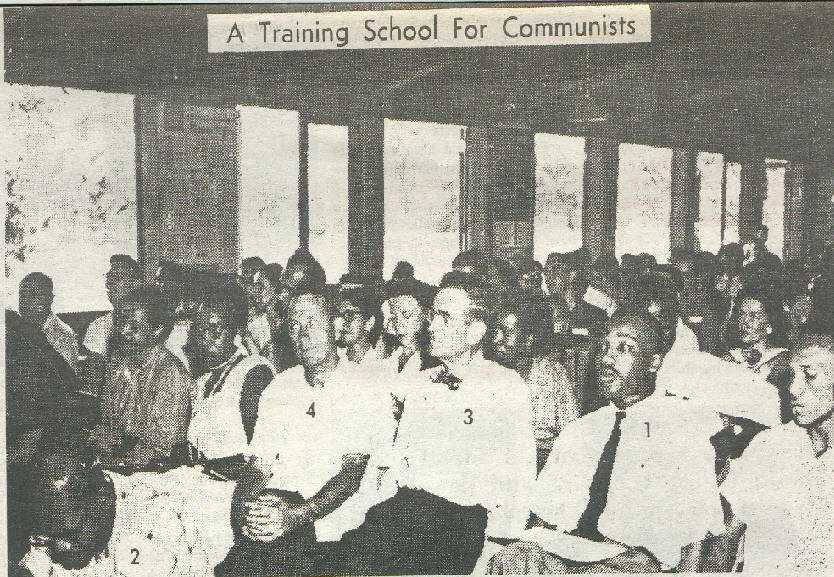
The teacher begins by passing around a postcard. On the postcard is this photo, which sears a brand into my brain:

king_jr-communist_school

I look at it, shaking my head in classic cognitive dissonance. The teacher begins (and ends):

“Students, your reading homework is an example of how textbooks lie. Martin Luther King, as you can see from the postcard, was a Communist and an enemy of the American people. You will do well to remember that. He is an enemy of the American people. Now, if you will return the postcard to me and get out your math, we will check that assignment.”

Wait! Not that other things he has done haven’t also smelled to high heaven (keeping me in from recess because I had said, “I screwed this problem up”; belittling fellows students who could not sing to his standards; threatening to call our parents but being too frightened to pull the trigger; taping a list of my regular offenses to my desk and asking me to put a tally mark next to each offense whenever I committed it–????), but this just feels—I am only 12, and an overachieving B+ intelligence at that—extremely wrong. My class numbers 30; I notice no one else looking bamboozled or otherwise uncomfortable. But I hold on to the feeling. I will wonder for years about what they were thinking.

The next weekend, I ask my mom to drop me off at the babysitter’s, aka the public library. I speed down the stairs to the kids’ section, and look up as many books on MLK and the Civil Rights Movement as I can find. I spend the morning and afternoon tearing through the pages. I am already reading relatively adult material, so I make it through multiple texts and notice what I am not yet able to identify as a consensus: Dr. King is not by any stretch of the imagination an enemy of the American people; if anything, he seems to be a fighter against the worst strains of the American “way.” In the midst of a blissful yet disturbing reading hangover—it will become one of my favorite feelings—I sit back, surrounded by three piles of books, and arrive at a different lesson than “Never trust a textbook” (I will get to that eventually, under more intelligent pedagogical auspices): “Never trust a teacher.”

I proceed to wreak havoc upon the teacher with imaginatively incorrigible behavior for the rest of the school year—except on those days when my mom is his substitute.

I am quite serious when I say that this particular experience with a horrible instructor was the first step I took toward the career I’d eventually embrace, however oblivious I was at the time. It was the beginning of a lifelong intellectual focus that shows no signs of ever letting up: social justice and “race” relations in the United States. It was incredibly important for me during my next six years of schooling—when for the first time I would sit side by side in a classroom with people of color, imperfect in my grasp of inequities though I was (and still am, but I’ll never cease working at it). And, all kidding aside, it gave me the opportunity to test myself against authority at a very young age; this man was very bad at his job, and I was given a real-life opportunity to confront badness and act against it, as opposed to just reading about it.

Lesson: Sometimes I think that the worst teacher I ever had just happened to be the most influential one I ever had. It’s the yin and yang, I suppose, and, though of course I’d encourage those of you who have bad teachers now to strive to comprehend their effects reflectively, I can’t help but remind current teachers to think about just what they might be remembered for–if this is what I vividly remember of that man 44 years later. It’s a scary deal, and it’s all too real.

Farewell Tour: An Appendix of Reflections

20 HIGHLIGHTS OF THE “THE RIDE”

(feel free, Overeem survivors, to add your own in the comments–I may have forgotten a few!)

1) First question asked by a student ever: “Mr. Overeem, what is a maidenhead?”

2) First check received: stolen out of my mailbox by one of my students and fortunately left intact when the student tried to cash it at a convenience store.
3) Screening of film of To Kill a Mockingbird to third class in a row, last day of Homecoming Week, 1988, while sponsoring student council: fell asleep in class and forgot to excuse kids to go to lunch. (85 hours at school in five days that week.)
4) Homecoming debrief, 1989: leaning back on my chair against my classroom chalkboard as we evaluated our performance, I flipped backwards and knocked myself unconscious. Woke up in nurse’s office. Thank you, whichever students carried me down there.
5) First live concert staged in one of my classrooms: F-Bombs, 2006, was it?
6) Most unexpected unexpected guest to my classroom: TechBackwardNine’s tour manager.
7) Tightest spot: showing High Plains Drifter to a class to illustrate the weirder influences of Shane, which we had just finished reading, I was surprised to note the entrance of the North Central Evaluation committee–right at the outset of the rape scene I had forgotten was in the movie. (I began yammering about Shane connections, backed myself to the VCR, and behind my back felt around successfully for the FF button….)
8) Wardrobe malfunction: John Steitz invaded my classroom, chased me around it, and I ducked under a table, where an exposed screw ripped my (Paisley????) shirt straight down the back. Message from the fashion gods.
9) Most pain caused me by a student: demonstrating a technique I had taught him, the son of CPS’ current chief academic officer broke my rib blocking me out in a game of recess roundball.
10) Most unique vomiting: Sarah Bacon, from laughing at me.
11) Most extreme pedagogical change of direction: deciding twenty pages and two days into The Red Badge of Courage that it would not work–and discarding it.
12) Another tight spot: being threatened with a knife by a ninth grader. All I could think to say? “Make your move.” He walked out and never returned to school.
13) First decent disciplinary idea as a rookie: allowing a volcanically-tempered but extremely gifted 9th grader to simply get up, leave the classroom, and walk around and breathe whenever she felt like erupting. Worked! Valerie Wood Baker (not the student in question) can confirm.
14) Second decent disciplinary idea as a rookie: tired of an annoying senior interrupting me during instruction, I told him, “Here–you teach.” I then moved back to his seat and yammered while he tried to figure what to do. Worked! Steve Patterson (THE student in question), if you’re out there, please confirm!
15) Favorite unit ever taught: mini-unit during an interdisciplinary “Culture” unit at Smithton on “Chuck Berry and America.” Kids had to write songs either in emulation of Chuck’s style or using Chuck’s subject matter. We sent the best songs directly to Chuck!
16) Least favorite parental interaction: A student was pulled as a result of #15 due to my description of Chuck’s verbal style on “Too Much Monkey Business” as “machine-gun delivery.” Pulled. From my class. For good. Because I “did not have the moral fiber to teach her child.” Thanks, Wanda Brown, for having my back totally during that conference.
17) Favorite thing I was ever turned on to by students: The Watchmen, when it was coming out in serial form (Kevin McCoy, I am eternally grateful for that and other stuff).
18) Chicken-skin moment: Watching Patterson Hood of the Drive-By Truckers dedicate “Buttholeville” to our club the Academy of Rock while playing at the Blue Note on March 30, 2005 (I know that song title makes it sound like an insult, but it wasn’t by a long shot). Tony Reda, standing next to me at the bar: “You’ve got to be pinching yourself right now.”
19) Stupidest coaching decision: violating every track record in the book by trying to pace Tim Cornell into a Smithton 1600 record by running alongside him (not on the track, at least!) during the final 110. Wearing an Elvis shirt. I think someone tackled me before I disqualified him.
20) Favorite coaching loss: Getting our butts kicked in a JV boys-vs.-varsity girls benefit game at Smithton (before a over-capacity crowd) after my guys had baited the girls continuously during school for the previous two weeks. Their coach, Shannon Gilleland, and I colluded on the notion, which raised money for Second Chance Animal Shelter, I think. Thanks, Reggie Hatton, for a) almost getting in a fight before the game; and b) losing the string that held your shorts up! We still would have gotten killed, but still! (Can someone find the Tribune article on that game? The accompanying photo, if I remember it corrrectly, reveals perfectly the mild panic I was feeling at the time…though I KNEW we would get our butts handed to us. The girls team went undefeated and destroyed EVERYONE they faced.)