December 2012

Day 74: I have been very lucky to work in the same building (actually, two of them) as my wife for over a decade, but outside of extracurricular activities we don’t often get to work together. For the last month, however, we have teamed up to “academically harass” a shared student out of a 44% into a 69%. The student made the last jump by composing a poem about an unnamed teacher who was holding her back (based on Milton’s style and content in Paradise Lost), which gave us mixed feelings, but…but…the things we do to see a senior cross the stage.

Day 75: All in one class, I have two students who cannot leave without an escort (due to their perpetually wandering ways) and one who has been truant for the last two weeks. One of the wanderers also has come off such a string of suspensions I have not seen her for over a week. They all showed up today and, predictably, once I’d “induced” the lesson and got kids rolling, each of the trio had legitimate reasons to need to leave (counselor, re-check a book, get a new book). These reasons are also popular ploys. I gazed deeply into their eyes (like Larry David in Curb Your Enthusiasm)–and validated their departures, despite having not fallen off the peach truck yesterday. They all returned promptly, having actually done what they said they needed to do. Willingness to trust against the odds? Naïveté beyond the call of experience? Avoiding a sure confrontation? Unfortunately, you have to roll some dice.

Day 76: Ran sound for and recorded the umpteenth HHS Poetry slam this afternoon. 30-some poets bared their souls and occasionally their wit. The Slam is one of the best things that happen at Hickman–many kids justifiably have stuff to get off their chests, and this event gives them a safe, artistic opportunity to do that. GREAT DIVERSITY OF PARTICIPATION, too–I’d venture as good as ANY event at Hickman other than a homecoming foo’ball game, and the diversity I’m thinking of is in the stands. Props to Poetry Club sponsors Diana Rahm and Brett Kirkpatrick (and MCs Adriana Cristal and Patricia DeCastro) for facilitating its success. Next one’s coming in the spring.

Day 77: Some days are slow; this was one of them. Though I taught about eliminating deadwood and wordiness in writing, introduced a class to the writing and music of Linton Kwesi Johnson, facilitated a discussion of social media with 12th graders, and advised (with shaky wisdom) a kid being troubled by lack of sports success, nothing sparked. My favorite moments were small: a very passionate student decided to speak truth to power, and a young English teacher whose work I’m very fond of suggested a new name for our school Curriculum Fair. I’ve always found the joining of those two words painful, and was cracking wise about it when Sam Kriegel said out the side of his mouth, “Cirque du Curricula.” That is a lovely vision, Sam.

Day 78: Though I swore to myself as a youth that I would never wind up in sales (no offense intended to anyone, just not my bag), in essence it’s what I do MUCH of the time. Case in point: I have a reluctant reader who, based on the two books she’s read and liked so far, seemed a good target for Felicia Pearson’s great memoir Grace After Midnight. Ms. Pearson played the charming and frightening Snoop in The Wire, and having gotten my student half-hooked today, and observing her nibbling ever so daintily while holding the book, I showed her the famous Wire clip of Snoop buying a new nail gun at a hardware store. Deal sealed. By the end of the hour, 20 pages read. One does what one HAS to do.

Day 79: A moment in our in-class reading and discussion sends me back, back into time. 1984. I arrive at my first teaching interview in Lebanon, Missouri, wearing a grey three-piece suit and maroon tie and driving a beat-up Renault I could probably have lifted off the ground. Viewed from afar, the tableaux already smacks of doom. I am on time–in fact, early–but I wait 45 minutes past my appointment time to be ushered into the AP’s office. In the 90 minutes (!) I sit still for the interview (I was not then nor am I now the sharpest tool in the shed), I am:

1) Encouraged to get married, and informed that some attractive single women teach in the system.

2) Alerted that only a few teachers STILL smoke cigarettes (at the time I learned this, I was dying for a chain of five).

3) Warned that, should I be seen buying alcohol anywhere in the vicinity of Lebanon, I would be terminated. (I am hoping he didn’t see the cooler in the back seat on his way into the office.)

4) Offered four SEPARATE preps (that’s teacher-speak for different courses you teach in a given day–normal’s two). Ninth grade English, 10th grade English, basic speech, and…see next #. Thank you, sir, can I have another?

5) Asked to sponsor the yearbook. Thank you, sir, can I have another?

6) Asked to assistant coach track. Thank you, sir, can I have another?

7) Congratulated on my being just the kind of young teacher Lebanon was looking for, and let know, that upon my acceptance, a contract would be in the mail, and I could be getting ready to teach summer school. Thank you, sir, can I have another?

On the loooooooooooooooooong drive across I-44 back to Springfield, enveloped in gloom, I imagine who–what!–I will become if I don’t get another offer. And 30 years later, re-reading this before clicking “Post,” I thank–with deep reverence–my methods prof and supervising teacher for making sure I did.

Day 80: Know-nothings saw many disparaging things about “today’s students,” mainly because they don’t get to watch them on a daily basis. I know one, for example, for whom “ethics” is not just a term to be written in one’s notes, or a concept upon which to compose an essay answer–for her, ethics are to be put into practice. And that’s where the game of life gets difficult–and where one finds that it’s a worthy one to play. This entry is for her.

Day 81: After many years of teaching Hamlet, I was delighted when a student actually SANG Ophelia’s lines in Act 4, extremely well, with no advance study of the text, and without my requesting it. That one makes the year’s Top Ten. Also, a reading student more than doubled his August STAR test score, but given the waxing and waning motivations of students’ approaches to such computerized assessments, I am not quite prepared to dance a jig. But…I am happy. Oh, speaking of happiness, we also traded “stories of joy” in Brit Lit (it was related to an extra credit question on a grammar quiz): they offered tales of perfect dates, escapes from bad family situations, attending anime and music festivals, and performing on stages, I replied with the stories of the first winning football game I ever experienced (after two years of no victories, against a Fayetteville, AR, team that was clearly Goliath–right, Shawn Baugh?) and the first (and only) winning romantic relationship I have ever known, courtesy of Nicole Overeem’s willingness to take a chance on me.

Day 82: I am almost always in a jovial mood at school, but today, as I entered my first class, my main man (and fellow pain in the butt, right, Andrew McCarthy?) Theo Howard said, noticing my glowering intensity, “Are you OK?” “Yeah, Theo–I just want you to do fantastic on this danged STAR test.” Honestly, I could NOT give less a hoot about electronic standardized tests, and I won’t bore you with the 101 reasons why, but I had offered the kids a less stressful final exam if they improved their scores, I had written some decent practice questions, and, by Jove, I was going to at least…FRIGHTEN some of them into caring. Well, it definitely worked with my second block–the whole class, aggregated, improved by over 10%, my most struggling reader improved by 250 raw points, and a scrawny little JD who just clicked through the test back in August almost doubled his score. I’m not beating my breast over this–all I did was provide an orderly space for reading and glower for four months, and they just came in and read every day. And many have good regular English teachers. Plus, after all–it’s an electronic standardized test, being excited about the results of which is like cheering paint for being able to dry. But, I have to admit, I am going to enjoy watching a few kids JUST READ A BOOK for their final, and have some donuts to boot.

Day 83: Things I got to do today—

1) read a blistering journal entry (that I didn’t even assign) where a student related a father-son struggle worthy of Hamlet and wrestled with race, class, romance, and self-image in a more powerful fashion that in any student writing I’ve read in the recent past;
2) tell my most-disadvantaged reader that, due to improved work on strategies and a jump of 135 points on a diagnostic test, she could just READ for her final exam;
3) hear a student tell me, with a SMILE on her face, that Yale had turned her down (their loss);
4) sell a student who just finished The Hunger Games series on Orson Scott Card (even though I am not a fan);
5) discuss William S. Burroughs and Captain Beefheart with two radio station kids–yep, Ken Shimamoto, 16- and 17-year-olds into Bill and Don!;
6) open a package to discover a vinyl copy of Professor Longhair Live on the Queen Mary, which I had forgotten I bought off some sucker two months ago;
7) eat one of Tranna Keely Foley’s daughter’s should-be-illegal chocolate-covered cherry cake fund-raising confections;
8) be greeted by former student and peach-fuzz-faced Ryan Pruitt as I was walking out of school at the end of the day–BEARDED and grinning, having survived a 20-hour semester (no wonder he hadn’t shaved)!
9) experience, with my students, a productive, safe, and reflective day of public education.

I am grateful for this job.

Day 84: The great thing about being a literature teacher that you don’t think about when you start teaching is having to, then wanting to, look at the same great lit every year, year after year. And often looking at lit you have been ASKED to look at that you don’t initially WANT to look at, that you grow into loving (for me, John Donne, Gerard Manley Hopkins, Lady Mary Montagu come immediately to mind). Today’s case in point: Hamlet. This has to be my 10th go-’round in the classroom with that text. We are steaming toward the final exam, which will require my “Brit Litters” to pose a thesis about the play and support it. We read most of the play together, but I made them read Act V on their own (really, that’s part of the final), and today, our last meeting prior to the test, I showed them the Olivier film version’s Act V for concreteness’ sake, and found my mind wandering to any number of current dilemmas that act ALONE touches upon, and opens windows of understanding to. Then on to what it says about the difficulty of facing evil while remaining free of evil yourself. About the too-frequent impotence of intellect and nobility in this tangle we are caught in. The second half of the period, students tested their theories out in a Socratic discussion, and it just made me hope at least a third of them end up reading the play a few more times, not because their theories were poor (not at all!), but because of how it can help them pull the veil back. Sorry that took a while. The rest (of the evening) is silence….

Day 85: Finals have begun at Hickman. It is definitely a quiet place as I type, with a sprinkling of students here in the media center hunkered down over projects, making final alterations. But I fondly remember my middle school tenure at Smithton, when the last days of the semester meant celebration, fun, and reflection. As my old buddy John Steitz (a fellow teacher whose also stalked the halls and paced the floors of both schools) always says, “I love middle school because their last semester’s memory of you is NOT you hitting them over the head with a 90-minute test.” Actually, I am paraphrasing because I can’t post what John actually said. Which I agree with even more.

Day 86: Ahhh, the snow day. We didn’t get one today(four finals worth of hell on the schedule, would have had to have been made up somehow), but I remember one special day when we did. I am probably the only teacher in Columbia Public Schools history to WALK to school, unaware that school had been cancelled. I lived four blocks away from Hickman at the time, arose at the crack of dawn as usual, noted the lack of snow on the ground, showered, dressed, chowed on brown sugar cinnamon Pop Tarts, slurped down some coffee, grabbed the briefcase, and headed out. 15 minutes later, I arrived at the east guidance doors and found them…CHAINED! Disappointed (!), I rattled them, and a custodian arrived on the other side of the glass and, curiously, drew his finger across his throat (lots of room for interpretation there). Initially, I refused to leave, but when he made shooing gestures, I turned to go. By the time I reached the corner of Wilkes and 8th, the sleet began to slice in waves across my face….

Day 87:

10 Things I Accomplished on 2012’s Last Day of School:

1) Survived both Mayan Apocalypse (I know, I’m arrogant, six more hours to go) AND first-ever Hickman All-Day Lock-In Closed-Lunch Final Exam Party.

2) Ate entirety of Leia Brooks’ bag of chocolate-covered mint Oreos (and I hate mint) in 15 minutes.

3) Thought very intensely about grading on-line HAMLET finals, and didn’t.

4) Gave away a bunch of great old cassettes to a student who still listens to them (Little Walter, John Fahey, MC5, and more).

5) Discovered Hickman student who both likes Lefty Frizzell and played guitar on The Phaggs’ “Pee-Pop” cassette (Spenser Rook).

6) Filled out CPS’ Exit Survey Questionnaire (but ignored the standard form and typed four pages in Word).

7) Avoided eating Tranna Keely Foley’s daughter’s sinful Christmas confections–white chocolate-covered cherry-filled cherry cake balls, if you’re curious–AGAIN, but bought two for radio stations kids. (The young Foley could be raising money for a cult and I still would have bought them.)

8) Thought very intensely about grading literacy seminar finals, and didn’t.

9) Wasn’t apologized to for the sixth consecutive day by the student (not even my own) who hammered me with F-bombs last Friday, unprovoked (I have been known occasionally to provoke, but, as Elvis as my witness, I was a gentleman in this case). Note: This does not count as negative because it’s humorous now; I was asked to tell the story at lunch yesterday, which allowed me to yell F-bombs in the lounge! Don’t blame me–it’s what my audience wanted!

10) Surreptitiously checked out four additional True/False Film Fest documentaries under my account for one of my doc-addicted students (student limit is two).

Hidden track: Conspired with Jim Kome to put Kewpie Internet Streaming Radio in motion before end of next semester.

Part One of Farewell Tour (Liquid Goo Stage) Complete! Happy Hollerdays! And now that the Mayans have eaten my shorts, the NRA can get started on my “fresh” pair.


PASSING TIME, PART 4: Brothanogood

Then

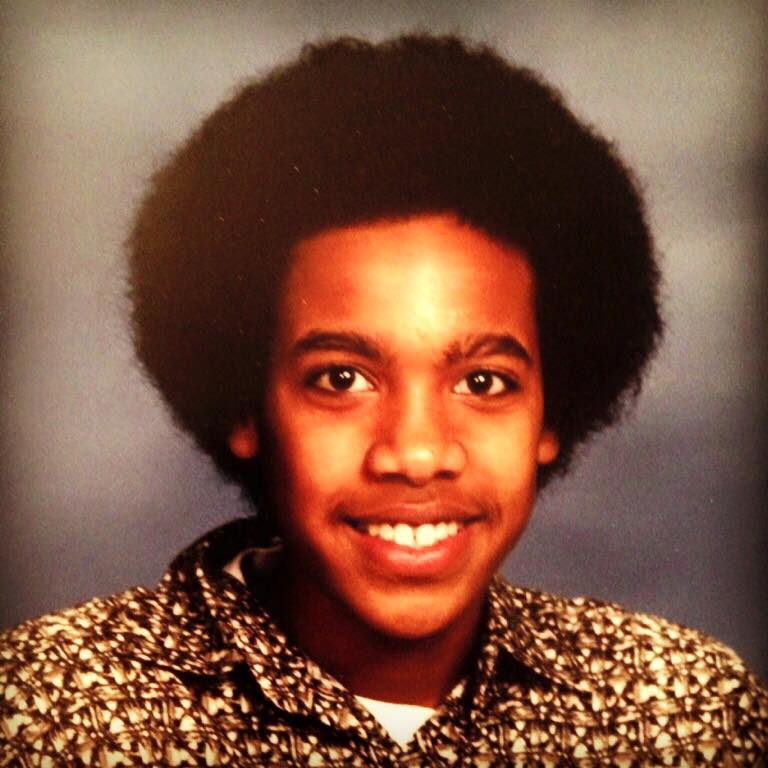
Brothanogood, back in the day

By the 2002-2003 school year, I had returned to high school teaching after an intense, rewarding, and embittering seven-year stint at middle school, and was having difficulty regaining my footing. Sixth and seventh graders are never short on energy and have little else other than school—cars, romance, parties, jobs, and serious athletic competition are, largely, in the future. Aside from being tired of a decade or more of instruction, not all of it imaginative, high schoolers are far more withdrawn and skeptical, and can withstand the most exuberant and creative attempts to motivate them. I was missing middle school kids sorely, and literally wandering the halls before school and between classes in a daze, looking for some kind of catalyst; I was putting out plenty of pedagogical energy, but I was getting barely more than a faint pulse of intellectual response in return. For the first time since my second year as a teacher, I was questioning how long I could stay in the profession.

Being a habitual early riser, I typically arrived at school about an hour and a half before classes began. Relaxing in my classroom, turning on some great music, and doing some informal meditation upon my daily goals were—and are, though I only work part-time—essential parts of my day. I could never have enjoyed the work as much if I’d shown up a minute before the bell and hit the ground running. But I was also restless, aimlessly taking laps around the hallways a few times a morning for no good reason. By the time a few weeks had passed, I’d noticed a somewhat unusual chap hanging around outside the business teacher’s classroom next door to mine. No self-respecting student showed up to school that early; no other student in the school (which normally pushed a population of 2,000) had a fully-blown ‘fro; no student I’d observed seemed so excited to see his first teacher and get started working. I made the mistake of inferring he was a high-gainer, and introduced myself one morning for gits and shiggles.

“Hey, man, what’s up,” I asked, affecting a cool-dude casualness.

His near-uni-brow arched almost to the base of his puff. “Excuse me?”

“Ah, never mind, man. I see you playing the wall every morning and thought I’d say hi since we will apparently be seeing each other every morning. No biggie.”

He stared at me as if I were an alien being. “Uh, I’m Joseph Fessehaye. Sorry, man.” He cautiously stuck out his hand, and I shook it.

After a brief chat, I learned he was a 10th grader (he seemed more together than that, though) and that, though he wasn’t a business nut, he rather enjoyed the teacher, Mrs. Thompson, and liked to visit with her as she was preparing for the day. I complimented him on his hair, and carried on with my morning preparations.

Over the course of the year, we talked almost every morning for a few minutes: about sports, television, school, rap and r&b, and race. The latter subject was an obsession for both of us, and, before long, we were kidding each other about the stereotypical traits our social groups had assigned each other: he quizzed me over arcane facts in the career of Billy Joel (I flunked), and I asked him why he didn’t have a Black Power pick in his back pocket (his coif was as meticulously sprayed solid as a Ken Doll’s). We agreed heartily on two things: the respective mastery of Michael Jackson and Richard Pryor. In fact, Joe, doomed to failure but destined to take his future classrooms down with him, yearned to ascend to the mantle of the latter. As for the former, I was impressed he never (and has never, to this day) tried to dress like, sing like, and move like The King of Pop. I don’t think I ever walked away from him that year without chuckling, and I encouraged him to take my American literature class the following year.

Why, oh why?

Sure enough, as the bell rang to begin my initial first-hour American lit class of 2003-2004, Joe had staked out a spot in the back left corner of the classroom, and would proceed to behave as if he were on The Hollywood Squares. When I saw him on my roster, I had hoped he’d help me anytime our discussion turned to being black in America (an unfair expectation, I know); instead, his goal was to launch at least one successful laff-line a class period, his Pryor influence exercising itself. Though his funniness percentage was a shade above the Mendoza Line—Joe was a 175-pounder—his habit did give the class a flavor my others lacked, and he maintained a “B” all year long. And I never had to move him.

What does all this have to do with my struggles? Well, I’d forged an enjoyable connection with a very unique kid, which had come so easy at middle school but at which I’d become rusty with older students. Joe was adept at making friends with everyone, so that led me to further student connections that would prove momentous. In addition, in class, he played that catalytic role I’d been seeking—not exactly to my specifications, but it was a start. Trapped together in a 7:45 a.m. to 8:35 a.m. class, our repartee at least kept things lively, which is a must when, say, a class is wading through the Puritan era or non-Twain realism. But most important to the return of my mojo and a major shift in his personal growth was what transpired after he popped into my classroom one day after school and launched this question:

“Do you think I should run for student body president?”

Um.

“You have the charisma, you have the connections, your Afro gives you visibility, we need a black president, but. Your other teachers are always asking me, ‘Are you having any difficulty with Fessehaye?’ And, uh—do you have any ideas?”

“Like what?”

“Well, you need a platform, and you need to be able to promise achievements you could conceivably pull off. As far as your behavior, you know, teachers don’t vote for student body president, but you would have to work with your sponsor and interact with the faculty.”

“It’s my understanding that’s just talk and no president really does anything.”

“So why would you want to do nothing?”

He looked at me like I was insane for asking that, then paused to consider.

“We could bring the school radio station back.”

“Not exactly a pressing political issue at Hickman, but, OK. Still, you really need to go think about this.”

“So are you telling me ‘Yes, run!’?”

“I am telling you ‘Yes, run!’” but I am not going to share any responsibility for disaster should it ensue. On the other hand, I want some credit if you win and do stuff. And I do think you could win. You gotta get your people out, and make a few splashes.”

On that we shook hands. After he left, I strolled down to the student council advisor’s room. Jami Thornsberry had really taken Hickman High School’s student government and energized it. Fundraising, entertaining assemblies, service—she’d taken it to such a high level that the organization was taken seriously by many students and most faculty. And, in the face of this, I pulled up a chair in front of Jami’s desk and admitted, “I just encouraged Joe Fessehaye to run for president.”

“Goddammit, Phil! Why would you do that? He can’t possibly win, but just the thought of the havoc that would result is making my stomach do flip-flops. I thought we were friends. You know he’s an ass.”

“He does have his moments, but that’s a little harsh. I just think he has untapped potential. He can lead, and given the chance, he might surprise us. And we’re a school that’s 25% black that hasn’t had a black president, to my knowledge.”

“Well, it doesn’t matter, because he can’t win. He’ll be lucky to come in third.”

He won. Shivers went up the administrative and extracurricular backbones of the school.

Joe walked in the morning after the results were announced and very humbly thanked me for giving him a push. I congratulated him, reminded him of our deal, and wished him luck. I’d gotten very informally plugged in, and helped something into being for a student. Jami swung by my room later in the day, stuck her head in, and looked daggers at me, but eventually forgave me. She was a pro.


I’d hoped to be Joe’s advisor-in-the-shadows during his 2004-2005 term, but I seldom saw him during the first half of his senior year. From the grapevine and the school newspaper, I’d gleaned that he wasn’t going the Nero route, and Jami hadn’t been by to complain; on the other hand, I wasn’t sure he was working on any legacies. One day, in late fall, I was grading after hours in my classroom when Joe blew in, clearly rattled, carrying some paperwork.

“Oh, so you need me, do you? What’s up?”

“I have to make a grant proposal to the PTSA tomorrow night. How do you write a grant?”

“Wait, what? Tomorrow night? A grant for what?”

“A new school radio station.” Ah—a legacy.

“Oh, no problem, we should be able to knock that out in, oh, about five days! What the hell were you thinking, waiting this late?”

“I’m a senior. You’re the only one who can help me.”

“Well, definitely not really, but let’s not waste time.”

For two hours, we scoured web pages for the materials we thought we’d need, neither of us knowing a thing about radio station equipment. Our theory was, if Joe’s grant could just persuade a fair amount of money out of the PTSA coffers, we could make adjustments later if the grant was actually funded. We came up with a $2,800 plan for an antenna, a transmitter, boom mics, a mixing board, cable, speakers, and some furniture, and printed off some merchandise web pages, and I sent Joe home to fill out the paperwork. I still can’t believe we were home by 7.

He drove me nuts the next day about what he should wear to the PTSA meeting and how he should speak to them—I think he was picturing blue-haired old white ladies, when in fact our group was a diverse, excited, generous and relatively free-thinking group—and I dismissed him with a simple, “Just be yourself. But no jokes.”

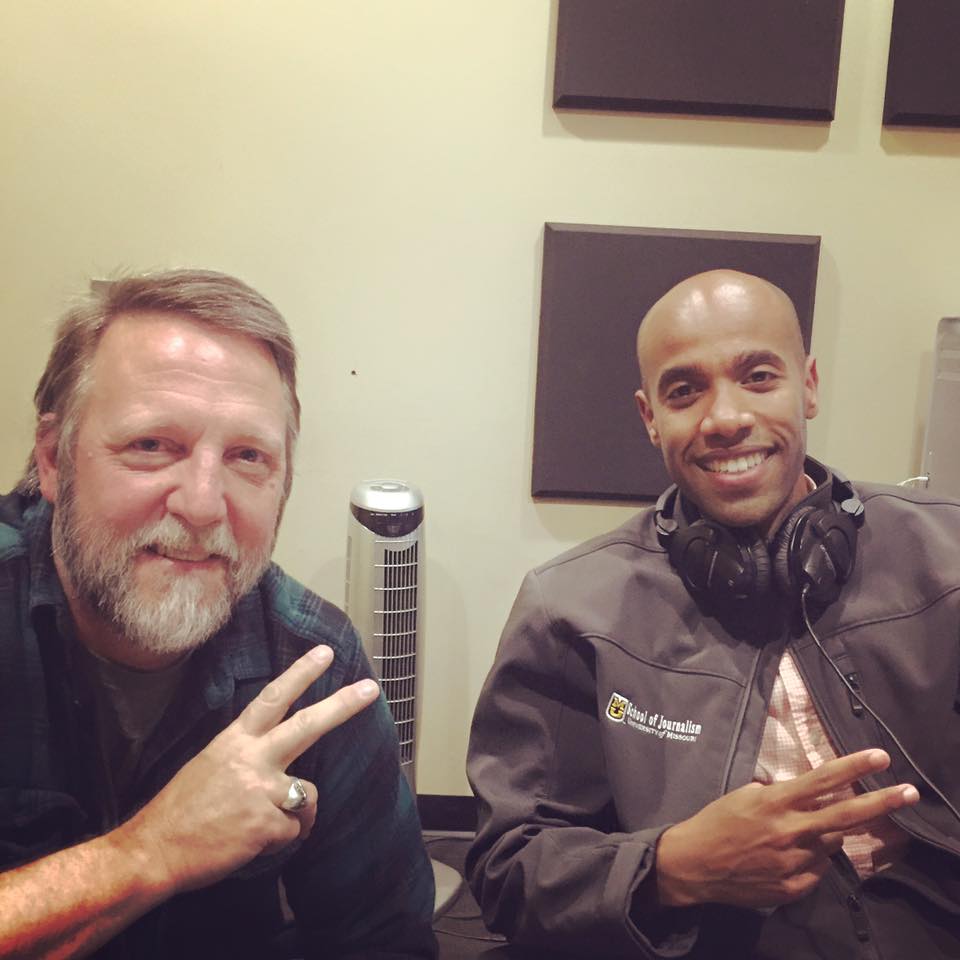
He convinced them to fund the grant. When he told me the next morning, I felt like busting the cap on some Moet, then remembered where we were and how old he was. I was still a little aggravated with him, but my payback was that it took so long to get the materials together and create the station (in a basement room that had previously served as the men’s lounge, the smoking lounge, in-school suspension, and one fondly-remembered janitor’s secret nap space) that, by the time we made our first broadcast in January of 2006, Joe was a freshman at the University of Missouri. We never did order the gold plate he asked to be inscribed with “Joe Fessehaye Memorial Radio Station”—I had to remind him, “Joe, you’re not dead!”—and nail it above the door. But it was, and still is, the location of student talk-show broadcasts, interviews, music programming, and rich conversation, as well as a brief escape from all that rat-race noise up in the halls. Joe has much to be proud of, but he did more than he knew: he helped me get back in stride professionally, and make it to my first finish line. Tonight, I am due as a guest on the college radio show he has hosted for years—now, as a Mizzou employee—and I am planning to read an excerpt from this encomium.

Joe and I, relatively recently, on the air at KCOU

Lately

November 2012

Day 56: The last time ’round with another sure-shot piece of early Brit Lit–Duchess Margaret Cavendish’s “Female Orations,” in which Cavendish creates seven brief theoretical orations that express the various outlooks women of the mid-17th century held about male supremacy. I assigned each oration to a different student, and after each reading led a brief discussion. Amazing that non-fiction so old and British could produce spontaneous exasperated laughter–and outrage. I tried to Google a text to attach…but all I found were “free essays” on the piece. Ah, the times.

Day 57: In this profession, you can feel completely ineffective, even unnecessary–then a student asks, while discussing a true crime read-aloud and a lawyerless teen in an interrogation room, “What if the teen can’t AFFORD a lawyer?” Even if the rest of the week is a yawning educational void, your response to THAT ONE might be worth a year’s failures. That wasn’t an abstract example; all “Farewell Tour” entries are guaranteed fresh and authentic.

Day 58: As a student, I DESPISED group activities–I just wanted to be taught by an expert, and when an expert wasn’t available, self-educate. As a teacher, I have consistently violated the well-considered dictum that what worked for me might not work for all, or even most, of my students–by studiously avoiding group assignments, other than one cursory quarterly wave in the collaborative direction. Of course, I have had to incorporate more group work into my planning this year, with 90-minute (as opposed to 50-minute) periods to contend with. And, also of course, I have not only started to like it (a little), but also get better at facilitating it–it helped that today’s lesson was on John Donne. A little late for an addition to the kit bag, Overeem.

Day 59: I created a hyperlinked guide through Brit Lit as I have been teaching it for future teachers at Hickman and Battle. NERD ALERT!!!!! (As if you didn’t know.) (I wonder what these unknown individuals are going to do with Linton Kwesi Johnson and Samuel Beckett’s “Ping.)

Day 60: I guess I have become a dyed-in-the-wool literacy teacher. First question at 7:46 a.m. (from a VERY smart but quiet kid I have taught for a year and a half): “Mr. Overeem, who’d you vote for?” Me: “OK, let’s practice inferring.” I think they reached an accurate conclusion without me uttering anything close to a direct answer and without me impugning the dignity of the runner-up–objectivity ain’t easy, or possible, really. However, we closed down the discussion, one of the best of the year, with an investigation into the wisdom of voting for someone solely due to their skin’s melanin content or lack thereof, and they reverted to looking at me like a pack of cross-eyed penguins. Keep ’em guessing–that’s what literacy is all about.

Day 61: Followers of the tour may recall a certain feisty reading class I have referenced from time to time (last mention was my meta-pedagogical near-mind-imploding walk-through experience). An unfortunate truth about the biz remains that sometimes, if a certain one or two are absent, a class’ core chemistry can be unleashed. That happened today. We had a BLAST: great post-election discussion and journaling (I saw actual brows furrowed during scribbling), productive partnering up for fluency practice (they had to do four read-aloud reps of their favorite ‘graph in the current independent reading book), and EXCELLENT final “recitals” to me. Then…they read silently all the way to the bell without trying to line up at the door. Lagniappe: Mr. Kelson Floyd getting to sample The Graphic Canon!

Day 62: Scrambling around unfocused as a result of not hitting the sack until 12:30 (see concert below), awakening at 5:30 to discover someone had attempted to break into our house, and arriving at school at 7:25 (not my usual practice), I patiently assented to allowing an MU Language Arts fellow who’s teaching at Hickman to OBSERVE ME right out of the gate. (“No” and I have as many issues as Molly Bloom did with that word.) Leave it to my packed-out band of ragamuffin lit seminar kids to do an expert imitation of an honors class and bail me out–led by yet another kid I kicked out earlier this year. Hmmm…maybe I’m on to something…maybe you HAVE to kick them out to show them you care? Nah. Surely not.

Day 63: Hey teacher friends! You ever done Socratic seminars? That’s where you get to sit back and listen to and think about student questions like this one, posed during today’s discussion of an excerpt from John Milton’s Paradise Lost: “In what way does Milton’s representation of Lucifer’s fall comment on, or parallel, Milton’s political experiences during the [Cromwellian] revolution and the restoration of the monarchy?” Then you get to hear the rest of the class change the subject! (Sean Brennan, I’m paraphrasing, of course!)

Day 64: After my first two classes today, I just needed about 20 minutes (our lunch allotment, when it’s boiled down) away from students to return to serenity. The Hickman PTSA being so nice as to serve us harvest burgers and pie in the media center (did you ever see the “Pretzel Day” episode of The Office?), I loaded up a plate and picked what I thought was an inconspicuous table at which to dine. It was not to be. Two students, including a son of a former student, turned on their instructor radar and sat right down with me. At first…I repressed a sigh and a roll of the eyeballs and attempted to send Garbo vibes–all of which were not received. But eventually, those two goofballs had me laughing, and I ended up more Zenned than I’d been if I’d gotten the solitude I had craved. Kids–it’s too bad they have to grow up.

Day 65: Sean Jarvis, I thought it couldn’t be done, but someone just topped your standard-setting Ian McEwan/Saturday independent reading project from ’07. I shared with her that, in my estimation, you had risen to honorable heights, and I am sure she will follow. It made me miss you, and her, and she’s not gone yet! (By the way, her subject was Brave New World.)

Day 66: Well, on the plus side, I had a nice mini-conference with a student whom I’ve taught for two consecutive years in reading who’s really turning into a nice human being, and a student who has trouble being interested in anything school-related told me he thought what we did today was cool (watched part of Errol Morris’ The Thin Blue Line). Down the ambivalent middle was actually filling out retirement forms in Jeff City. On the negative side, do you know what Gavilax and Bisacodyl are? I’d rather face Scylla and Charybdis.

Day 67: Shakespeare never fails to stir students. Seriously. I don’t think I’ve ever had a BAD experience (overall) with a unit on Ol’ Will, whom I’ve taught to grades 6, 7, 10, and 12. Today, in the midst of a reading and discussion of Act I of Hamlet, a student–perhaps the best writer I am fortunate enough to be teaching–spontaneously queried, “The quality of this writing is SO HIGH. Does he sustain it?” That’s one of those moments where you think, “If I could just lead them to a moment like this once an hour, I’d do this for free.” Or at least in exchange for food.

Day 67 (Revisited): Attended my first-ever Kewpie wrestling match–I did go to the state finals once with my dad–and saw one of my students slap a pin on his opponent to seal his status on the team! A nice way to spend a Monday night! (I left a little early, so I don’t know if the guy in the kilt did a demo afterwards.)

Day 68: Many rituals in this school biz, and one of them is the return of graduates to old haunts just before a hollerday. Some may ask, “Why would they do that?” but, in the school biz, we don’t get to see the finished product; we only get to hammer it a little when it passes our place along the line. So I’m glad that people like Kit Webster stop by to assure us we didn’t necessarily break anything–occasionally the dents are pounded OUT, rather than caused.

Day 69: People, after five days away, our vocabulary word for the day is one of my favorites. Logy (pronounced LOW-ghee) means “characterized by lethargy, or sluggish.” Today, it pertained to me; it pertained to four-fifths of my 3rd block and three-fourths of my 4th block. I do not know what my 2nd block was fed, but they appeared to have defied the law of educational science by being almost…academically perky. All they did was set me up for disappointment the rest of the day. Serious bright spot: a student who transferred from “the other school,” who has been a fantastic addition (thank you, “other school”), called the film adaptation of A Lesson Before Dying, which we saw a small chunk of, “cheesy”–then backed it up.

Day 70: Today’s radio station debate, stimulated by Mr. Brock Boland–Western-style education (“Help the student unlock the special inspiration inside him!”) vs. Eastern-style education (“Teach the student the value of struggle!”). And you thought all we talked about down there was Dimmu Borgir! Bonus props to ace DJ Ziggy, who at 17 loves KRS-One and won’t quit nagging me until I listen to his new album, which I will do now. Double-bonus props to the custodian who was moved to capture the aforementioned MC’s song “Black Cop” on his cell by using Shazam while we were playing it in the station–you know those guys and gals KNOW EVERYTHING!

Day 71: Those who have experienced my instruction know that I can launch a tangent of personal narrative from the base of a piquant literary moment at a moment’s notice. This is a weapon than can be used for good or ill, and I have had mixed success keeping it in the silo (and aiming it). In lit seminar today during our read-aloud, the introduction of a religious conflict between the main character (a backslider, to put it mildly) and his aunt (a true believer) triggered Defcon 1 and loosed the story of how the Sex Pistols got me kicked out of Mrs. Schull’s Sunday school class for good (I will leave that to your imagination). I feared the tale would destroy my lesson on an epic scale, but it set off a chain of several similar reminiscences from kids–and locked them in to the reading for an extra chapter. Seriously, it doesn’t usually work, and it IS always deliberate (though not always consciously so), but when it does–it’s fun. Bonus track: thank you to Daniel Johnston for reversing roles and encouraging ME in our shared battle with Hamlet earlier in the day.

Day 72: Much thanks to my former student from 1996, Helen Pfeifer, who, as a 7th grader, beautifully balanced academic excellence with joie de vivre and outreach to other kids, and who, currently, as a PhD candidate in history (15th and 16th century Middle East) at Princeton, is sustaining that balance, for visiting the radio station, enchanting the kids, and batting the old pedagogical ball around with her old teach. Good luck to you, though you always made your own, and don’t forget to recommend some Middle Eastern fiction to me! Ms. Pfiefer is just one of a particularly amazing Smithton Middle School class that also included Josh Parshall, Sam D’Agostino, Cale Sadowski, Anne Rodeman, the Facebook phenom known as Weird Danger, Nathaniel Taber Stebbing, Jackie O’Brien, and many, many other brilliant miscreants.

Day 73: A simple pleasure on a Friday afternoon with my reading class. We all read for 90 minutes–no one dozed–and I came away with this jewel, courtesy of George Eliot in Middlemarch:  “…what believer sees a disturbing omission or infelicity? The text, whether of prophet or of poet, expands for whatever we can put into it, and even his bad grammar is sublime.” Words for the wise….

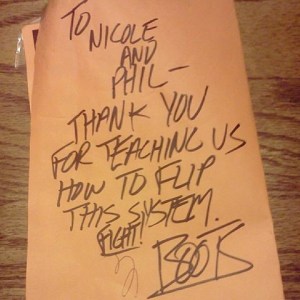
Boots Boots Autograph

Boots Riley signs autographs post-show at The Blue Note, and his personal missive to us.

PASSING TIME, PART 3: Rookie!

23 years after I started teaching, I finished a master’s degree in education administration with an action plan to increase teacher retention at my school. Though the main thing I had learned from my studies is that I did not want to be an administrator, the process of researching my action plan helped me realize that my mostly fun and exciting ride through teaching was not the norm. How did I not already know that? Well, for one, I wasn’t in the habit of hanging out with teachers—that can be trying after a long week of teaching—and, for another, the ones I was hanging out with really enjoyed it. Still, forced me to consider objectively the forces that were spinning (and still are spinning) young people out of the profession, I often wondered how I’d made it as far as I had.

Entering the profession is indeed a crap shoot. It’s hard to know how much you’ll love it until you have your own class, in your own building. Though both my supervising teachers abandoned me completely after watching half a lesson a piece—I believe they covertly “collected their data” (we didn’t talk like that then) through moles—today’s student teachers are probably oversupervised, which I’d argue doesn’t help with retention once they’re in the biz. I had always pictured what teaching would be like by putting myself behind the eyes of my best teachers, but then I tended to imagine looking at 30 students who were exactly like me, which was a monstrous distortion. From day one of my student teaching experience, though, when I introduced a Chaucer unit to a class of very jaded seniors, I felt more myself than I did in normal social settings (my buddy Ken tells me, “That’s power, man,” but I hope it was more complex than that). Classroom control, the thing all my cohorts in education at what was then Southwest Missouri State University were worried about, seemed a snap, though when I shifted to teaching 7th graders my last eight weeks I was forced to think harder, faster, and more imaginatively than I had wth 12th graders. Still, I walked away from the experience thinking, “Dang! That was fun and easy!” You will note that I had only been assigned two classes to teach, each of them with fewer than 25 students. Also, I taught at Greenwood Lab School, where there was reputedly a long waiting list mostly made up of professors’ kids. I had definitely not been put in touch with reality, and my methods classes hadn’t taken up the slack.

My first day teaching at Parkview High School in Springfield was, um, quite different. My first class opened with a local television station’s camera rolling into my room for a “first day of school” shoot—I had not been warned, but, in retrospect, I might well have been set up. Already nearly paralyzed with fear by the 33—33?—ninth graders confronting me, waiting to be entertained and possibly educated, I begin bleeding sweat into my grey three-piece suit; I felt like a 19th century British imperialist in the heart of Indian heat. I asked a student to pass out copies of my syllabus and turned to get a stack of To Kill a Mockingbirds off the shelf. The shelf was about seven feet high. Common sense having apparently flown from my being, I attempted to bring down a stack of 20 in one trip, which I did, but upon my head, as the stack immediately toppled. The camera still rolling and my students, who still had not heard me say my own name, giggling as politely as possible, I picked up the books from the floor in extreme panic and began sending them down the aisles.

“My name is Mr. Overeem.”

Rather less impressive an introduction than Eminem’s, wouldn’t you say?

Back then, teachers often got hard copies of their rosters on the first day of class. I hadn’t even had a chance to peruse mine, and, by the time I had crawled across the seventh-hour finish line, I was forced to come to grips with these numbers: 150 students. In five classes. 125 of them freshmen. Only my ignorance kept me from trying my hand at self-immolation; I assumed that what I had just survived was normal. I didn’t know I’d walked into the schedule no one else wanted, the schedule that traditionally awaited the “new meat.” Deluded in thinking that everyone had such a schedule, that this was the job, I put down the kerosene can and carried on.

I was also so absorbed with the challenge of just controlling so many freshmen that I had not fully considered some other unsavory aspects of my schedule. I’d been assigned two sections of 12th grade “Personal English”; any experienced teacher knows exactly what that euphemism means, but I wasn’t experienced: this was the last-chance class for seniors who’d already blown several credits and weren’t exactly the reading and writing type. (“Wait? You mean everyone doesn’t love to read and write?” Such are the thoughts of the previously self-absorbed when they embark on a career in public ed!) Sure, I’d inspected the materials beforehand: Forms in Your Future—that title is making me tear up in laughter as I type—the complete works of S. E. Hinton, a very thin Scholastic magazine delivered in the middle of the week, and—well, that was it. I had inferred from said inspection that that class would be “the easy class.” Silly, silly, silly boy.

Most disturbing was the amount of grading entailed in properly educating such a mass of humanity. I wasn’t calculating that accurately, if at all, because the homework of two classes (not taught concurrently, I might add) had barely interfered with my beer-drinking regimen when I was student teaching, and no mentor had suggested tricks by which I might reduce my grading load while still giving students necessary practice and holding them to a high standard. Then again, I never asked for suggestions. It was guesswork to me, and my arbitrary standard of eight full works of writing per student per year would carry to my final year of teaching, clearly demonstrating my taste for S&M. You do the math: 135 students a year x eight papers/writing-intensive projects x 30 years that you can’t really grade at school. The contract’s from 7:30 to 3:15, you say?

No choice was available but just to do it. In the opening weeks (though, actually, this phenomenon has never quite vanished), I was aided by the waves of sheer intensity, fueled by my fear, insecurity, panic, and nervousness, which I sent rippling out through the rows. I remember the eyes of front-row kids reflecting fear right back at me, which was fine by me. Fairly soon, though, my enthusiasm for literature and writing wedged its way into my attack—that’s exactly what it was. Attack, or be attacked. Within a few more weeks, I felt comfortable enough to crack the occasional joke, the earliest ones followed first by students exhaling with relief, then laughing. It helped, too, that my sense of humor roughly approximated that of a 14-year-old. However, just as I was beginning to feel that my teaching was actually working, serious difficulties began to arise.

My first paycheck was stolen out of my mailbox. By one of my seniors. He was caught trying to cash it at a convenience store about three blocks up from the school. Fortunately, I had enough Ramen to get me through the three days I had to wait to get my hands on the check; I’d taken a pay cut from the $880 a month I earned working in a cheese factory over the summer to the $865 that was my monthly teaching wage, and I was already running on financial fumes. On top of that, I was trying to figure out how I was going to keep teaching the kid. I went to my principal for advice, and she just shrugged and said, “Oh, he won’t be back.”

Not even counting the theft, “Personal English,” predictably, was not “the easy class.” These kids were rough as cobs. Initially, they would be attentive for my fancy set induction, then as soon as we moved to the real action, they zoned out. Before class and after class, they were quite friendly, but when it came to being asked to read and discuss a story or book, fill out a 1040EZ form, practice balancing a checkbook? No can do. And once they saw I was in quandary about what to do about that, they began ignoring my opening monologues, especially one student, Steve Patterson. As soon as opened my mouth to explain a lesson or begin a discussion, he would turn and start talking at party volume to the girl on his right. Like clockwork.

One day, I just lost it. Without any conscious consideration, I yelled, “Steve, you get up here and lead the lesson. Clearly, I am not making The Outsiders an interesting experience for you, and clearly, you must know everything Ms. Hinton has to teach us in the book, so you help us understand it and get better at reading it.” In retrospect, I can see why he—if not the entire class—might have been bored by the subject matter.

Brow furrowed for the first time in my experience with him, Steve replied. “Are you serious?”

“As a heart attack. I can’t do this as well as you can.”

I held out the book.

He scanned the faces of his peers, most of which seemed equally stunned, though a few others sported excited grins. “So I can get up and take the book and teach the class? I haven’t quite finished reading the assignment, though.”

“Don’t worry about that. You’re smarter than I am, so you’ll figure it out.”

He got up, walked up the aisle, took the book, and turned to the class with eyebrows raised. I walked back and sat in his seat.

He actually began. Or tried to. “Well—”

I immediately started chatting up his favorite listener. “So, how’s your school year going? Think you’ll graduate? Think Steve’s going to graduate?”

Steve looked up from the book in annoyance, our eyes met, and I became silent.

He continued. “So—”

“Um, what kind of car do you have? I have a Lynx. It’s pretty rad.”

“Uhhh, Mr. Overeem…can you let me get started?” I had to give him credit: he was trying. I admired that.

After a few more ritual repetitions, which I ceased when Steve’s pal asked me if I got high, I stood up, walked back to the front of the class, took the book from him, and asked him, loudly, “How’d that feel?”

“It was frustrating as hell.”

“Indeed. So, could you give me a chance to teach? You might be surprised.”

To this day, I cannot believe that gamble worked. It was barely even a gamble, as I had not calculated any risk. Steve went on to make As and Bs for me; he needed my credit to graduate, and got it. Though he didn’t quite reform, he was very enjoyable to have in class, and too smart (as I had suspected) to be in “Personal English.” We stayed in touch for many years afterward, and he even invited me to his wedding. Most important, since it was clear he was the sole leader in the classroom, once he gave me breathing room, the rest did, too.

The class remained difficult to inspire, but few failed. They brought in their actual 1040EZ forms in February and knocked them out. In a job simulation, they interviewed each other, then I interviewed each of them, then Steve interviewed me—and had to explain to me that he couldn’t hire me: I was overqualified. Balancing checkbooks? I am not sure they mastered that skill.


Despite the fact that my ninth graders were far more numerous—those three classes housed an average of 32 souls—I found them far easier to work with. I fed off the collective restlessness they radiated, and, being less jaded, they were far more fun. If I was excited about a lesson or a project, most of them would be, too—and since I was designing all my own lessons, I was purt-near always excited. They, too, however, presented obstacles, ranging from pebbles in the road to boulders. One day, as students were finishing the first test I’d given them and possibly feeling altered from the fresh duplicator ink fumes rising from the pages, I strolled up and down the aisles. A scrawny, scrappy kid named Andy Rittershouse was chilling to the max in the seat nearest the door, hands cupped behind his head and, like Huck Finn, “gapping and stretching.” Before him lay a completely blank test.

“Andy, you haven’t even filled the test out.”

“I didn’t have a pencil.”

He was serious.

I’d barely begun my first unit, a study of To Kill a Mockingbird, when I was presented with my first parental conflict. The school day had ended, and, as usual, I was slumped, totally drained, at my desk, staring into space that, while empty, still reeked of sweaty freshmen (my students and I would not enjoy an air-conditioned classroom until 1996—12 years later). Suddenly, a strange man strode into the room and up to my desk, glowering at me the whole way. He slammed a copy of Mockingbird down on my desktop, jolting me out of my catatonic state.

“My son is not gonna read this trash!”

“Come again, sir?”

“MY SON is not gonna get sex ed in his P.E. class!!!”

OK, now I was really confused. To Kill a Mockingbird, trash? Yes, well, reading is a very subjective experience. But, um, P.E.? Sex ed? I was thinking, “What the fuck, dude?” and standing on the precipice of actually saying it, when I realized, “Ohhhhhhhhhhhh. I am a man. No man with any pride would teach anything but physical education; all others are pussies. Ah, yes, I get it. He thinks I am a coach!” One puzzle solved, on to the more titillating one!

“Sir, I am not a physical education teacher. I am an English teacher. So, can you explain what you mean when you say, ‘sex ed’?”

He slammed open the book to a page he had bookmarked. Taking a pen from his shirt pocket, he began repeatedly underlining a phrase, exerting so much pressure that the pen tip was tearing through the pages. He turned the book toward me and said, with utter moral indignation, “Right there!”

Readers of Ms. Lee’s famous novel may remember that, early in the book, a new teacher at Scout’s school, Miss Caroline, has a tense encounter with a poverty-stricken student named Burris Ewell. Lacking the community wisdom to handle the encounter gracefully, she blows it, and Burris calls her a “snot-nosed slut.” Ladies and gentlemen, meet the offending passage.

“Sir, have you read the entire book?”

“No, I don’t have to. It’s right there in black and white!” And blue ink, for emphasis.

“Sir, the young man is not held up as a character for admiration. In fact, he’s more to be pitied.”

“I don’t care. My son will not get sex education at school. Period.”

“Sir, I can’t excuse him from the unit.” Out of the clear blue sky, just like the impulse that pushed me to ask Steve Patterson to teach The Outsiders, an electric jolt of problem-solving mischief was visited upon me. “However, I could assign him alternative reading, something with similar themes and style.”

“As long as it doesn’t have sex education. What do you suggest?”

“Have you read The Adventures of Huckleberry Finn? By Mark Twain?”

“Oh yes. That’s perfect. That’ll do. Way better than that book.”

Feigning disappointment, I blurted, “Oh wait, he can’t read that. It’s got the word ‘nigger’ in it on almost every page.”

“Oh, that word’s fine.”

Oh, it is? Just as I suspected. Not that I have any issue with Twain’s usage; you understand me on this, right? The imp of the perverse within me just had to see a little more of what this fellow was made of.

We shook on it, but, the next morning, when I explained to his son that I was assigning him an alternative book, I saw the face of heartbreak. If you teach, you eventually will.

“But Mr. Overeem, I love this book.”

“Your dad paid me a visit, and he doesn’t want you to read it, and I could not convince him otherwise. I can’t force the issue, because no one will back me up. But I did assign you a fantastic book, in fact, one of my personal favorites, and I’ll work with you on it independently while we finish up Mockingbird.”

“Do I have to leave the room?” This was uttered in abject fear—the fear of missing out.

“Of course not. If we distract you, though, you are certainly welcome to.”

“No, no, I won’t be distracted. I want to stay in here.”

“OK. Don’t worry—you’re gonna dig Huck Finn, and I’ll write you a great test.” Cold comfort, that.

So, as we finished the unit, the young man sat at his desk, pretending to read Huck Finn, but in actuality absorbing every drop of discussion and reading we engaged in as we moved through Mockingbird. Peering over the top of his alternative book, his eyes met mine about five times a class period, and it made me mad and sad, and worried for him.

After we finished the book and students took the test, I rewarded them for being very decent learners with a viewing of Robert Milligan’s screen adaptation. After I announced the event and the bell rang, I saw our young man still lingering in the room. He shyly shuffled up to the desk and, eyes on shoes, asked a question I had saw coming:

“Can I watch the movie, Mr. Overeem?”

I thought for a second.

“Yeah, but if you tell your dad—I will kill you.” The mid-Eighties were less sensitive times.

The kid sat so close to the VCR I thought the cathode rays would burn his retinas out. I don’t think anyone has ever watched a film so intently. I never did hear from Pap, and I have always wondered if our young man ever checked the book out later in life and read it on his own. I suspect and hope so.


Oddly enough, To Kill a Mockingbird was also the springboard for the most difficult problem I encountered that year—and it ranks with the most difficult I’ve ever had to solve in a classroom. In my most populated class sat a young lady who vibrated with tension. Blonde, troubled with acne, astoundingly gifted and naturally pugnacious—I had witnessed her thoroughly kick the ass of the class bully under the bleachers at a football game—she’d identified with Scout, the novel’s protagonist, and actually bought in to the class. She’d also, following with a heavy tread in the footsteps of her literary kin, found her way to the office multiple times by mid-first quarter (a few of them at my expense—and it was indeed at my expense). Julie’s nervous system featured many subtle triggers a mere greenhorn like myself could not divine, and I had an oaf’s tendency to trip one nearly every class. I would be sailing through a lesson, or she would be working (sometimes, not so quietly) on an activity, when, upon a mere guiding comment to another student or a mild wisecrack on my part, she would erupt, springing out of her chair by the window and spewing verbal lava in my direction. Sometimes, I later realized, she was perceiving an injustice I’d committed, and she was so acutely sensitive she may have been right; I blanch when I think back on some of the things I casually said and did when I was paying my dues. Sometimes, she was looking for an excuse to blow out build-up from her difficult home life. Sometimes, it was too quiet in the classroom and she felt an explosion was required. And sometimes, she just wanted to assert her existence. Trouble was, I had a class to teach, and, as classes will, this one was looking at me to seal up the mouth of the volcano. I could feel my ever-so-tenuous control slipping.

I knew I had to act, but I honestly had no answers. I’d tried everything: rap sessions, calls home, referrals to the office, incentives, classroom responsibilities, seating chart chess moves. I lost sleep dreading Julie’s next outburst, and, inevitably, it came. I was handing back a test and explaining the curve I’d applied—a curve that left Julie a mere point away from an A-. Her overall grade was still an A-; believe me, I’d checked, anticipating her dissatisfaction. Upon scoping her score and letter grade and absorbing my explanation, she informed me, and the class, in a serrated tone, “This sucks. You just made up that curve.” I patiently reminded her it wasn’t made up; I curved it to the class’ top score, so everyone benefited.

“Nope, it sucks, I got the shaft. Fuck this!” The F-bomb had made its first appearance in my journey, as it does in every teacher’s.

Breaching the cardinal rule of disciplinary engagement, I replied, as she sat there steaming, arms crossed, “It’s over. I’m done having to cater to your every whim at the expense of the other 32 kids’ education. Get out in the hall—I’ll be there in a minute.”

She flipped me off, spun out of her chair, and ran out the door.

After begging the shocked class to simply talk amongst themselves quietly for a few minutes, I headed out the door myself, having no clue what I was going to do now that I’d drawn a very faint line in the sand, and hoping she hadn’t just bolted for home.

To my somewhat ambivalent relief, she was waiting, red-faced, outside the door. The crimson shade was not wrought by shame; she clearly wanted to kill me. I inhaled—and winged it.

“Look, Julie, I love you, kid. You are smart, passionate, funny, and talented. You never miss a class and I’d miss you if you did. I know things aren’t easy for you outside of here, and that pretty much the whole world is pissing you off. On top of that, I’m not perfect. But seriously, this can’t go on. I am losing them just trying to keep you. And I have tried everything.”

I clammed up as a student runner zipped past us. And inspiration hit.

“So, how about this? What if, when you feel you are about to lose your shit [I have cussed in speaking to students in the hall—many times—because, sorry, it works like a charm in the right situations], you just get up, quietly walk out of the class, and just do a few laps, then come back in when your blood pressure’s normal?” I said this with the ease and matter-of-factness of one who had it all figured out.

Julie narrowed her eyes. “You can’t be serious.” Yes, I have heard that response many times in three decades, but probably more often my rookie year than any other.

“Yeah, I absolutely am. I know you could just leave the grounds. I know you could just go hang out in some nook and cranny in the building and not come back to my class. I know you could fake it just to blow off work or hearing me yammer. But I am going to trust you on this. I know you could get busted, but I am going to make you a permanent pass.”

“You are kidding me.”

“You think it’ll help?”

“I hate to admit it, but I think it will.” She liked me, but she really didn’t like me to win.

“OK. Starts tomorrow. Can you come back in and let me salvage the last seven minutes of class?”

“Nope, just let me stay out here and I’ll listen to you through the door.” I was just smart enough to recognize this as face-saving, so I went back in to finish class.

Next day: no blow-ups.

Day after: no blow-ups.

That Friday: stealthy exit, fellow students barely noticed, back in 5, raised her hand to answer a question (correctly!) that she hadn’t been present to be able to know.

And that was it. For the year.


Later, I realized that student runner had helped me subconsciously tap in to something buried in my memory: my great high school art teacher Howard South’s strategy of letting us go out in back of the art annex and take his sledge hammer to a stump when we became creatively frustrated. It had worked for me, though I was stupider and less volatile than Julie, and though it would also lead me to one of the most egregious and imbecilic acts of my high school career (more on that later). In this case, it sealed the deal between me and one of the best students I’ve ever taught. What’s more, it convinced me, finally, that I was going to make it to May.

October 2012

Day 33: My first two literacy classes chose A Rip in Heaven for their read-aloud, followed closely by The Color Purple. Also, I will miss supervising our school radio station, which is hidden in the bowels of Hickman, with the infamous “tunnel to Jeff Junior.” Today, Brock Boland and Isaiah Cummings, two peers of mine, and I debated the promise of a David Bowie memoir vs. a Neil Young memoir (Brock held for The Thin White Duke), and a young DJ who is taking guitar lessons got to hear this cranked up really high (for full appreciation) after our shifts were over: Memphis Minnie’s “Me And My Chauffeur Blues.”

Day 34: Some fantastic spontaneous moments–in the morning, two seniors whom I didn’t even know wandered into the radio station (where I was hunkered down grading during my planning time, and where they’d never been before–they were lured in by my “Pop Hitz” Spotify playlist), and we proceeded to discuss Hickman and the complicated wonder that it is, touching on class, race, history, “the tunnel,” and the Grupe-Frissell experience; in the afternoon, a great student who’d just finished Ian McEwan’s The Comfort of Strangers and was a bit gobsmacked came to me for some assistance, and I think I actually helped (I have not read it, so it was a challenge). Another spontaneous moment that was not so fantastic: only seven people showed up for my fourth block lit seminar class.

Day 35: You have not lived until you have seen Science Olympiad contestants lay their eyes on a new manual. That yelling people heard coming out of 135 was Ryan Wood gleefully reading the specs for the new builder’s event. In other news, Hickman flautist Michele Sun was introduced to Rahsaan Roland Kirk, Marielle Carlos laid her ears on Peter Stampfel and Steve Weber’s “Euphoria,” and the literacy kidz started A Rip In Heaven.

Day 36: Items crammed into 95 minutes of Brit Lit today…

*Plug for The Graphic Canon; also, discussion of the idea of “canon” with accidental cuss word escaping….
*Explanation of “Whirlwind Tour of Early British Lit” assessment (kids have to creatively emulate their favorite piece or author from the unit)
*Quickest political/cultural/spiritual overview of first British millennium in public school history
*Reading and discussion of “Caedmon’s Hymn” (oldest English poem) in three versions (Old E, Latin, Mod E)
*Enjoying of Richard Thompson’s stellar version of “Sumer is A-Cumen IN” from his “1000 Years of Popular Music” show
*Group work and discussion of Brit-Culture changes to be inferred by the space between “Caedmon’s Hymn” (7th century) and Carol Duffy’s “Prayer” (1990s)
*Speculation on possible U. S. epic (Huck? Wizard of Oz? Star Wars?) as lead in to…
*Intro to Beowulf and first few lines from Grendel’s appearance (2nd block only for the latter)
*Scattered jokes
*Enjoying of Richard Thompson’s stellar version of “Oops…I Did It Again” (see link) from his “1000 Years of Popular Music” show.

THAT’s what I want to do EVERY day. Right there. Why did I get it right out of the blue?

Day 37: It’s Friday. I’ve had 3-4 hours of sleep. It’s overcast and chilly. It’s an “A” day, first-block, nap-time situation. But no! They explode UNCHARACTERISTICALLY, OUT OF NOWHERE, with DEATH PENALTY QUESTIONS, and we haven’t even started reading A Rip in Heaven yet! An ultra-quiet young lady who hasn’t said ANYTHING all year rolls her eyes and hollers, “How could a country that’s anti-death penalty sell chemicals (thiopental) used for execution to a country that’s pro-death penalty?” I don’t want to stop the discussion (and, by the way, they voice both sides), but we have to read. I stop 20 minutes later, and a kid right in front of me says, “Just a few more paragraphs?” These are the surprises you never count on, and they will be deeply missed. (Note: the next class had no questions and no answers.)

Day 38: After 28 years of use with 6th, 7th, 10th, 11th, and 12th graders, I am retiring the following sentence, written by an actual student of mine who doesn’t know she’s legendary, which I have used to illustrate misplaced modifiers and the importance of precise comma use: “She is now living in Florida, pregnant with her aunt and uncle.” (I have never used the student’s name in conjunction with the lesson, by the way.) Soon to follow: “When my dog Baby died, the neighborhood kids balled in remembrance.” (What a wake!)

Day 39: I reflexively waved at a student I kicked out of class a little over a week ago, and she waved back and smiled. I say reflexively, because I did not intend to wave, which would have been a sign of weakness, which would have lent her the upper-hand in our psychological battle to the death in the classroom, which we cannot have on our Farewell Tour. Why am I so WEAK, so FRIENDLY? To quote Drake in Strangers with Candy, I wish I was smarter. Seriously, it was the highlight of my day. Leia Brooks, you know which student I am speaking of.

Day 40: Another weird Lit Seminar explosion, this time from the normally somewhat torpid B Day Core 4. I entered grimly, expecting our read-aloud of A Lesson Before Dying to be a blood-from-a-stone exercise in futility, and 45 minutes of conferences a series of grueling conversations. We started with a journal entry on the death penalty (same topic, different book from morning groups), and I asked a few folks to share. And did they! Then they took a right turn into incarceration inequities. Then a left into classroom inequities. Then another right into middle-school bullying. Then they drove across the median and suggested that, as the final seconds of class expired, we have a similar discussion at least once a month. They didn’t read, I didn’t read aloud, we didn’t conference, but they left happy–especially a kid who hadn’t shared all year and asked all the best questions. I received a $650 grant and taught a lesson in Brit ballads today, and those were second and third on the list. Sometimes you have to just…let go.

Day 41: If you will permit me a more abstract venture today, here are ten fears in no particular order of intensity that are associated with teaching on a daily basis that I will not miss.

1) Fear that nothing you did all day made any difference.

2) Fear that someone will actually act on something you mused about out loud and destroy his life.

3) Fear that you’re not as good as the other guy.

4) Fear that you’re not simply any good, period.

5) Fear that someone will expose you as a charlatan.

6) Fear that THEY have seen right through you into something hideous you either haven’t realized about yourself or about which you are in denial.

7) Fear that on this day, at this moment, you will lose whatever it is you had or thought you had.

8) Fear that the one thing THEY will remember about you in 10 years was the worst thing you ever did in their presence.

9) Fear that you’re not getting it all done, and getting it all done well.

10) Fear that you COULD have reached someone, but just didn’t take the time because it wasn’t convenient.

Of course, the joke’s on me, because they aren’t that specific to teaching. HAHAHAHAHAHAHAHAHAHAHAHAHAHAHA!!!!!!!

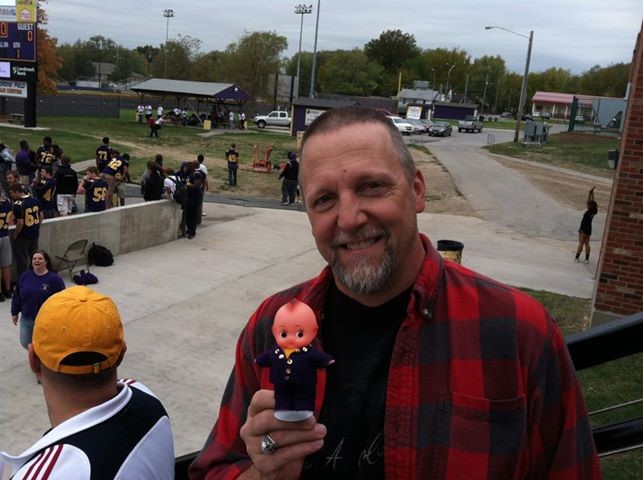
Day 42: In ’84 or ’85, a mere rookie, I won the faculty “Turkey Legs” contest at Parkview High in Springfield–I believe it was a fundraiser for Thanksgiving dinners for struggling families–and I was photographed wearing slacks, button-down shirt, and (horrors!) a tie. Today, I was pleasantly surprised to have been awarded the “Mr. Kewpie” spirit award at Hickman; truly, my spirit is dwarfed by not a few of my male peers. My garb today conveyed what prospects I thought I had: jeans, Chucks, a red and black flannel shirt (open) over a “Kurt Cobain” t-shirt–but no purple and gold. The ever-present shutter bug (and true Mrs. Kewpie) Terese Dishaw was there to snap a photo, so I guess I have my career bookends. But is what we find…devolution? Props to son-of-a-former-student Matt Matney for the photo!

Mr Kewpie

Mr. Kewpie, 2012-2013 Homecoming

Day 43: Some days, when the kids are lethargic (“lethargy” was a read-aloud vocab word in one of my classes today), your peers pull you through. I had a fantastic lunch with True/False Film Fest educational outreach heroine Polina Malikin, fellow English perpetuator Brett Kirkpatrick, and Nicole Overeem, the teacher from across the hall (among other things), and we plotted out the second installment of the True/False Hi-Def Academy, a program that involves students deeply in the art of filmmaking and the wonder that is the festival. I can’t wait to see which kids’ applications knock our socks off.

Day 44 (they are adding up quickly): I woke up on the wrong side of bed this morning, but was tickled by two incidents at school today. First, an office runner entered my room while my Brit Litters and I were listening to “Desolation Row” by Bob Dylan, and upon aural contact, she grimaced like she’d just smelled a fart. Second, immediately after school, I was witness to humor-ninja George Frissell North Dallas 40-ing (how ya like THAT verb?) our colleague Sam Kriegel. I don’t know if the humor of those two moments will translate, but I left smiling.

Day 45: After virtually assuring me they were going to hate A Rip in Heaven after its pokey expository opening, several students in my lit seminar class howled in pain when I stopped our read-aloud at the absolute peak of suspense….uh, just so we’d REMEMBER where we left off. If you are a former student and recall me having done this to you (my third favorite trick behind asking students, “I don’t know–CAN you go to the bathroom?” and constructing diabolical seating charts), LIKE THIS POST!

 Day 46: Hey, guess what? Chaucer is still relevant! Exploring the glorious Wife of Bath’s tale, Brit Lit had an uproarious time (both hours) discussing her warning never to point out a woman’s flaws–turns out a few of my students have learned it the hard way! Also, I was reminded of the first question a student ever asked me (Jessica Mee Kirchhofer will verify this) as I taught this tale in my very first student teaching lesson 30 years ago: “Mr. Overeem, what’s a maidenhead?” Apparently, some current students are still in the dark, though I am not sure the original interrogator was….

Day 47: It is helpful to remember, as I drag my fatigued carcass to the end of a work week, that, while today I am eagerly awaiting a music-filled road trip south to see my parents right after school, 29 years ago I would have been eagerly awaiting deep slumber by 7:30 p.m. on a Friday night. That’s far from a casual confession, as those of you who knew me at 21, who tried to pry me out of my apartment for hijinks, can attest.

Day 48: Another thing I will miss about Hickman is its distinguished tradition of excellent heavy metal musicians who are also scholars. This year, the honor goes to Sean McCumber and Daniel Johnston of Volatile, who not only shred, but give a damn about their work and studies. Sorry to embarrass ye, brothers, but ye deserve it. Step up on the pantheon next to Isaac Stickann!

Day 49: All teachers have a secret weapon or two in their arsenal for days when, for example, a school-wide test decimates a class to a quarter (or a fifth) of its usual size. For the last decade, one of mine has been a box set of Errol Morris’ intriguing First Person episodes, which force students to keep their eyes and minds alert and do some heavy inferential thinking. Today–maybe for the last time–I showed my two tiny classes what I believe is the best episode, “Leaving the Earth,” in which pilot and hero Denny Fitch recalls his experience being coincidentally thrust into the position of helping land a commercial airliner that’s lost its hydraulics at top elevation. The dang thing can be a life-changer.

Day 50: Sometimes, kids, you gotta get the heck out of Dodge. 29 years ago, The Replacements; tonight, Rosie Ledet, the Zydeco Sweetheart. Will return refreshed.

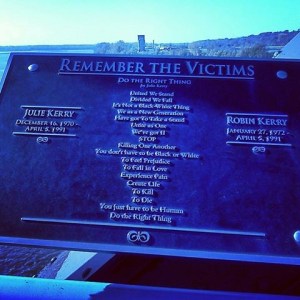
Days 51-52: Yesterday, as followers of this status may well have deduced, Nicole Overeem and I took a personal day and visited two sites in St. Louis associated with our educational experiences: The Pruitt-Igoe site (see The Pruitt-Igoe Myth by Columbian Chad Friedrichs if you haven’t already) and the Old Chain of Rocks Bridge (the site of tragedy in A Rip In Heaven, which my lit kidz are currently reading). We also visited Left Bank Books, where I successfully avoided buying new material for my stack. Today was a “slow news day” (other than a tale about our visit to Edgar Allan Poe’s home in Baltimore) but after school, we had a fun-filled dinner with my first excellent student teacher, Tasha Terrell, and her adventure-geared hubby Ryan Terrell. Mrs. Terrell made me realize I’d actually like hosting student teachers, and I’ve had four since her…though no way will I have one this year. But fellow teachers, you need to try it sometime.

Rip in Heaven Plaque St. Louis Bridge

Day 53: It was a between-the-lines day. The teachin’ and learnin’ were fine, but what was best were the conversations–with Isaiah Cummings and Patrick D King, about whether music is really losing its urgency; with Laurie Hoff, about the world’s largest pecan, Todd Akin signs, and medical insurance; with Arnel Monroe, about a mysterious football poem called “He” that we cannot locate n(help if you can!); with Sean McCumber, about the absurdity of the importance given standardized tests; with Michele Sun, about “twinkies” (not the kind The Candy Factory dips in chocolate, either); and with Nicole Overeem, about the worst scene ever in the series Treme that would have been a fantastic scene in Top Secret (clue: it involved the metal band Eyehategod). Now I am getting ready to get back to a book by Padgett Powell (You and Me) that’s one long conversation.

Day 54: You want theater? OK, I am reading aloud a passage from Ernest Gaines’ A Lesson Before Dying (set in 1948 Louisiana) in which a dying teacher tells the protagonist, his former student and also a teacher, that if he stays and teaches the local kids (who are destined for either SLOW death in the fields if THEY stay or QUICK death or incarceration if they flee to the cities), the controlling white culture will turn him (the young teacher) into “the n***** they want [him] to be.” The dying teacher is embittered from years of helplessly watching and enabling the vicious cycle; the young teacher is beginning to recognize that he is, indeed, enabling the cycle himself. I am reading the passage aloud to a group of students whose OWN futures are too uncertain, and who have their OWN cycles to cope with that I am none too sure I am effectively battling, and most of whom (I said MOST) are only dimly aware of the passage’s import. While I am reading the passage aloud, before I arrive at the word I censored above (but did not censor in my reading–I don’t do that) but after I have engaged the kids in some contextual discussion, the district suits roll in for a “walk-through observation” of about five minutes. The resulting situation was so meta- my brain almost imploded. Am I writing clearly? It’s hard to capture it sparely.

Day 55: Came to school dressed as Walter White, and was immediately identified by a honey bee and a French maid. Walter has come a long way. (Note: Hickman does an annual Halloween scavenger hunt where teachers dress up, and students have to get signatures from them on their master list of characters.)

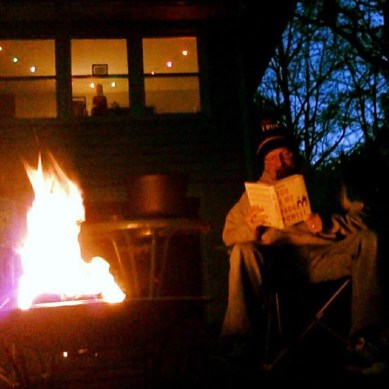
Halloween Fire


Halloween 2012: left, waiting for trick-or-treaters; below, aping Walter White.

Walter White


PASSING TIME, PART 2: Advice for Young Teachers

  1. Stay out of teachers’ lounges. They have a tendency to attract bitterly bickering bitter-shitters (I stole that from Ed Sanders of The Fugs) and student-bashers.
  2. The best classroom control technique is a combination of deep knowledge of your subject matter, genuine passion for your subject matter, and the ability to communicate how your subject matter changed you for the better to your students.
  3. Patience is a virtue.
  4. Respect your elders. If they are still in the biz and haven’t evacuated to an admin job or some educators’ rehab job, you have something to learn from them.
  5. Figure out quickly how to balance your life and teaching, which can become your life. If the latter’s what you want, fine—it can work. I would argue that continuing to have experiences without having to punch in your building security code will make you a better teacher, not least because they rejuvenate you and keep you honest. Teaching is a job that can always expand to as many hours in a day that you want to devote to it. It is a job that is never completed.
  6. Eagerly pay your dues. They will help insure your survival, and enhance your love and understanding of the profession. Volunteer for a couple committees and ask if a club’s available for you to sponsor. If one isn’t, create one around your own interests.
  7. Set a goal to be human in the presence of your classes once a day. Once a week might be fine at first, but “don’t smile until November” is a crock. You can be kind and challenging, warm and tough, encouraging and demanding. It takes dedication—then it begins to feel natural. All my best teachers and peers had that complex core, and I always tried to.
  8. Never forget why your own worst teachers were bad—and avoid their habits. It goes without saying that you should emulate your best teachers, but that’s more complicated—their power often derives from an external je ne sais quoi, and you have to figure out how to give your own wellspring air.
  9. I can honestly say I never suffered by admitting I was wrong or deeply misguided in front of a class. First of all, they will sense you are lying; second, they will relate to you. I can think of three situations, in fact, when my relationship with a student radically improved when I confessed I had wronged him or her. Heather Porter, it’s been many years since our extra-credit argument, but you won, and I am glad, because it made all the difference.
  10. Don’t think you can win a disciplinary showdown in front of a classroom. You can’t. If there is a way at all, sic the class on an academic problem and have a calm discussion with the unruly one in the hall. Goals: keep them in the class learning, and handle your own business. If you need a motivation, it’s that achieving those goals will gain you freedom to be trusted, which does not come cheap or frequently these days.
  11. Reflect daily. (I hope you will see the value in that by the time you’ve finished this book; reflection is really the secret.)
  12. Screw professional reading. Yeah, I said it! It’s bad for the brain and rots the soul. Read exciting books on your subject matter or your personal interests. I’ll go out on a limb and say reflecting on your practices on a daily basis is the most important tool in improving yourself as a teacher. Besides, 99% of those writers can’t write to begin with and aren’t even in the classroom anymore, so why waste precious seconds of life? (Exceptions: Jonathan Kozol and Alfie Kohn, but I am not sure the former writes “professional literature.”)
  13. If you don’t like your situation, get out and/or move on—there’s always a school looking for a good teacher. Don’t punish yourself, buffet your soul with pain, and become a martyr. As a great colleague of mine, Becky Sarrazin, once said to such a martyr’s face, “Climb down off the cross. We need the wood.”
  14. Abjure competition. No matter how great other teachers in your building are—and there will be some great ones—you will be able to do things they can’t. The difficulty is in figuring that out. Another thing: rather than sit stewing about how awesome they are and how much you suck, STEAL FROM THEM! It’s completely legal. All great artists are accomplished thieves, so you might as well hone that skill.
  15. It’s well worth the time and effort to learn about your students’ lives and interests. That seems like common sense, but the Herculean amount of other things you will have to do may distract you. When you know about their lives, you will understand the demeanor with which they enter your room (whatever their attitudes, they are seldom “about you”); when you know about their interests, you can more skillfully and honestly make connections.
  16. Look for the best in kids. And you may have to squint. Just remember the great things within you that your teachers couldn’t see and that you just couldn’t articulate.
  17. If you’ve made it this far without having developed a sense of humor about yourself, for Pete’s sake get started now. That lacking will lead to you being eaten alive, if anything will.
  18. Find a way to communicate weekly (at least) with your students’ parents. It’s simple now that we have email. Over the last decade of my career, I made a practice of sending out the coming week’s curricular overview, with some comments on the previous week’s activities. Though I mostly enjoyed talking to my students’ parents, that habit cut my parent calls and emails down to a trickle. Believe me, I found constructive uses for the saved time.
  19. Your administrators get their marching orders, too. It’s tempting to fall into an “us vs. them” mindset, but your building principals don’t have as much control as you think. You want to be a rabble rouser? You’re going to have to aim higher, and get your ass to board and teacher’s union meetings. I’m not discouraging that—it’s valuable as can be. Just make sure your aim is true.
  20. Be prepared to drink (or smoke—you may pick your own poison, child) heavily.


September 2012

Day 11: How ’bout this quote from a senior’s “Personal Statement” (on our on-line forum)? “This year, I’d be content with just graduating high school. My goal is to travel as soon as possible. College might have to wait. I want to fall into sticky situations, meet interesting people, eat bizarre foods, and disappear into a new landscape….” Cool, huh? Also, in the radio station, where interesting things are frequently happening and always talked about, Patrick D King and I discussed the mystery of the soul and the existence of Lincoln’s molecules, and that new transfer from Rock Bridge actually got behind the mixing board, opened up the mic, did a station ID, and intro’d…”Mama Said Knock You Out”! Knock ’em out, Justin!
Day 12:
Me, explaining how I approach a certain building secretary who can be rather intimidating (but whom I love very much): “I fall to my knees and ask, ‘May I address you?'”
Student (not listening very well): “Why would you want to undress the secretary?”

Day 13: Theodore Roethke, I bow to you and “My Papa’s Waltz.” I have used that poem what feels like a million ways in my career and it ALWAYS WORKS. ALWAYS. Today, it effectively helped 34 literacy seminar kids understand inference. Plus, I myself love it more every time I behold it.

Day 14: Overheard in the teacher’s lounge…

Stewart Johnson, speaking of a Texas high school’s football stadium: “I read in Sports Illustrated they are building a megatron.”

George Frissell, former Texan, not missing a beat: “But they have no library.”

Fortunately, I had not just taken a drink.

Day 15: Hands-down best moment–reading a personal essay authored by one of my literacy seminar students for another class in which he detailed his triumph over multiple heavy obstacles AND set EIGHT achievable goals for his senior year. Second-best moment–experiencing a creativity surge and designing a collaborative quiz in which groups in my Brit Lit class will have to project literacy criticism approaches upon a chunk of reading in Angela’s Ashes. Students, when the teacher says “This will be fun!”…DUCK.

Day 16: I do not like to linger over nostalgia or obsess over future speculations at a time like this–the moment is the thing–but I had wonderful reminiscences of my middle school sports experiences with Stewart Johnson and Pete Doll at lunch (particularly involving a certain gaseous initiation into the ranks of track coaching that is apparently quite common), and sat back in amazement as Brock Boland lined out my immediate post-ed future for me in specific detail (bringing a garage rock festival to Columbia). In student news, the interactive quiz worked, though it required a crash course in existentialism for two groups.

Day 17: Much for a Monday. You’d think administering diagnostic reading tests would be like having wooden wedges driven under your fingernails (for student and teacher), but they are often inspiring: the first eight kids I tested today showed measurable improvement over their last tests in the spring, and we had great conversations about how and why. Several are poised to be reading on-level, which is exciting (by the way, they haven’t been with me long enough for ME to have anything to do with it). Also, a student DJ with just a tad of training jumped near to the head of the class with a professional performance introing BOC’s “Cities on Flame,” The Clash’s “Stay Free,” and Elizabeth Cook’s “Camino” (only the last song was my suggestion). Also, solid feedback on our school’s rock and roll concert series that’s being facilitated by Michael Wesley Wingate and his co-conspirators at The Bridge. First show last night drew 30+ folks, and Odd One Down gave an inspired and rocking performance (thanks to future sponsors Bill Morgan and Brock Boland and former student teacher Vance Downing for coming out); next up, Volatile and a band to be named later, October 14! Finally, got to hang out with a fellow educator (Nicole Overeem) after school and watch an angering but informative doc about our economy, We’re Not Broke! I am grateful to have such days. (Sorry for the essay answer….)

Adriana

The author with Adriana Cristal, fellow Natural Child fan and T/F Film Fest Youth Brigade Homecoming Queen Candidate.

Day 18: My former student from eleven years ago, Neil lileazy Hayes, contacted me via Facebook to ask about some books I had asked him to/made him read when he was a sophomore, because he wanted to read them again! At the time, I couldn’t quite tell whether he liked them or not (he was a bit of a pistol), but now I know. Teaching = delayed gratification (if you’re lucky…but it’s so satisfying!) The books: Claude Brown’s Manchild in the Promised Land, Walter Mosley’s Easy Rawlins books, Nathan McCall’s Make Me Wanna Holler. If he were in class now, I’d be forcing some Chester Himes on him! In the latest installment of “B-Day Lunchroom Follies,” a certain educational philosopher-king was reduced to tears as we speculated about a Sunday Faculty Film Night double-header of Bang the Drum Slowly and Brian’s Song. Also, he could not regain his composure upon remembering this: “The National Lampoon did a brutal comic-book parody of “Brian’s Song” – at Brian’s funeral Gale glances at the now ex-Mrs. Piccolo, thinking “That fine lady’s gonna need some comforting tonight” as she thinks “I’ll ask Gale to comfort me tonight…”

Day 18 Footnote (well, I guess it’s a headnote): True story. I was teaching sixth grade at Smithton Middle School eleven years ago today and the news had broken (see Brittany’s post below for details). During my planning period, I was walking in a fog down the hall when, unsolicited, a fellow teacher barked at me, “We need to just blow their whole country up.” I walked straight out of the building, got in the truck, drove to Streetside, bought the brand new Dylan album “Love and Theft” and immediately stuck it in the truck CD player for my sanity’s sake. Driving around, I heard these lyrics creep out: “Well, George Lewis told the Englishman, the Italian and the Jew/You can’t open up your mind, boys, to every conceivable point of view/They got Charles Darwin trapped out there on Highway 5/Judge says to the high sheriff, I want him dead or alive/Either one, I don’t care/High water everywhere….” Bush would quote eleven of those words exactly not long after. Just chilled me. Still does.

Day 19: Every year, since I teach mostly seniors, I write a passel of letters of reference for kids applying to colleges. Today, I wrote one to Yale. It’s a strange experience: of course, you’re trying to represent the student in the best possible truthful light against serious competition, where, say, a 150 IQ and a 4.17 GPA might be the norm, but you are also very conscious of how YOU are being evaluated as a reference-letter writer. I ultimately said, “Screw it!” and just wrote it (it helped that the student is wonderful in a lot of ways)…but I did hold for tradition in the case of two supposedly defunct concerns: ending a sentence with a preposition and employing the subjunctive mood. *For late-breaking followers of my status: I am not going anywhere, nor am I ill; I am retiring from full-time teaching at the end of the year, and, in the case of the title I chose, I think like a rock fan, of course. But I will not be The Who, I promise.

Day 20: Fed students a dose of Angela’s Ashes, Jonathan Swift, and Richard Thompson. Last time I will ever teach “A Modest Proposal.” Gulp.

Dr. King

Day 21: Busted out one of the hoariest anecdotes in the old repertoire today to make a point to my reading class about thinking about texts–and questioning authority. The scene: social studies time in 6th grade at Columbian Elementary, 1974. The topic: the (few) paragraphs we had read about MLK (the first I’d heard of him–and I was hungry for more). The issue: our teacher passed around a photo of King at “American Communist Headquarters,” and pronounced that King had been an enemy of America. The resolution: I was dropped off at the babysitter (the Carthage library) at the next opportunity, went downstairs to the kids’ section, read everything I could cram in through my eyeballs about King, and, for the first time, realized I couldn’t trust my teachers. I’ve always wondered about the rest of that class….

Day 22: Pressed play on The Third Man (installment one in the course’s “Great Brit Films” series) and mentally ducked, knowing how atmospheric, dialogue-heavy, and relatively action-free its first 70 minutes are. Could it flop? Yes, it could. It definitely could. And it might have, but at least one kid–a kid’s who struggling academically–totally dug it and was all over the brief Q&A we had after Part 1. Another kid looked me in the eyes and quietly nodded, “Yes.” We ended today’s segment with this shining, mischievous moment:

 Day 23: A simple tableau. At the end of my second block literacy class, I got up to do some closing instruction with 10 minutes to go–usually the exact time they’ll start zipping up backpacks and looking at the clock–and, to a one, they were SO buried in their books I crept back behind my desk and let the bell shock them back into reality. A gem of a group.

 Day 24: A bittersweet revelation. I feel like I am teaching better than I have since my middle school days–and it seems solely because I am RELAXED and doing just what I want to do (as usual, the same ol’ lit-writing-music-film combo with a Brit flavor, but I am feeling no guilt about “enrichments” and just executing ideas with no self-fuss). I am enjoying myself so much that 95 minutes a class is not enough. I need more science between my ears to be having a similar experience in reading, but why did I wait until Year 29 to relax? I confess, I have often felt it an impossible state to achieve. But it is good to me. I hope that it continues….

 Day 25: Five minutes left in class. Me: “Let me tell you about the time I was kicked out of an assembly for heckling a magician–” Them: “WE HEARD THAT ONE!” Me: “How about when my best friend and I got kicked out of school for a day for fighting each other and went fishing the next d–” Them: “WE HEARD THAT ONE!” Me: “Uh, the time my kindergarten teacher pressed my face into her ’emergency’ drawer of little girls’ panti–” Them: “THAT ONE, TOO!” Me: “How about when I told on a kid for just scribbling during cursive practice and he proceeded to kick me in the nu–” SAVED BY THE BELL.

Day 26: I will genuinely miss observing moments such as my third block Brit Lit Socratic group provided today as they discussed the implications of a very delicate and complex subject in Angela’s Ashes: Frank’s sexual coming of age. They spoke with dignity, understanding, and intelligence that the non-education world often assumes are NOT the provinces of the young.

Day 27: No kids today. Therefore, I shall list the 10 things I love most about Hickman High School:

1) We are a microcosm of the world, in a lot of ways. And if you get through three years here, you will have learned something AND found kindred souls whether teachers help or not. No one has an excuse for not finding someone cool at this school.

2) We have the sharpest, hardest-working danged staff I have ever worked with. And they’re a nutty lot, to boot.

3) We have a class called “Classical Ideas and World Religions,” taught by the most highly evolved human I have ever met.

4) You can check out a Minutemen CD from our media center.

5) We have housed the most Presidential Scholars in our history of any public school in the country.

6) The principal has arranged for the faculty to make the calls on numerous important occasions. I bet she’s held her breath a few times, but I doubt she’s regretted it. Much.

7) My wife works across the hall from me. Directly.

8) We can beat ANY school in the nation over its head with our multiple clubs, from Gay-Straight Alliance to Philosophy Club to T/F Film Fest Youth Brigade to Zombie Defense League.

9) We have such support, through labs, the Success Center, special ed resource, essential skills, ELL, and a terrific and versatile guidance department, that your problem better be darned tough not to have a chunk taken out of its ass by our support personnel.

10) Nobody messes with our main office secretaries.

Nicole and Phil and David

Front to back: Nicole Overeem, the author, David Truesdell, on the beautiful Eleven Point River

Day 28: A few weeks ago, a kid got added to my second block literacy class (you’ve heard a few stellar reports from there). I was a little sensitive about it, because my lit classes are bigger than they should be, I’d worked to get that one in shape, and I’d already gotten two adds earlier that week. It didn’t take her long to flash (what I thought was) some attitude, and being cranky, I took her outside and growled at her, as is my wont. Well, turns out she just has that look on her face–it ain’t attitude at all, she’s just quiet and has a slow-burn appearance–and she’s outread almost everyone in that class in half the time they’ve had to read. With an extra-credit reading report turned in, she has a 106.5%. I goofed. Fortunately for me, she was graceful in accepting my apology.

Day 29: The plan WAS, go over items coming due, remind them of some neat resources, help a student by promoting the school “Read Banned Books” campaign, introduce the Brit song (“Watching the Detectives”) and poem of the week (Dame Edith Sitwell’s “Still Falls the Rain,” a dandy), then debrief on our Angela’s Ashes Socratic from last week. In my mind, all but the last item would take 10-15 minutes (typing it out, I see that was ridiculous), then I would spend 30-40 minutes on the debrief. All was going smoothly, until said student asked me about censorship. 30 MINUTES LATER, I finish three real-life stories about problems with To Kill a Mockingbird, The Catcher in the Rye, and “Giggle”mesh (inside joke). There goes the lesson plan. I am going to miss these kinds of days, though I suspect this one shan’t be the last.

Day 30: How Not to Do Things, Part II. I was really excited about the lesson I was presenting today. We were going to practice inferencing and visualization with the text to the short film I have linked for your enjoyment; the text includes no description of the speakers or the setting, so the reader’s forced to have to visualize imaginatively and infer constantly (then we look at the film to compare). Of course, two 17-year-old boys not too different from the kind I was had to be jackasses from the git-go, and, after taking one of them out in the hall to just get to the bottom of things, he forced me to send him to the office by refusing the openings I gave him. So, I walked back in, started over–more jackassatry. What do I do? This–to the whole class, in (early) Eastwood Style: “OK, let’s just get this over with right now. You have a problem, I want to take care of all of ’em NOW so I can teach. Anyone?” A kid gets up and walks out, muttering, “I don’t need this sh*t!” And, in a way, he was right.

Day 31: A hard day to reflect positively, but…here goes. I have been grading papers digitally for the first time (fun–but the enjoyment is doubling the time), and ran across a very nice one that sent me back, which student essays will often do. The kid wrote about being overconfident and failing his driver’s test–in the parking lot after returning from the drive! I had to mention in the comments that I failed mine, too. Twice. I purt-near had to be talked into even learning, totalled my first car a month after finally passing my test, and hit a pedestrian and sent her to the hospital (and later got sued by her) shortly after that. So it seems I still ended up sounding a negative note–but the point of good writing is connect with the reader and make him reflect. Well-done, student who is brother to former student of mine who used to drive him to school all the time…

Day 32: It’s a weekend, I know, but I’ve not been able to get school off my mind (tough day Friday), so I’m-a do one of these for therapeutic purposes. First, Banned Books Week’s coming up, and I’ve linked the American Library Association’s list of “Banned and Challenged Classics.” If you aren’t reading anything, I challenge you to just grab one off this shelf. Second, here’s a list of books (plus one outlier) I have had censorship “incidents” with since 1984: To Kill a Mockingbird (by Harper Lee), Angela’s Ashes (by Frank McCourt), Disgrace (by J. M. Coetzee), The Catcher in the Rye (by J. D. Salinger), Lolita (by Vladimir Nabokov), and a meticulously hand-selected set of lyrics by Chuck Berry. I am probably forgetting a couple, as well. Keep your mind out of cages, whether they are made by the forces of order or your own “hand.”

PASSING TIME, PART 1: The Violence of Chuck Berry

Chuck

I have taught many unusual lessons in my career. This one was not only successful (though even the best lessons are only partially so), but its history also incorporated a lot of the best and not a little of the worst of this profession.

I was teaching middle school at the time and was graced with a bunch of seventh graders who were game for anything interesting I proposed. They would go on to make me look great many, many times that year. In this case, their lesson grew out of a screw-up on my part.

Striving to realize our school’s challenging goal of integrating curriculum, our instructional team had tried to design an opening unit focusing on the idea of “culture.” For three weeks, each teacher—math, science, social studies, reading, writing, and special education—would design his or her instruction so that it addressed that common theme, with the unit output being a single assessment of learning, as opposed to five separate tests. Theoretically, it still sounds neat to me—in fact, it drew me away from my previous job just for the chance to try it. In reality, it’s a bitch to pull off. Just trying to talk about it caused my first teaching team to implode.

At this point in my middle school tenure, however, I was surrounded with comrades willing to give the idea a shot. We planned our culture unit very meticulously, and, of course, I, likely the most enthusiastic among us, zipped through my part of the unit quicker than necessary, quite possibly leaving a few students in the dust in the process. So, confronted with an additional three lessons to write before my fellow teachers were finished, I decided to give the young’uns a dose of Missouri culture and rock and roll, as well as an opportunity to be creative.

I have often said, only half-joking, that I teach to subsidize my record collection. But I have always reinvested what I’ve gained from music in the stock of U. S. public schools’ pop culture curriculum (even though that exists only in my mind), and, in this case, I thought it would be valuable for my students to study how one great rock and roll writer reflected his rich and complicated culture. I prepared, with one eye on Fair Use guidelines, a handout highlighting some of Mr. Chuck Berry’s most revealing lyrics (“Brown-Eyed Handsome Man,” “Too Much Monkey Business,” “Sweet Little Sixteen,” and “Back in the U.S.A.” among them), prefaced the lyrics with a quick artist bio, then guided the class through some close-listening of his music. As we proceeded, I led the kids in discussing what we had learned about U. S. culture circa 1955-1964, and advised them in taking a few notes. Then, over the next two periods, we put our shoulders to the wheel of the task: either write a song of your own, reflecting current U. S. culture, in Chuck’s style, or write a song about Chuck’s version of U. S. culture in your own style.

We had a blast, and, I must say, their work was very perceptive, witty, and—what do you know?—indicative of their having learned some valuable things! A couple students even brought guitars and played their songs. What we’d done leaked outside of our classroom (not surprising, in that my classroom was open to the hallways!), and we soon learned that our homeschool communicator’s college roommate had been Chuck’s lawyer at one point—and had his phone number.

One of the kids excitedly blurted, “Hey! Let’s send Chuck some of our songs!” You don’t say no to such a proposition, and soon the ex-roomie lawyer was on the horn to Chuck, asking him if he’d be up for reading some 7th graders’ tribute-songs to his bad self. Almost immediately, we received word back from Berry: send them on! We did a quick read-around, whittled our stack of 150 songs down to the best 30—we didn’t want to swamp ol’ Johnnie B. Goode!—slid them into a “vanilla envelope,” and put ‘em in the post. I didn’t really expect to hear from Chuck again; one of my long-time philosophies regarding ambitious enterprises is to expect absolutely nothing, which intensifies the exultation if things work out.

The next thing that happened was not a working-out.

A week after the culture unit’s conclusion—it worked nicely, but we were never to replicate its success beyond squeezing a birds-and-the-bees discussion into a “plant life cycles” unit—came our school’s “Back to School Night,” a late summer public ed staple during which parents are invited to meet their students’ teachers. These evenings usually prove a bit of a dog-and-pony show on our parts, but they are seldom high intensity, and, though the parents who most need to come don’t (usually they can’t—they are working), we usually at least mildly enjoy the opportunity to communicate to the grown-ups what we’re up to.

I didn’t expect to be called to the principal’s office. Via intercom.

When I stepped into her office, in front of Dr. Brown’s desk sat what I presumed to be a parent. On the parent’s lap lay her daughter’s English folder, open, with the Chuck Berry handout removed and unmistakably on display. I thought, “Oh shit—she’s a journalism professor and she’s got a copyright complaint. I knew I should have picked up those handouts after we finished writing!” I stood at attention, ready to be, perhaps justly, upbraided.

“This man does not have the moral fiber to be teaching my daughter!”

I take copyright seriously, but, well—wasn’t that a bit strong?

But this wasn’t about copyright. I could not have possibly guessed what it was about.

Remember that “quick artist bio”? I know what you’re thinking: no, I did not mention Chuck’s Mann Act scrape and accompanying prison stint, nor his naked photos with equally naked groupies, nor his tax evasion escapade, nor his exploits with video technology. Nor did this mother look those biographical tidbits up. (All idols have feet of clay, anyway.) Her concern was this: I was promoting violence in this unit.

She said that. Yes. And it was in the bio ‘graph I had written, branded into my memory since:“Berry’s machine-gun lyric delivery in songs such as ‘Too Much Monkey Business’ (see below) influenced none other than Bob Dylan, one of this century’s greatest songwriters.” She read that aloud, from the handout, to my principal and me, with supreme confidence and righteous indignation, as if it were irrefutable proof I was a warlock.

Wait—what??

Actually, I think that is exactly what I said. I looked at Dr. Brown—an excellent administrator I had purposely followed over to this particular school, and a human whom I was desperately hoping valued loyalty at the highest level—and stared in disbelief. The mother stood, read the passage aloud again, and punctuated it with this outburst: “It says right here—‘machine-gun lyrics’!!!” (As you can see above, it didn’t quite say that.)

I confess to being a lifelong smartass, but my reply was simply self-defense: “Do you understand figurative language?”

“Don’t try to slither out of this!” At that moment, I was the closest I have ever been to deeply understanding Kafka. And “slither”? Really?

Keeping my far eye pleading with the principal and my near one defiantly on my judge, I patiently explained the point behind the lesson. No sale.

I looked directly at my boss and said, in quizzical defeat, “Well, you could move her daughter to another team.”

The parent exploded. “She’s not going anywhere!”

I was stunned. I reflected for about an eighth of a second and said, to them both, “This is ludicrous. I have sane parents to speak to. Do what you must. I cannot explain more clearly what my valid and very moral intentions were. Goodbye.” Turned on my heel, went back to my class, and pictured two die spinning through the air.

That absolutely wonderful administrator, Dr. Wanda Brown, refused to budge in giving me full support—that’s one of the reasons why she still hangs the moon for me. The parent pulled her daughter from regular classes for homeschooling (I am sure, much to the daughter’s embarrassment), though she continued to send her over to us in the afternoon for French classes (that’s bullshit, if you ask me—you teach her French, lady). In spite of the whackiest—and wackest—parental guidance episode I had ever witnessed in my career, I proceeded to have a better year than Frank Sinatra’s in the song. The story of the Chuck Berry unit, however, had not yet concluded.

Spring. That lovable homeschool communicator rolled into my classroom—he did, in fact, roll—and motioned me over.

“Chuck’s coming to play at a local high school next week. [He lives in Wentzville, Missouri, just down I-70 from Columbia.] He loved the packet of songs, and he’s authorized you to bring over the ten student writers you think would get the most out of hearing and meeting him. I’ll take care of the bus.”

As the generation of teachers prior to mine would have exclaimed, “My goodness!” (That is not what I said; I repeated the title of a well-known Funkadelic title exclamation, but my moral fiber is too strong to repeat it here.) Though selecting the ten students proved an exercise in pure agony, we were soon filing into the choir room of the local high school, where the kids were given a front-row seat—a mere five feet from the man himself, at that moment swiveling on a stool, his guitar on his lap.

My natural high was so intense, I cannot remember much of Berry’s talk, other than that Chuck gave rap lyrics his seal of approval (good man, and my kids beamed). However, when the afternoon turned to Q&A, I received an electric charge greater than a cattle prod’s when one of my students, Sekou Gaidi (whom I must name for posterity’s sake), stood to ask a question. Sekou, who often underperformed for me despite frequently being the smartest person in the room (including me), had actually been inspired during the Chuck Berry unit and written a killer song. He was also a combination of a cannon packed a shade too loose and Sun Ra (a jazz genius who uttered many a head-scratcher in his day). I admit, as the charge passed through me, that I was holding my breath.

Chuck: “Young man, what would you like to ask?”

Sekou: “I don’t know who in the heck you are”—Unadulterated claptrap! He was laser-focused through the entire three-day lesson!—“but my mom wants you to autograph this book.”

This request was delivered dry as toast, with arm toward the stage, Chuck’s recent autobiography at its fingers’ end as if it were trash recently plucked off the ground. Sekou’s expression? Slot-mouthed.

Three beats of silence. Excuse me while I break to present tense.

Chuck—Chuck Berry—is staring (glaring? I couldn’t tell!) at Sekou, then a pudgy, bespectacled little seventh-grader wearing mauve sweats. I am covering my hands, shaking my head, fairly sure that this is one of Sekou’s jokes, stunned by his unholy audacity if I am correct, and dreading what might rush into the resulting vacuum of silence.

Into the void rush explosive guffaws, straight out of the gut of The King of Rock and Roll. Then out of the audience’s. Then out of mine. My team teacher is laughing so hard she’s tearing up, and my wife Nicole, who’d come along and would later get her own copy autographed, is staring at me in stunned, gaping delight. In fact, I am tearing up a little right now, staring at this screen, mouth agape as I recall it.

Thus properly ends one of the best lessons I ever taught, embedded in the history of which, as with all the best lessons, are other very important lessons. I can only be thankful that the lessons did not come at me with machine-gun-like rapidity.

August 2012

Day 1–I ask my students to share some of their hopes and fears. Student who likes Chief Keef and claims to be 22: I hope I get that Impala. Me: And a fear? Student: I fear nothing. Me: But your next second is not guaranteed! Student: I fear nothing. (And he puts his headphones on.)

Day 2: As we are doing a block schedule, today was the first day I met my final three classes. On the positive side, we listened to “Waterloo Sunset” by The Kinks, perused its lyrics, and in a discussion of persona, elaborated theories about urban alienation, loneliness, agoraphobia, voyeurism, irony, and Englishness (by the way, the kids did the elaborating). What’s not to love about that?

Day 3: Two stellar literacy seminar classes (we “tasted” books, discussed what makes good reading, and got to know each other better) led one of my students, a transfer from Rock Bridge, to ask about our radio station. I suggested he stop by, and he showed up pretty immediately; they usually take a while to arrive. We jammed out to Kurtis Blow’s “The Breaks” and Biz Markie’s “Pickin’ Boogers,” the first his request, the second my “answer.” He is coming back tomorrow.

August2012 1

“A” Day, 1st block Lit Seminar: supposed to be small, but you can’t even see a third of the students who were actually present for the photo.

Day 4: Got an opportunity to sell Ulysses, Project Nim, Serengeti, Built to Spill, the “big-little” law of capitalizing titles, and The White Tiger. Got an opportunity to start over with a kid I referred to the principal’s office on Day 2 (first-ever first-day referral, couldn’t be avoided, neither of us were at our most stellar, though) and we got along great, gabbing about The Hunger Games and Black Like Me. Put about 25-30 quality independent reading books in kids’ hands. Victory–not Pyrrhic ones, which are our defining kind. Thank you, Teaching Gods, for managing my professional manic depressive state….

August 2012 2August 2012 3

Left: Serengeti at the Blue Note; right: the author representing for Serengeti’s alter ego

Day 5: 20+ kids showed up for our first True/False Film Fest Youth Brigade club meeting of the year, including a bevy of sophomores! First meeting of last year: more teachers than students, and less than 10 total people! THAT’S progress. Thanks, Tracy Lane, for bringing passes, and Aaron Bressman, kudos for airing your grievances with the Westboro dolts. Congrats, Adriana Cristal, for being the first-ever Youth Brigade Homecoming Queen nominee. OK, that is all.

Day 6: A) Received an e-mail from a Hallsville student asking how she could start a hip-hop dance club at her school and how she could find a sponsor (!?). All-time most amusing school e-mail ever.  In demonstrating “making connections” to my Brit Lit class in our study of Angela’s Ashes, I shared my kindergarten experiences of getting caught looking up a girl’s dress (HEY! I WAS 6!) and having my face forced into the teacher’s lower left-hand drawer–which was full of panties. I thought she was a child-killer for years until my kindergarten-teaching mom explained the very benign truth….

Day 7: I engaged in a lively debate about the true nature and spirit of punk with a former student, my esteemed co-sponsor Brock Boland, and our stellar intern Patrick D. King. I mostly listened. In general what emerged is “punk” can’t become just another straitjacket or boys’ club. This is not new information, but it’s always valuable to revisit it through logical discussion. We also played the music of Natural Child, dreamed of what we hope will be that band’s future visit to Columbia, and discussed a mysterious Hickman phenom. That was just lunch! Oh…TGIFF.

Day 7.5: I am extraordinarily grateful that my career has given me such opportunities as last night’s–sharing a table at a local music club (The Blue Note) with my wife of twenty years, three extremely bright former students (two college grads and one to-be), one extremely bright current student, and one Hickman grad I never got to teach but whom I’ve known personally and talked American music with since he was 12, watching together one of the nation’s most compelling and unique performers (Serengeti) showcase his songs in front of a mostly uncomprehending crowd, being able to have an insightful conversation with them about the performance and audience afterwards, and getting to meet the man himself. I thank my youthful friends for not minding being in the company of an old fart like myself.

Day 8: The son of a former student shows up at the first Academy of Rock meeting. He is the only one among nearly 30 who knows who George Jones is. That is both awesome and sad. Also, I attempt to stimulate my students into writing interesting memoirs and college app essays by sharing some of my own 6th-through-12th grade experiences, like the time my sixth grade teacher contradicted our textbook reading by telling us MLK was a Communist and an enemy of America. I’ve never trusted authority since–thanks, Mr. Lawhon!

Day 9: A generally quiet day, but fruitful–a nice discussion on the Jena 6 case with my Da literacy kids to exercise their questioning skills, a dedicated effort to grade 45 sets of lit seminar comp book entries and 31 Brit Lit “personal statement” posts to our on-line platform (so far), a gradual turning over of the mixing board to student DJs, and…there’s the bell…

Day 10: For a day where I taught three 95-minute classes, attended three meetings, and wolfed down a 22-minute lunch, I really had a blast–I witnessed Ginny Mathews Lennon’s Gay-Straight Alliance club nominate its Homecoming Queen candidate, stood amazed as my Brit Lit students thoroughly explored the implications of the opening of Angela’s Ashes, was catapulted into a state of literally weeping hilarity by a George Frissell anecdote involving a subconscious name-checking of Jeffrey Dahmer, oversaw my notorious last-block lit seminar kids really take their reading seriously, and got to finish the day by giving a talk to Mr. Frissell’s and Nicole Overeem’s Amnesty International Club about the Pussy Riot case (with side trips to Little Richard, Plastic People of the Universe, and Bikini Kill). Isn’t David H. Hickman High School – Home of the Kewpies great? Now–the whipped cream with a cherry on top…Back to School Night, and five seven-minute syllabus thrill rides across 90 minutes!


Introduction: Those Who Can’t, Get the Hell Out PDQ

cropped-pic1.jpg

 “Those who can, do.

Those who can’t do, teach.”

As someone who has perused 30,000 student essays in his career, bleary eyes peeled for elegance, I certainly admire the beauty of that construction.

As someone who has read vast libraries while trapped in classrooms overseen by the tucked-away incompetent, indifferent, incurious, and ill-educated—classrooms far rarer than supposed, but still too numerous, though longer green and better conditions might help that—I can definitely understand that thought.

As a proud American who is sometimes too exhausted to deal with our peculiar complexity, I can see why someone might want that bumper sticker.

As someone who for his first 21 years could not quite see beyond the chalkboard curtain, I can even imagine why someone might reach that conclusion.

Conclusions, though, seldom stand still.

Thus, as someone who taught, coached, supervised, sponsored, advised, and, mostly, importuned the public school students of these United States from 1984 to 2015, through turbulence and change I need not catalog (because had those decades been unaccountably halcyon and stagnant, the truth would not have changed), I can say this with authority:

That quote is bullshit.

Oh, the times I have wished to Barbara Eden-blink an insufferably certain boor into a classroom of 30 variously motivated and inclined 15-year-olds, who are oh-so-simply waiting for something cool to happen—and keep that boor in place for 180 days.

Oh, how I have wanted to point out that, if teaching were that much of a soft option, why aren’t people stampeding in to get that easy money, that three-month vacation, that panoply of benefits, that podium behind which one need only stand and talk while urchins copiously take note of one’s unassailable wisdom?

The fact is, from my current retired vantage point, I deeply understand that I loved teaching because it isn’t a cakewalk. Maybe I can’t count money or prognosticate its movements. Maybe I can’t build a house, take a car apart, or help folks heal. I definitely respect and admire those that can. But I must say the doings of teaching are manifold—and, more than that, layered in a way that would cause most jugglers to drop their hands to their sides in defeat. Beyond the challenge, it is also very frequently fun, and always worthy.

My hope for this account of my final year of full-time teaching is to try to support those contentions beyond refutation—especially that such as the sophistry expressed above.

“Those who can teach, do.
Those who can’t, get the hell out–
PDQ.”

There. That’s at least a shade truer. Take it from me.

Though I am descended from several teachers on my mother’s side (she was a teacher herself), that I’d become one was far from a foregone conclusion. In fact, I had a bizarre stamp on my forehead from a very early age: “NBA statistician.” This may have stemmed from my father taking me to a Los Angeles Lakers – Kansas City Kings game in 1973, when I was 11—I was dumbstruck as I watched Wilt Chamberlain lope stiff-kneeded up and down a court for one of his last times, then pass within a yard of me coming out of and going back into the locker room. However, in my recollection, I’d begun a strange habit before that moment: designing my own statistics sheets and scoring televised games, then typing them up—little fingers hammering an old manual—hole-punching them, and keeping them in a notebook. Soon after, I began inventing players and creating box scores for imaginary games in which they, for example, grabbed 30 rebounds, scored 30 points, and passed for 11 assists. Fantasy career statistical profiles followed, and, before I really realized it, my notebook had stretched beyond 1,000 pages. Though my parents knew about it, I showed it to only one friend, and was still working on it when I became the statistician for the Carthage (Missouri) High School baseball, basketball, and football teams—while playing on the former two!

In a later time, someone would have suggested medication.

None of this seems to point to a classroom. Truly, it seems to point to loneliness. I did not see that; I saw myself gaping at the greatest basketball players in the world every night of the season for free while getting paid to do what I’d already been doing obsessively since I was 10. The fabled no-brainer. The reader’s familiarity with Malcolm Gladwell’s commentary on repetition might lead him to suspect I walked away from good fortune—but Gladwell really often misses points.

A teacher interfered with my brain. A teacher who did many different things extremely well, unlike anyone else—unlike any teacher—I’d ever known: Howard South. Technically, he was an art teacher, and he actually painted and showed us his work. Every time I’ve written an essay or done an assignment to provide students a model, I’ve thought of him and smiled. But he was more than an art teacher—just as most in our profession are, out of necessity, teachers of things beyond our certification. Perhaps because he had accurately identified me as a cocky moron with a sand-grain of potential, he dropped a folded slip of paper off at my workspace almost every day, and I didn’t see him do it for anyone else. I’d unfold it to behold—well, I remember the very first one, scrawled in his eccentric, loopy hand: “The mass of men lead lives of quiet desperation. THOREAU.” I didn’t know from Thoreau; I dimly apprehended the meaning of the phrase, mainly because I was desperate to get in about 50 girls’ knickers, desperate to find someone who wanted to talk seriously about Bob Dylan, desperate to locate the delinquents who spray-painted “Ramones” on the baseball stadium walls, desperate not to be terrified while I was driving a car. That wasn’t exactly what Thoreau was getting at, but I was within shouting distance. I looked him up, and immediately figured something out: Mr. South had told us he’d built his own home in the woods, and ol’ Hank had done something of the same thing back in the 19th century. A-ha. Convinced of his authenticity (I didn’t know that word then), I took Mr. South’s art instruction seriously—how else to explain a cubist painting of Indiana Pacer star Billy Knight (I wish I still had that)?—but the quotes and my private research were a irresistible driving force that released my thoughts from the captivity of teenage self-involvement. Also, I was thinking about what weren’t known yet as triple-doubles a whole lot less frequently.

Not that everything was liege and lief between Mr. South and me. In his class, as in most others, I had jerkoid tendencies. The difference was in his responses. When I accidentally ripped a lightning bolt-shaped tear into one of his large-scale paintings with the leg of a stepladder and didn’t tell him, thinking I could sneak out undetected, he found me in English thirty minutes later and assigned me a 15-page research paper on the differences between objective and subjective art. Teachers aren’t supposed to punish recalcitrant students with writing, because that might condition them to hate writing. In this case, however, I was fascinated with what I learned, and my thinking is still influenced today by my discoveries then. Also, the paper was easily the best I had ever written, and the post-paper conference I had with him taught me more in 15 minutes than I learned that entire month elsewhere.

On another occasion, I made an honest if colossally stupid mistake. Just outside the back door of the annex in which South taught was a stump. Mr. South kept a sledge hammer leaning against the stump and, if a student became frustrated with a project, the student could step outside and hammer on the stump to release the frustration. I am telling you, he was a genius. I must confess, though, that I was easily the most frequent visitor to the stump, and the frustrations I was exorcising were seldom artistic. A summer had passed, and I was a week or two into South’s Art II class when I became vexed at something, likely a girl’s indifference to my cool. I slipped out the back door to find…no stump. Mr. South had ground out the stump over the summer and built a storage shed. Wind whistling between my ears, I picked up a large rock and two-hand-overheaded it into the shed’s cinder-block foundation. Literally. Into. As in, embedded in. This time, I fessed up, and South gave me a list of materials to buy at the hardware store; the next day, he taught me how to mortar up a hole by making me mortar up the hole. Like I said, he was a genius.

When I walked out of my last class with him, I walked out with a heavy heart. He’d shaken me up. As I approached graduation, I was still thinking about statistics, and what a guy had to do to see Julius Erving on television, but not nearly as often.

Arriving at the University of Arkansas via the spin-the-bottle method of college selection (it was the only school I had visited, and, even then, I was giving a friend a lift down there for his college visit), I took what I thought were the typical boring gen-eds and, through a fellow Carthaginian who’d been recruited by the Razorbacks, landed an unpaid position as the college baseball team’s statistician, a stroke of luck which thrilled me, even if I did have to tutor my pal in college algebra. As fate would have it, the excitement quotient inherent in these undertakings was the reverse of my expectations.

I had accidentally enrolled myself in honors composition and literature, and, after nearly vomiting when I came back from the university book store with 12 novels and a textbook for that class alone, then learning I was required to write an essay a week on top of the reading, I figured the jig was up and I would flunk out. I didn’t really know what drop-add was, but neither was I a quitter, so I figured I’d just take my lumps. The class and the excellent TA, however, picked up where Mr. South had left off, galvanizing my attraction to pure thinking and berzerking me into an English major by the time I walked out of my final exam. Slaughterhouse Five. We. The Crying of Lot 49. Emma. The Great Gatsby. Those are the novels I remember most, and they exploded my mind; in my six years of secondary school, the entirety of my reading (aside from weekly close inspections of Sports Illustrated and The Sporting News) had been an abridged Great Expectations, Of Mice and Men, Hamlet, and The Picture of Dorian Gray, the latter two left squeaky-cleanly unexplicated by my senior English teacher, who preferred telling stories of his war experiences. After that freshman year baptism of literary fire, I was hooked on lit.

Meanwhile, the statistician gig bored me stiff. Part of this stemmed from no longer being an athlete myself; part of it was the daily wiping of tobacco off my shoes (even if the spit had originated from the lip of future MLB kinda-star Kevin McReynolds); part of it was the sheer torture of the tutorial obligation. The biggest, and saddest, factor was that keeping stats had lost its luster for me—particularly when juxtaposed with the challenge of reading Zamyatin and Pynchon. I’d known what career was in store for me since I was in elementary school, and I recognized quickly that that had vanished. The question for me had now become, “Can I just read for a living?”

Maybe I was under the influence of Flannery O’Connor—actually, I still am—but I did have an epiphany, and remember the exact moment it emerged from my progressively brightening consciousness. At this point, I was a sophomore. I’d characteristically changed majors twice, from journalism to psychology to English. But I was just having fun in the moment. I don’t remember giving much thought to a career, and, as great as Mr. South and that freshman-semester TA had been, I was still locked into the idea of a solitary job. Much of my life’s grand excitement had really happened in my head, and I pictured myself working by myself. Right there, the reader should see how important this epiphany was going to be.

I was sitting in Mr.—that’s Mr.—Soos’ English literature class, and he was leading us in a discussion of Wordsworth’s “The World is Too Much with Us.” Soos had already won me over by a) making deceptively difficult essay assignments (“Write a 1000-word personal essay around the word ‘vacillation.’ That is all.”); b) digging my argument that “Layla” was the greatest rock and roll song of all-time (he argued for “In the Still of the Night”—I’d bow to that now over my own choice); and c) really taking time to break literature down with us—not for us. In the case of Wordsworth’s poem, he was on fire, and fellow students were making modern connections like a string of Black Cats popping. I watched, listened, thought about his smart, funny, and encouraging comments on my essays, and realized, “This would be a fun a job. This is for me.” Helping people see, think, communicate, and appreciate—for one, those tasks were unselfish and paid dividends for humans in the future, and, for another, one could enjoy oneself thoroughly while performing them. I can still see Soos wildly waving his arms as he homed in on a line, suddenly came to a stop and slammed his hands to his hips, leaned forward, and stared at some mesmerized student for a response, then exploded in joy when the student articulated a powerful thought, scanning the class to make sure we had heard what our peer had just said. Yep, I thought, I think I can do that.

And I did. My professional career carried me first to Springfield, Missouri’s Parkview High School, where old pros like Charlie Smith and Jim Dunlop taught me the dos and don’ts in the faculty smoking lounge, where speech-and-debate legend Bob Bilyeu, the first of the “great ones” I ever met, explained the pedagogical concept of benign negligence to me, and where a great principal named Dolores Brooks forced me to sponsor two different extracurricular clubs—as it should be for the newbie, as it isn’t often enough done today. Now, they get a choice. What’s up with that?

After a difficult wrangling with a new and high-strung principal who thought my student government was doing too much (more on that later), I found my way to Columbia, Missouri’s Hickman High School, a much larger school where class, academic, and racial tensions throbbed through the hallways and the competition between teachers might have finished me had I been a rookie. For the first time, I drank from the well of teacher leadership, ever so briefly, as we debated the issue of tracking as it (truly) existed in our school; I was also introduced to the concept of team teaching, specifically the CWC (“class within a class”) approach, through which my partner Karen Downey would train me to be twice the teacher I was coming in.

Karen and I followed an excellent principal, Wanda Brown, to a newly constructed middle school named Smithton, where I fell in permanent love with 6th and 7th grade humans, entered a skill zone that sometimes seemed unconscious, served as team representative, after-school detention supervisor, basketball and track coach, building philosophy committee member, and unwilling mediator of 97% of team discipline issues—all at the same time, and I never felt too tired. It was great fun, until certain adults ruined it with their narrow insights into pedagogy, personal responsibility, race, and special education, and Karen and I split for our old Hickman haunts (more on that later, too).

During the final decade-plus there, I taught decently (I’d give myself a “B”—after middle schoolers, I was spoiled for older students, and never quite regained my mojo), but did co-found, with a horrible English student named David Kemper who also happened to be genius networker, a club called The Academy of Rock, that achieved many of the heights with which I am most proud to have been associated with in this business. Somehow, I also ended up coaching Science Olympiad—I am science guy, but a “C” student in the field—which, though I did little but paperwork and bus-riding, put me in contact with some of the brightest, nicest, hardest-working, funniest students I’d ever known. Then the convertible of my career rear-ended the 18-wheeler of retirement. What followed is the nougat of this book.


Today, as a retiree who likes to work and can’t give up a longtime habit, I tutor college students when they have difficulty with any writing-related project. One thing I hear from them on a regular basis is how scared they are that what they think they want to do, what they are paying great gobs of money for the paper that says they can do it, will end up not being what they want to do, and they’ll be S. O. L. Every time I hear that, I reflect on how grateful I need to be that I ran into these three teachers in particular. They disrupted and rechanneled my thinking, and saved me from sitting on my ass watching sports events (albeit getting paid to do so) for 30 years, which I can honestly say would not have been as enriching as what I ended up doing instead: teaching.

Even after my epiphany in Soos’ class, I was still shooting craps: you can’t know if you’ll like teaching until you are left alone with your own classes and have enough time to work through the initial shocks, which can last a few years. However, the moment I stepped in front of a class of seniors at Greenwood Laboratory School in Springfield, Missouri, a student teacher charged with selling Anglo-Saxon and Medieval lit to a passel of jaded seniors and knowing precious little about either the lit or the kids, I knew that space was home. In time, I’d feel more comfortable in front of a class than any other place (until I got married); I am still not sure why that’s the case, since humans fear public speaking just a little less than dying. I speak more clearly, think more freely, respond more spontaneously, and laugh more frequently when I am running a classroom than when I am doing anything else. In fact, it hurts my heart to realize I just wrote that sentence with present tense verbs, because I don’t run classrooms anymore. But teaching has been a gift I have been able to enjoy for 60% of my days on the planet, and I am deeply thankful.

For most teachers in current United States classrooms, the game has changed a bit: their preparation time, organic collaboration time, and recovery time have been clogged up with tasks invented by people who’ve either never taught or got out into the big money of administration as soon as they could (“Teaching: where the major financial rewards are in getting out of teaching!”). In addition, today’s teachers are regularly not trusted to do what they are trained to do, and their so-called evaluators, often with no background in the subject matter at hand, render potentially career-altering judgments based on five-minute observations of 50- to 90-minute lessons. In the district I just retired from, these judgments are made under the rubric of “rigor” and “relevance.” The two best teachers I have ever taught with, one a classical ideas and world religions expert whose classes for the adult community in our city are in high demand, the other a history teacher who’s visited damn near every country in the world and structures her lessons around not only her direct experience but also classroom reading that would give college upperclassmen pause, were both judged to be offering lessons lacking both rigor and relevance by administrators half their age with a tenth of their experience and none of their background. A damn shame.

Fear not, reader who might want to teach, or who is teaching under the above yoke. Trends cycle through; the current one has cycled a little more widely, but it’s recently been exposed—unsurprisingly, in massive cheating scandals and plummeting standardized test scores—for the sham that it is. That doesn’t mean the next trend will be any more, um, rigorous and relevant, but it is sure to be a reaction against a method that’s seems designed to suck all of the joy out of our profession. All jobs have such obstacles, but for us this is the truth: in teaching, if you are passionate, if you know your subject matter, if you like the young, if you aren’t allergic to hard work, if you can reflect and adjust, if you’re joyful, if you can take a bad day and know the next one might be (and often is) fantastic, if one academic victory in seven hours can sustain you, if you’re not afraid to play and improvise, if you really believe that all humans can learn and change—nothing can touch you. Also, if that string of ifs applies to you and you aren’t teaching at present, you might want to think about filling out an application today.

What follows is a day-by-day account of my final year of public classroom teaching, which, as I described above, came faster than I ever could have expected, and which I did not exactly meet with relief. It was originally published in different form in 2012 and 2013 on Facebook, where my audience was composed to a great extent of fellow teachers, current and former students, and many others who’d been in my educational orbit. Knowing it was my last year, I wanted to remember the best moments of every single school day. I could have been more discreet and written in a private diary—“How public – like a Frog – To tell one’s name – the livelong June – To an admiring Bog!”(Emily Dickinson, you ol’ spoilsport!)—but my instincts told me that, for one, the journey might be entertaining, and, for another, it might reveal an educator’s reality in an appealing way at a time when we were under a bit of political fire. I’ve never been one to grouse much about student behavior or tsk-tsk across the generations, so I chose to pick an instance each day that was simply piquant. Initially, I feared I wouldn’t finish it, but when I named it “The Farewell Tour” and began numbering the days, I provided myself a sense of obligation and appealed to my old statistician self (it’s still down in there, somewhere). To occasionally break up the marching-by of days and elaborate on some of their happenings, I have inserted some useful advice for future and current teachers, humorous and frightening career anecdotes that may defy belief but are verified true (I assure you), a few Top 10s (because who doesn’t love those?), and a few encomiums to colleagues and students without whom I probably wouldn’t have gotten here.

I hope you enjoy the journey as much as I did, and encourage some of you to consider sharing your knowledge in a classroom. My biggest hope for this book is that it will convince you that teaching is a very fun profession, and please keep in mind while you read that, according to ol’ Fessler’s career cycle for teachers, I was allegedly in a stage accompanied by stagnancy, cynicism, disengagement, and—I love this one—the wind-down. Make any interpretative adjustments as you see fit, folks.